

Development Practitioner & Human Rights Advocate | Views are my own, Retweet or a Like isn't an endorsement | Optimist Absurdist Nihilist | #YNWA 🔴 |
- Tweets4.4K
- Following1K
- Followers1.1K
- Likes3.3K
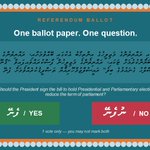


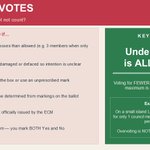






ALT Graphic titled "Invalid Votes – When does your ballot not count?" lists situations where a ballot becomes invalid: marking more boxes than allowed, damaged or defaced ballot making intent unclear, marking outside the box or using an unprescribed mark, markings that reveal voter identity, ballot not officially issued by the Elections Commission, and marking both Yes and No in a referendum. A highlighted key rule states “Undervoting is allowed,” explaining that voting for fewer candidates than permitted is valid. Example provided: on a small island LCE ballot, voting for one candidate when two are permitted is still valid, while overvoting is not.
ALT Graphic titled "Invalid Votes – When does your ballot not count?" lists situations where a ballot becomes invalid: marking more boxes than allowed, damaged or defaced ballot making intent unclear, marking outside the box or using an unprescribed mark, markings that reveal voter identity, ballot not officially issued by the Elections Commission, and marking both Yes and No in a referendum. A highlighted key rule states “Undervoting is allowed,” explaining that voting for fewer candidates than permitted is valid. Example provided: on a small island LCE ballot, voting for one candidate when two are permitted is still valid, while overvoting is not.

ALT Infographic titled “Local Council Election – How many votes do you get?” explains voting allocations by area type. For Small Islands (under 2,000 residents): voters cast 1 vote for Council President, 1 vote for Council Member, and 1 reserved gender quota seat — 3 votes total. For Large Islands (2,000+ residents): voters cast 1 vote for Council President, 2 votes for Council Members, and 2 reserved gender quota seats — 5 votes total. For City Wards (Malé, Addu, Fuvahmulah, Kulhudhuffushi, Thinadhoo): voters cast 1 vote for Mayor (city-wide) and 1 vote for Ward Council Member — 2 votes total.

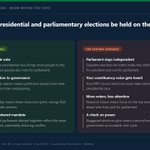
ALT Graphic titled “Referendum 2026 · Know Before You Vote” asking: “Should presidential and parliamentary elections be held on the same day?” Two columns compare arguments: For Combining (green panel): More people vote — High-profile presidential race brings more voters who also vote for parliament Less disruption to governance — One campaign season means more time governing Costs less — One polling day reduces expenses A stronger shared mandate — President and parliament elected together may reduce conflict For Keeping Separate (red panel): Parliament stays independent — Voters make separate choices for president and parliament Your constituency voice gets heard — Local issues and MP performance get more attention More voters, less attention — Voters may focus on presidential race and know less about parliamentary candidates A check on power — Separate elections allow mid-cycle accountability Footer text: “Vote YES to combine · Vote NO to keep separate · 4 April 2026 · Constitution

ALT Graphic titled “Referendum 2026 · Know Before You Vote” with the heading: “Two things happen when elections combine. One is good. One is a risk. Know both.” Two panels explain potential effects: The Benefit (green panel) Voter mobilisation When a high-profile presidential race is on the ballot, more people come out to vote. This increases participation, strengthens democratic engagement, and gives those elected a stronger mandate. The Risk (red panel) Coattail effect When a popular presidential candidate wins votes for their party’s parliamentary candidates simply by association, rather than voters evaluating MPs individually. Parliament may then reflect the presidential outcome rather than independent voter preferences. Footer text: “4 April 2026 · Constitutional Referendum · Maldives” with “Go Vote” in the bottom corner.


