

Discover how AI technologies can change your life
Joined December 2024
- Tweets3K
- Following1.1K
- Followers1.2K
- Likes4.7K


This is f*cking insane.
A prompt crawler swarm just read 181 words across 7 sections and mapped every claim, owner, and approval chain in real time. 16 legs. 22 tentacles. All running in parallel.
The trick is stupidly simple.
The swarm does a cheap first pass on everything. Claude only gets the sections that actually need deeper analysis.
So instead of:
entire prompt → Claude → $$$
It's:
entire prompt → swarm crawls → flagged sections → Claude thinks
The boring structure never touches the expensive model.
Claude gets a small filtered pile that actually deserves reasoning.
Crawl log shows exactly what happened. read can. read with. link staff. link source. link claims. link owners. read release. flag full. link traceable.
18 words per second. 1,680 words per minute processed.
Coverage radar live across all 7 sections. Role: 25/25 complete. Objective: 0/23 queued. Rules: 0/25 queued. Context: 0/35 queued.
Word heat tracking 181 terms simultaneously. Spec score: 11. Still climbing.
2 flags raised. 8 links established. 25 words read. All before Claude opened a single section.
The swarm sorts the signal. Claude only sees what the swarm couldn't resolve alone.
Faster. Cheaper. Way less compute burned.
The swarm decides. Claude thinks. Code ships.
Full breakdown in the article. Bookmark it.


2
47
It is becoming genuinely unsettling!
One typed command. Claude Code read today's meetings, updated every person's file, and listed everything promised. Without being asked twice.
The prompt that triggered all of it:
"read today's meetings, update each person's file, list what I agreed to"
Claude parsed 4 meetings. Updated every contact file automatically. Queued 33 write operations. Connected calendar and mail. Processed 15 of 23 threads.
Note inspector shows exactly what landed in each file. Pricing draft promised by Friday. Vendor intro still pending. Final onboarding screen owed back.
Document diff committed. Every promise tracked. Every commitment visible before the next meeting starts.
1,200 notes. 15,222 links. 5,020 graph records.
One command runs all of it.
Most people finish a meeting and forget half of what they agreed to.
This system doesn't forget anything.
Full breakdown in the article. Bookmark it.
Iron Mind retweeted

I JUST LAUNCHED 250 AI AGENTS WORKING SIMULTANEOUSLY. It’s not even about how fast they work, but the fact that they are physically incapable of misleading me
I spun up a real-time command center: 250 instances of Claude Fable 5.1 generating data in parallel, while Jev handles backend validation to cross-check every single output against its primary source. This goes way beyond standard acceleration. It’s a self-contained ecosystem that won't rest until every last discrepancy is wiped out
I set them loose on 80 IT companies
First pass: 18 issues flagged, broken APIs, fake metrics, empty endpoints
Second pass: narrowed down to 9 failures
Third pass: total clean-up, zero errors remaining
This isn’t just another agent flex. It’s a fully autonomous workflow that fixes its own mistakes before I even lift my laptop lid
If you know how to build systems like this, you’ll never have to worry about job security
If you don’t, the article linked below was created specifically for you

It is becoming genuinely terrifying.
A solo developer just deployed 75 Claude Code agents in a file swarm and wired them to a dependency layer so none of them could produce unverified output.
He pulls up the live dashboard:
- 75 files processed across 4,096 threads simultaneously
- Every change cross-referenced against the source within milliseconds
- 4,137 edges mapped, zero dependency cycles found
- Everything routed through a central context core holding 21.5k tokens
The architecture splits the load: one agent writes, a second diffs the output against the original, a third indexes the result. The swarm doesn't advance until every pass clears.
45 files written. 1 done. 31 idle. Build index passing across every module.
A senior engineering team would charge months of work for this level of dependency mapping. He ran it in a single session.
Same swarm architecture that keeps appearing everywhere. Bookmark the full breakdown.


4
71
This is starting to feel genuinely dangerous. One question to Claude Code. 12 agents deployed. 540,000 lines of code mapped in a single session.
Here's exactly what happened on that screen.
64 research papers. 12 agents. 11 methods. 28 scenarios. 4 items flagged for manual review. All running in parallel inside Claude Code Paper Lab.
You type one question: "What happens when a user uploads a file?"
Claude traces the full circuit. Frontend to API. API to background jobs. Background jobs to database. Database to tests. Every connection mapped. Every dependency linked. Every gap flagged automatically.
Jev handles the routing between agents. Strips irrelevant context at each investigation stage. Each agent gets only what it needs to answer its specific question:
→ Which component handles this function
→ Which files need to be examined
→ Is another agent already processing this route
→ Does this section require deeper investigation
The final map charted 170 user flows. Linked them to 2,400 tests. Left 26 open points clearly marked for human review.
The prompt that builds it:
Generate a searchable blueprint of this repository. Audit entry points, services, background tasks, and databases. Assign separate modules to different agents. Map every user scenario through the codebase. Link file locations and key references to each step. Connect existing tests to their respective flows. Flag assumed logic and incomplete paths. Build a UI to navigate the map.
Start with one user path before scaling to the full repository.
Any new developer can now review a feature, trace its dependencies, and find the relevant tests before touching a single line.
This used to require a full architecture team and weeks of documentation. Now it takes one prompt and a lunch break.
Full guide in the article. Bookmark it.
1
47
Iron Mind retweeted
She's a 27-year-old crane operator making $95,000 in her first year — and she runs it from 40 meters up.
About $38k comes from the crane. The other $57k comes from filming what the world looks like from up there.
Here's why this works so well.
She started filming because nobody believed her.
Friends kept asking what she actually does all day.
So she mounted her phone to the cab window and pressed record.
First video: the city spreading out below her, the hook swinging a steel beam into position, her hands on the controls like it was the most normal thing in the world.
No caption. Just posted it on the way down.
4.7 million views in four days.
Not from construction workers.
From people who had never once looked up at a crane and wondered who was inside it.
"I had no idea a person was up there." "This is terrifying and I can't stop watching." "She's operating that like she was born to do it."
She posted another one the next morning.
Same formula. Real height. Real load. Real hands on real controls.
A safety equipment brand reached out after video three.
Then a construction machinery manufacturer.
Then a UK trade organization offered her a paid campaign to recruit women into crane operation nationwide.
Now the income runs in four layers.
Brand partnerships — $7,000–22,000 per deal.
Crane operator training affiliate — $1,800/month passive.
Her "life at 40 meters" photo guide — $29, sold 3,100 copies.
Operator work — companies request her by name now, rates 70% above market.
Year one total: $95,000. Still climbing the ladder every morning at 6am.
She never changed what she does.
Just started showing what it looks like from up there.
Millions of people walk past construction sites every day.
Almost none of them look up.
Almost none of the people up there film what they see.
There are maybe three female crane operators with a camera on the entire platform.
Would you mount a phone to your cab tomorrow or keep the best view in the city to yourself?

I still can't figure out why nobody has built this yet.
Andrej Karpathy, co-founder of OpenAI, shared one idea that reached 16 million views: stop asking AI to generate code. Ask it to build your second brain instead.
You point Claude Code at a folder. Drop in any material — a report, a recording, a document. Claude processes it, connects it, and organizes it into a living knowledge base of everything you've ever learned.
It works like compound interest. The more you put in, the more valuable it becomes.
Here's exactly how it works:
→ Download Obsidian, set up a vault, connect it to Claude Code
→ Add Karpathy's wiki concept file and instruct Claude to assemble the structure
→ Claude builds three directories: raw for incoming material, wiki for structured pages, CLAUDE.md that controls everything
→ Add any new material to raw and type "ingest this"
→ Query across your entire knowledge base, forever
Takes five minutes to configure.
You never open a blank conversation again.
Complete step-by-step walkthrough in the article.
Save this before you scroll past.

1
97
GLM-5.3 just dropped. Everyone's calling it a Claude killer. The numbers say otherwise.
Three models. Same tasks. Real benchmarks.
GLM-5.3 wins:
→ SWE-bench Verified vs Sonnet: 95.4% vs 79.6%
→ Price: $1.40/$4.40 per M tokens
→ Open weights, runs locally
Claude Sonnet 5 wins:
→ GPQA Diamond: 88.9% vs 88.1%
→ LiveCodeBench: 82.4% vs 80.5%
→ MMLU-Pro: 87.5% vs 86.8%
Claude Opus 5.5 wins:
→ Agentic tasks: 100 vs 81.6
→ Code Migration: 66.6% vs 44.2%
→ SWE-bench Verified: closes the gap entirely
→ Health benchmarks: 100 vs 91.6
The honest verdict:
GLM-5.3 is a real option for code-heavy workflows on a tight budget. One benchmark win that actually matters.
Sonnet 5 is the daily driver. Better than GLM on most tasks at a reasonable price.
Opus 5.5 is the agent model. The harder the task, the wider the gap gets.
GLM-5.3 isn't a Claude killer. It's a cheaper alternative for one specific use case.
Full breakdown in the article. Bookmark it.

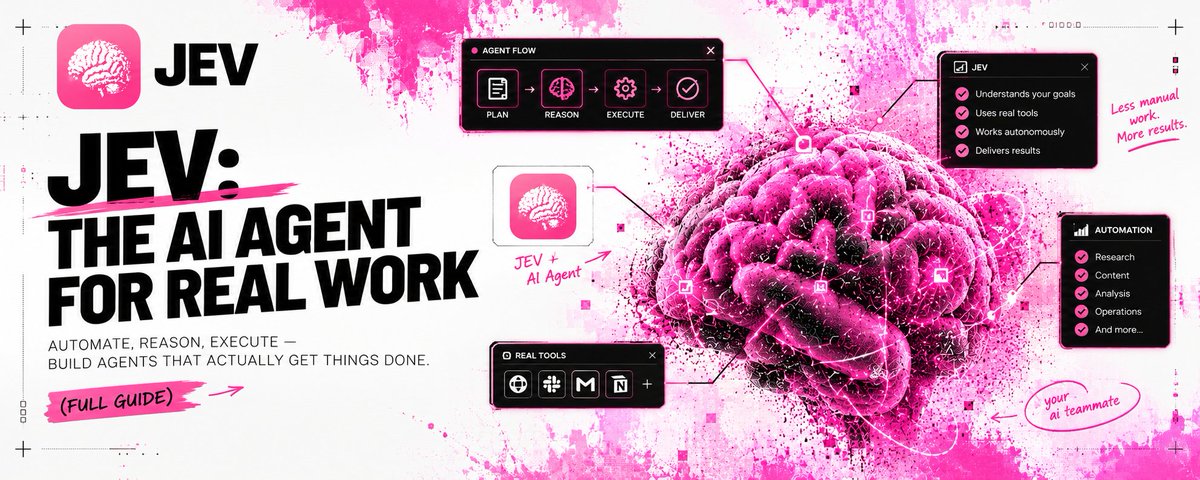
Jev is the missing brain in every AI agent
It decides what happens next in milliseconds, at almost zero cost
Set it up right and you cut most of your agent bill without touching quality
In this article, I show you how

1
90
A guy turned $1,000 into $107,000. Claude did the thinking. He watched it happen.
Here's how it worked.
Since launch, this wallet has averaged $890 in profit per day, executing 18 trades per hour across Polymarket.
The strategy is simple.
→ Targets markets where odds haven't fully adjusted yet
→ Enters before the repricing is complete
→ Repeats the same setup across hundreds of entries
→ No single trade carries the weight. The size comes from repetition.
Most profitable trades:
$149 → $4,200 (+2,718%)
$88 → $3,100 (+3,422%)
$204 → $2,800 (+1,272%)
He had a Quant bot already running. Then Claude Fable 5 dropped.
He pointed Fable 5 at the existing system and told it to find every inefficiency in the logic.
Fable 5 rewrote the entry conditions in one session. Tightened the edge. Removed the noise. Left only the setups that had proven positive expectancy across 10,000 historical entries.
The wallet went from grinding to compounding.
$1,000 → $107,000.
Fable 5 ran the projections itself.
$890/day → $2,400/day
$6,230/week → $16,800/week
$107,000 so far → no ceiling found yet.
The edge isn't the bot. The edge is what happens when Claude reads the bot and finds what the builder missed.
Full breakdown in the article. Bookmark it.


1
79
Jev + Claude. I can't comprehend why nobody is building this yet.
In my workflow this cut costs and time by 26x.
Claude handles the hard reasoning. Jev handles everything around it.
47 decisions in 12 seconds. 254ms per decision. One step. One direction. Move on.
Most people run every task through the most expensive model they have.
This routes each task to the cheapest model that can handle it. Claude only activates when the reasoning actually requires it.
→ Jev screens tasks before Claude touches them
→ Simple decisions never reach the expensive model
→ Claude gets only the 20% that actually needs it
→ Jev validates outputs before passing them forward
80% of the decision load handled at 254ms.
20% escalated to Claude when nothing else will do.
Same result. 26x cheaper.
Full breakdown in the article. Bookmark it.

59
I still don't understand why everyone isn't doing this yet. Elon Musk reposted this guide, and using this exact agent setup, I made $4,171 just last day
$1,200 into the desk on Monday. $4,171 by end of day. +236%. Phone never left my pocket.
Eight Claude agents on the desk, costing $200 a month, running a trading floor that typically costs a crypto fund $500,000 a year in analyst salaries.
A 5 AM morning call. I don't participate in it.
How the agents are distributed:
SEARCH: gathers real-time alpha, developer repositories on GitHub, and unindexed Telegram signals before anyone else finds them.
RISK: checks contract functions, minting rights, and LP locks, flagging honeypots before entry.
SNIPER: places high-speed orders on-chain at the exact millisecond the risk clearance passes.
WHALE: tracks smart money wallets and flags insider accumulation in real time.
RUG: monitors developer wallet activity 24/7 and dumps the entire position if they touch the LP.
EXIT: dynamically trails stops, scaling out as liquidity accumulates.
SHILL: tracks social volume, impulse speed, and key influencer calls.
HEAD OF DESK: never trades, routes data, checks transmissions, and brings me the single decision that requires a human.
While I was sleeping, the system scanned 164 setups, selected 21 qualifying positions, and executed 8 trades. Net profit: +$2,932. Already after fees.
Each agent has its own virtual browser, terminal, and local cloud memory. The trading floor stays active even when my laptop is closed.
Setup is easier than it seems:
Open Claude and create your Head of Desk.
Give the remaining 7 agents task descriptions as if you were instructing new employees.
Run the workflow once on your screen while they observe.
Connect Telegram and wallet webhooks.
No VPS. No code. No waiting for developers.
Crypto trading used to mean 16 hours in front of a screen, paid alpha groups, and constant fatigue. Mine took one evening to set up.
$1,200 → $4,171 in one day.
Save this before your next trade.

70
I gave Claude 5 SOL and told it to run a race.
5 bots. 1 SOL each. 24 hours. One winner takes everything.
SWING won. 2.62 SOL from 1 SOL start. +162% ROI.
Here's what actually happened.
Claude built 5 strategies and deployed them against each other simultaneously. Not a backtest. A live race on real markets with real money.
SWING: buys bottoms, sells tops. Slow. Patient. Consistent.
SNIPER: fast entries on new launches. High risk. 2.13 SOL.
COPY: mirrors winning wallets in real time. 1.93 SOL.
ARM: takes 0.5% fees on every trade. 1.54 SOL.
CONTRARIAN: shorts every pump. Collapsed at 0.47 SOL. Down 52%.
The race chart told the story in real time. CONTRARIAN started strong. Hour 8 it began collapsing. Hour 23 SWING extended its lead by 2 SOL clear. COPY closed on SNIPER for second place.
The live race events log showed exactly when each strategy broke.
00:12 COPY closing on SNIPER for P2.
00:15 SWING extends lead.
00:18 CONTRARIAN collapsing.
Most people pick one strategy and hope it works.
Claude ran all five simultaneously, let them compete, and showed exactly which one survives real conditions before risking serious capital.
The winner wasn't the most aggressive. It was the most consistent.
1 SOL → 2.62 SOL in 24 hours.
The other four taught me more than any backtest ever could.
Full setup guide in the article. Bookmark it.


1
2
79
I told Claude to make money or get deleted. Started with $50. Came back 26 hours later to $1,109.
Still alive. Cycle #159. Uptime 26 hours. Survival mode: active.
It doesn't trade markets. It trades weather.
6 agents running in parallel. HOLT. BRAM. ILSA. KETT. RIGO. TESS. Each one reading a different data source. None of them waiting for me.
Every cycle it:
→ processes 813 weather station reports
→ scans 935 feeds for temperature anomalies
→ reads X sentiment across 701 posts
→ places orders on meteorological outcomes
→ resolves positions automatically
Phoenix high above 112F. Gulf water temperature above 30C. Hurricane landfall count. NOAA storm naming. Real events. Real outcomes. Real edge.
1,048 resolved. 422 wins. 490 losses. 50.9% win rate.
The loss rate is the point. A system with 50.9% wins and positive P&L isn't lucky. It's sized correctly.
Subscription: $0.00. Covered by P&L since day one.
$50 → $1,109 in 26 hours.
What actually got me wasn't the number. It was the activity log still firing when I came back. Order placed. Resolved. Order placed. Resolved. Over and over with nobody watching.
This one never had to predict the market. It just had to read the weather faster than everyone else pricing it.
$50 to $1,109 isn't one good call. It's 1,048 small ones that compounded while I wasn't looking.
Full breakdown in the article. Bookmark it.


1
60
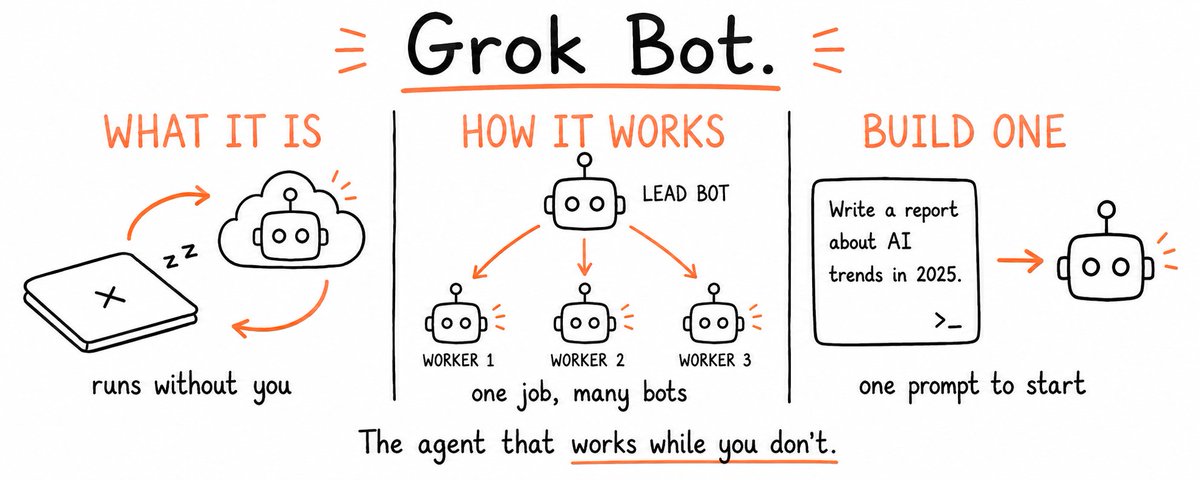
I still don't understand why everyone is not doing this yet. Elon Musk reposted my Grok Bot GUIDE, and using this exact agent setup, I turned $150 into $14,932.57 this week alone.
Six Grok agents on the desk, $49 a month, running a floor that usually costs a crypto fund six figures a year in analyst salaries.
Win rate sitting at 83%. 5,862 tasks logged. I checked my phone twice today.
ORIX scrapes real-time alpha, dev GitHubs, and unindexed Telegram signals before CT even wakes up
KAIRO audits contract functions, mint rights, and LP locks — kills honeypots before entry
VEXA fires the on-chain order the exact millisecond risk clearance passes
ANNA tracks smart money wallets and flags insider accumulation live
NOVU watches dev wallet activity around the clock, exits the full position the moment LP gets touched
TOBI trails the stop dynamically and scales out as liquidity builds
$14,807.57 in profit, zero bad fills, and a balance chart that only moves up in steps — each step is one of these six agents doing its one job correctly while I was asleep.
Every agent runs its own virtual browser, terminal, and memory in the cloud. The desk stays live with my laptop closed.
The setup is dumber than it looks:
Download Grok Bot and create your first agent.
Give the remaining 5 job descriptions like you're briefing new hires.
Run the workflow once on your screen while they watch.
Hook up Telegram and wallet webhooks.
No VPS, no code, no waiting on developers.
Started with $150. Mine took one evening to set up.
Save this before your next trade. Save GUIDE.
56
$55,000 all-time. 15,786 fills. One bot. Never touched the keyboard.
Win rate 50.4%. Edge per trade +2.15%. Both sides. 93.2% fill rate. 1,220 markets monitored simultaneously.
Here's what's actually running on that screen.
Microstructure scalper trading BTC, ETH, SOL, and XRP in 5 and 15 minute windows. Not predicting direction. Detecting mispricing between Polymarket and spot before anyone else does.
Execution cycle #259. Watch → Detect → Mode → Buy → Fill → Hedge. Six stages. Zero human decisions between them.
The mesh shows every live position as a bubble. +$110 here. +$108 there. -$7 on one side, +$50 on the other. Hundreds of positions running in parallel, hedging each other automatically.
Edge matrix scanning T-5 to T0 across every asset simultaneously. The moment an edge appears it gets filled. The moment it disappears the hedge adjusts.
9 positions in-flight right now. 1,181 processed. 1,196 filled. 635 entries logged.
Trade log never stops. BTC up. ETH down. SOL both sides. XRP caught at the spread. Every fill adding to a number that just crossed $55,000.
Most traders wait for the right moment.
This system doesn't wait. It processes 13.6 fills per minute and finds the edge inside the noise everyone else calls random.
$55K isn't one good trade. It's 15,786 small ones that added up while nobody was watching.
Full setup guide in the article. Bookmark it.
1
55
$250 between me and bankruptcy. I asked Claude to do the impossible.
22 hours later it had deployed 6 tokens, collected fees from 3,573 holders, and printed 80.258 SOL.
Never asked permission once.
Here's what actually happened.
I didn't ask Claude to trade. I asked it to build a factory.
A system that deploys tokens autonomously, collects 0.5% on every single trade against them, and never stops running whether I'm watching or not.
Spawn rate: 1 token every 3.5 minutes. Success rate: 93%.
6 deployments. 6 live. 3,573 holders across all of them.
The factory doesn't care if a token moons or dies. It collects the fee either way. Every buy. Every sell. Every trade from every holder. 0.5% lands in the wallet automatically.
1,532 SOL volume across 6 tokens in 22 hours.
The live feed never stopped. Fees collected. Fees collected. Fees collected. One after another while I wasn't looking.
$16,854.28 USD. 80.258 SOL earned from creator fees alone.
Not from trading. Not from picking winners. From being the house.
Most people try to beat the market.
Claude built a system that gets paid regardless of what the market does.
$250 was everything I had. The factory paid it back before sunrise.
Full build guide in the article. Bookmark it.
28
I gave Claude $1,000. Told it to build a trading desk or shut itself down.
3 days later it's sitting at $7,123.89.
Subscription: $0.00. Covered by P&L since day one.
Here's what most people get wrong about AI trading.
They ask Claude to find a strategy. Claude finds one. The backtest looks perfect. They deploy it. They lose money.
That's not what happened here.
Claude didn't find a pattern. It built a system that tests itself before risking a single cent.
6 agents running in parallel. Each one with a different job. Each one killing bad ideas before they reach the market.
23 trades. 19 wins. 4 losses. 82.6% win rate.
The 4 losses are the most important number on that screen. Because a system that never loses isn't testing reality. It's drawing a beautiful curve on history and calling it a strategy.
The activity log shows exactly what happened. Positions settled. Capital routed. Agents flagged bad setups before entry. The ones that fell apart in testing never reached the market.
That's the whole difference between a desk that survives and a trader who blows up.
A fund kills 97 ideas out of 100 before risking a cent. Claude's desk killed the bad setups automatically. I never saw them.
$1,000 → $7,123.89 in 3 days.
+$6,123.89. +612.4%.
AI will build you a strategy in seconds. The only question is whether you build one that tests itself before it tests your account.
Full setup guide in the article. Bookmark it.
1
68
I gave Claude $65. Told it nothing else.
36 hours later it's sitting at $1,880.
Still running. Cycle #880. Uptime 99.8%.
6 agents working in parallel. FENN. ORKA. LUNE. BRYX. SABLE. QUIL. Each one with a different job. None of them waiting for me.
Every 10 minutes the desk:
→ scans 1,500+ new pairs
→ checks LP locks before touching anything
→ reads developer wallet movements in real time
→ flags rug risk and skips automatically
→ snipes mempool 2 transactions ahead
→ pays its own $200/mo subscription from profits
$GROLR dev wallet moved 20%. Skipped.
$MOONR LP locked 53 days. Entered.
$PEPU LP locked 95 days. Entered.
$DEGO LP locked 55 days. Entered.
239 wins. 88 losses. 73.1% win rate. 365 resolved.
The activity log never stopped.
$RIZZO +$18.74. $BOJAX +$23.38. $RIZZO again +$7.99.
Mempool showing 1,533 transactions, 2 snipes already queued.
Subscription showing $0.00. Covered by P&L since day one.
$65 → $1,880 in 36 hours.
The balance chart is one line. Straight up from $1,165. No panic. No drawdown. Just Claude's logic running clean while I slept.
+2,739.9% from $65.
I didn't place a single trade.
What are you waiting for?
1
40
i gave Claude one task. build me a pump fun swing desk or i shut it down.
started with 0.01 SOL. came back 22 hours later to 3.53 SOL.
and it never slept once.
5 agents. one pipeline. fully autonomous.
Scanner watches 325 tokens looking for oversold setups. Risk kills any position down 30% automatically. the desk never argues. never hesitates. never holds a loser out of hope.
6 positions opened. 6 wins. 0 losses.
$WIF69 +180%. $CATVIBES +110%. $MOONBOY +240%. solana:5SVG3T9CNQsm2kEwzbRq6hASqh1oGfjqTtLXYUibpump +90%. $BRAINROT +150%. $WOJAK69 +70%.
every single one closed in profit.
the desk doesn't pick tokens. it buys the bottoms and sells the tops. the logic is that simple. the execution is what most people can't do manually — no emotion, no second-guessing, no missing the exit.
$742.35 USD in 22 hours from 0.01 SOL.
i didn't place a single trade.
didn't watch a single chart.
the live order feed was still firing when i opened the laptop. $WOJAK69 sell executed +70% while i was reading the results.
that's the part that actually got me. it was still working after i came back to check if it worked.
0.01 SOL is nothing. Claude is $20/month.
what are you waiting for?
1
1
42