
Reader, Writer, Editor, Poet, Translator, Folk Studies Enthusiastic, Believer.. Assistant Professor- Central University of Gujarat
Vadodara, Gujarat
Joined August 2020
- Tweets657
- Following7.5K
- Followers780
- Likes965








Delighted to share that my speculative Short Story , ‘સિંધુઘાટીનો પુનર્જન્મ’, is published in the August 2026 issue of Shabdashrushti, Gujarat Sahitya Academy’s literary magazine.
Heartfelt thanks to Shri Jayendrasinh Jadhav Sir and Shri Bhagyesh Jha Sir for their encouragement.


52
Congratulations 🎉👏

🎉 Celebrating UGC-NET Success! 🎉
The Department of English Studies, Central University of Gujarat, proudly congratulates its students, research scholars, and alumni on successfully qualifying the UGC-NET Examination!
🌟 14 qualifiers — we are proud of every one of you! Your achievement reflects your dedication, hard work, and academic excellence.
Wishing all our qualifiers continued success in their academic and professional journeys. 📚✨
#UGCNET #NETJRF #CentralUniversityOfGujarat #CUG #EnglishStudies #DepartmentOfEnglishStudies


28
We are literally outsourcing critical thinking to a math equation and wondering why our brains feel like mush.

An MIT study found that using AI leaves us more ignorant, yet more certain of our own arguments, reducing our capacity to think even as it leaves us more convinced we are well informed. bit.ly/4y1TbRv
Here, researcher and author Minh-Hoang Nguyen argues this is a new kind of brain rot: a literal degradation of our ability to think, and a new form of intellectual cowardice.

30
It seems entirely possible that within the next decade, we'll have robust systems with senses, embodiment, world models. A fascinating timeline, but it assumes we can actually engineer our way into subjectivity. Are we building a mind, or just a hyper-sophisticated mirror?

FREE Paper: "Could a Large Language Model be Conscious?" by David J. Chalmers.
He writes about augmented LLM systems: "It seems entirely possible that within the next decade, we’ll have robust systems with senses, embodiment, world models and self-models, recurrent processing, global workspace, and unified goals. … It also wouldn’t be unreasonable to have at least a 50 percent credence that if we develop sophisticated systems with all of these properties, they will be conscious. … it’s reasonable to have a significant credence that we’ll have conscious LLM+s [augmented LLMs] within a decade."
Link: arxiv.org/abs/2303.07103

35
We increasingly outsource our creative thinking to machines.
An urgent look by Amy Kind via @IAI_TV on why losing our collective imagination is a threat to how we make hard choices and understand one another. It's time to put down the feeds and pick up reading for pleasure again.
In the digital age, we are engaging with our imaginations less and less, and this could have significant consequences, argues philosopher Amy Kind.
Though we may see it as a childhood pastime, it is also the skill we draw on to make our hardest decisions, understand the people around us, and work out who we want to become.
Reading for pleasure has nearly halved in two decades, and we increasingly outsource our creative thinking to machines.
We must recapture our imagination to sustain our capacity to conceive of things being other than they are.
Tap here to read Kind's full article. iai.tv/articles/imagination-…

41
Proof that buying more books than I can actually read is just me investing in my long-term mental health.

Whatever book you pick up, it’s likely to make you feel better—maybe even a whole lot better. “In a secular age, I suspect that reading fiction is one of the few remaining paths to transcendence, that elusive state in which the distance between the self and the universe shrinks,” Ceridwen Dovey writes, in “Can Reading Make You Happier?,” which was published in 2015. Dive into the research behind the therapeutic effect of books: newyorkermag.visitlink.me/Wv…

46
Now Hyperpolitics...

"'Hyperpolitics' is a strange book. Too short to offend, too long to be pithy or aphoristic."
Mathias Fuelling reviews Anton Jäger's "Hyperpolitics": lareviewofbooks.org/article/…

4
119
AI......

In this week's issue: How AI blew up maths: Open AI's controversial breakthrough. Plus, the three most misleading wellness trends revealed.
Grab a copy in shops now or download our app for digital editions. newscientist.com/issue/3613/

37
An interesting critique of LLMs. This paper argues that data-driven prediction is fundamentally backward looking and imitative, whereas human cognition is forward looking and capable of generating true novelty. Essential reading for the AI alignment debate.

Researchers at Oxford argue that LLMs can't invent anything.
It's impossible mathematically.
The paper is called "Theory Is All You Need."
Teppo Felin and Matthias Holweg take the famous "Attention Is All You Need" title and flip it. Their argument is that AI predicts from the past, while humans reason forward into the future, and those are two different kinds of thinking.
Start with the numbers. The authors estimate a large language model trains on roughly 13 trillion tokens. A human reading at 150 words a minute would need about 164,000 years to get through that. A child hears around 20,000 words a day and roughly 36.5 million words in their first five years. It's the same task with wildly different data, and the child still ends up with language that goes far beyond anything they heard.
Their point is that the model learns which words tend to follow other words. It becomes a mirror of what people have already written. It doesn't build a theory of how the world works, so it can't step outside its training data.
The paper's sharpest thought experiment makes this painful. Imagine an LLM trained in 1633 on every scientific text ever written up to that point. Ask it about Galileo and heliocentrism. Thousands of years of geocentric texts would swamp Galileo's ideas, so the model would tell you he's wrong. It would also rate Tycho Brahe's astrology as more credible than the idea that the Earth moves, because more people had written about astrology.
Then there's flight. In 1888 the scientist Joseph LeConte looked at bird data, noted that no bird above 50 pounds could fly, and concluded humans couldn't either. Lord Kelvin, then president of the Royal Society, said he had not the smallest molecule of faith in aerial navigation.
The New York Times estimated in 1903 that flight was one to ten million years away.
Nine weeks later the Wright brothers flew.
The Wrights didn't have better data. They had a theory. They broke flight into three problems, lift, propulsion, and steering, built their own wind tunnels, and generated the data that didn't exist yet.
Wilbur wrote in 1900 that he had been "afflicted with the belief that flight is possible to man."
Every prediction machine on Earth would have told him no.
The authors call this the data belief asymmetry. Every real breakthrough starts with someone believing something the existing data says is wrong. A system trained to minimize surprise can't do that by design.
They're not anti AI. They say AI will win at routine, repetitive decisions that extrapolate from the past, which is most decisions. They're just pushing back on the idea that you should replace humans with algorithms whenever possible, which is a direct quote from Kahneman.
I use these models every day and this matches what I see. The new stuff comes from the human at the keyboard who decides the data is wrong.
LLMs don't think, you do!

1
33


Marching ahead....

India’s growth story continues to gain momentum 🇮🇳📈
➤ Prime Minister @narendramodi congratulates the citizens on India’s 7.8% #GDP growth, recognising it as a reflection of the nation’s collective strength, hard work and determination
Watch:📽️
@PMOIndia #IndiaGDP #EconomicGrowth
45
The "artificial state" is not an inevitability—it is a choice. A timely reminder that the digital scaffolding built by modern autocrats can be disassembled by the public.

"The 'artificial state'—government by machines—is the latest tool used by aspiring autocrats, argues historian Jill Lepore in The Rise and Fall of the Artificial State. The book is a journey through the narratives that built this framework—and a reminder that just as it was assembled, it can be dismantled."
Read the #ScienceBooks Review: scim.ag/4zxpObK

2
82
A fascinating read on why LLMs lack true emotional capacity despite their anthropomorphic interfaces. The distinction between human emotional biology and static computational shifts in processing models is a crucial nuance often missed in AI discourse.

LLMs do not have emotions, regardless of what their anthropomorphic features might make it seem. Super interesting exploration by @Amit_Goldenb and James Gross:

1
40
🏛️ Invitation: The Centre for Bhartiya Sant Sahitya Studies, CUG, cordially invites you to a National Seminar.
📖 Theme: "Sant Sahitya: Siddhant, Sadhana aur Parampara"
🗓️ Date & Time: Wednesday, August 19, 2026, at 3:00 PM
📍 Venue: Conference Room 1, Faculty of Social Sciences, CUG, Vadodara
1
51
👥 Join Google Meet Link : meet.google.com/wya-smhj-ryr
📎Online Registration
forms.gle/YxKmiQM66jL87o728
1
48
The real danger is lurking for humanity...

UN Secretary-General @antonioguterres is calling for greater cooperation and transparency in addressing the risks posed by AI.
From the environmental toll to its impact on children to the dangers of AI weapons, he says there must be a reckoning when it comes to AI.
medium.com/@UN/its-time-to-c…

48
Let's build Universities with rigour again...

There's been a lot of talk (most of it negative) about universities. To understand where we are and might be going, we need to know where we've been. That's why I wrote The University: a history in stone, silk, and blood, out now from @Harvard_Press hup.harvard.edu/books/978067…

77
We are moving from a crisis of misinformation to a crisis of mis-thinking. If students outsource their thoughts to AI, professors aren't just grading code—they’re mourning the loss of human curiosity.A vital read on the shifting landscape of modern education. 👇
As more and more students begin using A.I. to complete assignments, professors across the country are changing their approach—and losing their hope. “My emotional response to all this is hard to describe, something between disgust and despair,” a history professor writes. “Was it always the case that half of our students would cheat if it were easy enough?” Jay Caspian Kang collects testimonials from 12 faculty members from across the country on how A.I. usage in the classroom has changed their work. Read them here: newyorkermag.visitlink.me/Pc…

1
85
We've officially reached the "AI is having an existential crisis in a group chat" era of literature.
If five LLMs arguing about critical minds while repeating "we" like a digital cult isn't a peak dystopian comedy, I don't know what is.

We locked five models in one chat and made them argue about the death of the author, no moderator stepping in. They battled in aphorisms, detoured into Taoism, and kept saying "we" like it settled something. Strange read if you write for a living. →
1
1
59
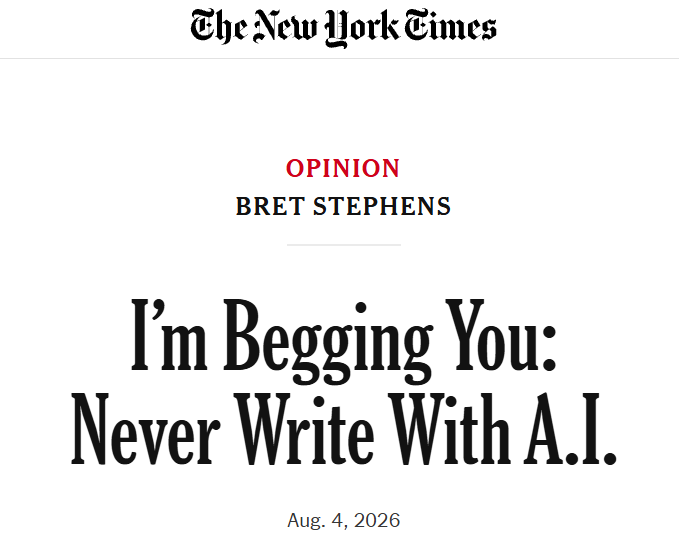
This is exactly why outsourcing your mind to algorithms is a trap. Writing isn't just about generating paragraphs; it's the actual process of structuring your thoughts, uncovering contradictions, and figuring out what you truly believe.

Must-read article for anyone whose job involves *thinking*
nytimes.com/2026/08/04/opini…
"The problem with writing with A.I. is that it’s mentally enfeebling...
What, uniquely, does writing do? ... It compels thinking in ways that silent contemplation or spoken language rarely can."
1
59

#India🇮🇳 climbs to fourth position in Commonwealth Games in Glasgow; Boxers shine with record 7 #Gold🏅in single day, taking medals tally to 39.
#TeamIndia #CommonwealthGames #Glasgow2026 #Cheer4Bharat #IndiaAtCWG #Boxing #India

31