

fredrikj @ mathstodon Computer algebra & Arbitrary-precision arithmetic. Researcher at @Inria.
Bordeaux, France
Joined March 2016
- Tweets656
- Following129
- Followers615
- Likes990





If you want to do this many times with a fixed modulus, then yes: you can precompute an inverse of n, or use Montgomery reduction. You can also do things more efficiently for n of special form, e.g. n = 2^k+1.
Here, or in a different medium? FLINT (flintlib.org/) is a C library for computational number theory and basic computer algebra functionality. It does exact or arbitrary-precision integers, rationals, number fields, reals, polynomials, matrices, etc.
fredrikj.net/blog/2023/04/fl…
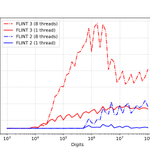
FLINT furnished with faster FFT: we recently merged Dan Schultz's amazing new small-prime FFT code into FLINT, enabling much faster bignum arithmetic (in some cases 10x faster than GMP).

I've released mpmath 1.3.0: github.com/mpmath/mpmath/rel…

In case you missed it: FLINT, Antic, Arb, Calcium and Generic-Rings have merged into a single project: what will be FLINT 3.x going forward. The 3.0 release will happen later this year; I'm currently working on debloating this 1 MLOC codebase. github.com/flintlib/flint2
My article "Arbitrary-precision computation of the gamma function" has been published in Maple Transactions!
mapletransactions.org/index.…
I have removed the links to Twitter on my website. See you all on that other social network instead!
Fredrik Johansson retweeted

LaTeXML 0.8.7 was just released!
We're ready for #MathML Core.
With gratitude to the wider community, who helped drive another productive year of extending our TeX interpretation fidelity and our LaTeX ecosystem coverage.
Full release notes at:
github.com/brucemiller/LaTeX…

There's currently a 7 month delay just to get the *appointment* for a national ID card or passport here. So much for free movement within Schengen 😡
Helping maintain wrappers like Python-FLINT could be part of the job. With that said, it's a public project and anyone is free to contribute right now!
Personally, I'm planning a rewrite of Python-FLINT when/if I get the generics module for FLINT fully working.
Anyone interested in a full-time job doing FLINT development should get in touch.
I don't have funding at the moment, but given a qualified candidate (skilled with computer algebra *and* C programming), there's a decent chance that funding can be found.
Sadly proof assistants are still quite limited when it comes to (complex) analysis, and computer algebra systems suck at handling inequalities. I wish we had proper "computer analysis systems" making computer-verified classical analysis truly routine.
Many proofs in analytic number theory look like this, and I can never quite shake the fear that the author might have dropped a decimal or a sign or a residue somewhere.
What strikes me about Yitang Zhang's preprint is that there doesn't seem to be any fancy math (I could be wrong about this), just 100+ pages of tedious analytic calculations. An interesting candidate for computer verification?
Fredrik Johansson retweeted

I finally launched CoWasm.org. It's kind of like @emscripten, but built using @ziglang, with first class support for both servers and browsers. The main package is @python 3.11, but there are lots of other fun #webassembly ports hidden inside...

Today is Bruno Buchberger's 80th birthday!
There will be a conference at RISC next week, with a Zoom live stream: risc.jku.at/c/symbolic-compu…

Fredrik Johansson retweeted

Accepting and rejecting papers is an archaic practice that is terrible for science. It strips peer review of its value & institutionalizes the practice of judging scientists based on where, rather than what, they publish. It's time for this system to go.
elifesciences.org/articles/8…
