






AI로 5배 빨라졌는데 시급이 그대로면, 같은 일 하고 1/5 받는 셈임
@gregisenberg 가 SF에서 AI 창업자들 만나고 올린 관찰 글에 이 얘기가 있었음
시급 받는 프리랜서랑 에이전시는 가격 매기는 법부터 다시 짜야 한다는 주장임
같은 글에 숫자가 하나 더 있음
미국에서 AI에 돈 내는 사람은 2%인데 SF는 110%처럼 느껴진다고 함
만드는 쪽은 5배 빨라졌고, 돈 내는 쪽은 아직 2%
나는 시간으로 값 매기는 방식은 이미 끝났다고 봄
외주 받으시는 분들은 요즘 견적 어떻게 내고 계신가요?

출처: xitter.cf/gregisenberg/status/21…
5배, 2%는 전부 Greg 본인 관찰이고 통계 아님
사진은 SF 1편 xitter.cf/gregisenberg/status/21…

I spent 48 hours in SF hanging out with billionaires, data labs and AI founders and execs running $1B to $100B companies.
My observations:
1. Sooo MANY stories of data brokers making like $2M a WEEK selling company data to labs. I can't tell if it's the beginning or a bubble, and I kept wondering which niches are left. Digging into it actively.
2. At dinner, someone asked the table, "If a new model drops next month, does your company get better or worse?" HALF the table went quiet! I think that's the best question to ask about any AI startup right now.
3. The bar people talk about now is hitting $1B in revenue in 12 months (I guess that's the new unicorn?). What I didn't hear much about is retention. AI revenue can come in fast and leave fast, and I think we're going to see a lot of stories of AI companies with huge revenue and terrible retention.
4. It's pretty clear we're living through the reinvention of the computer. The model is the CPU, the harness is the operating system, and skills and plugins are the apps. Thinking about it that way makes it easier to see where the whitespace is.
5. We're maybe 12 months from an agent that can watch you work for a week and then do your job without any instructions. The screen recording plus agent memory plus local model combination makes this possible right now.
6. Agent harnesses feel like the new GPT wrappers, in a good way, especially vertical ones. The best teams I talked to treat the model as swappable. One founder walked me through routing different models to different jobs: one for taste and visuals, a cheaper one for the everyday stuff, another for text.
They use prompts they can move across models over fine-tuning, and A/B test the output on what users actually do with it: do they edit it, export it, share it? A vertical harness is basically four things: the connectors for that industry's data, evals written by people who know the work, rules for what the agent can and can't touch, and a clean screen for a human to review. The model is maybe 20% of it.
7. There's a lot of reverse engineering going on/cloning going on more than I've ever seen. People are decompiling software and rebuilding it with agents, and someone showed a suite of like 10 apps that are worth $5B+ each all that he cloned open source. Me and everyone are still thinking through what it means when software gets this easy to copy.
8. My guess is the value moves to data. If the software can be rebuilt quickly, what's worth paying for in a legacy SaaS company is the years of customer data and workflows inside it. Some SaaS companies are secretly data companies.
Gets me thinking about how do you truly value data for this saas companies? Like if we were buying these dying saas companies at 2x ARR before (as example), maybe there is a better metric. Idk, just thinking out loud here.
9. It feels like a good chunk of legacy software won't make it to the agentic era, especially anything built around people clicking through a lot of screens.
10. Every company I talked to wants to pipe its internal data into one place and expose it to agents through MCP. Then they look at the data and realize it's a mess: five versions of the same customer, old Slack channels, PDFs nobody can search. Cleaning that up feels like a big consulting opportunity!
11. A lot of founders are building the basic building blocks for agents: APIs, data layers and tools. Some of the companies I saw barely have a UI because the main user is an agent. I really believe the startups that build primitives to this agentic era will do extremely well. Building blocks is the best way to think about it.
12. Labs can get plenty of training data, but it's harder to get real examples of agents failing inside companies. Whoever has those logs has something valuable.
13. Someone running a big consumer company told me the next fight is over memory. The model that remembers the most about you wins, and the smartest model matters less than people think.
14. Physical AI came up a lot. Astra I think was the first model that got people into AI can actually do CAD, and I think a lot of people are thinking what does vibe manufacturing really look like. The line I keep thinking about came from a robotics founder: the hardest problems in AI are deployment problems now, not research problems. Their robots work on their own, call a human when they get stuck, and every one of those calls becomes training data.
15. Cybersecurity companies are having a moment and are actually cool companies to build now, especially the ones that clean up after a breach. Every agent with access to your systems is a new door into your company, and a lot of those doors were left open.
16. Some startups are worth more dead than alive now. A shutdown company with 5 years of Slack, email and code can get paid for licensing all of it. I wouldn't be surprised if founders start factoring that into when they shut down.
17. People are starting to talk about monetizing the agent web. It feels really early, but when the most popular user of the internet is an agent, what startups should you be building?
18. I think agent insurance is coming. Once an agent makes an expensive mistake, insurers will want audits before they cover anyone.
19. Several people said the hire they want most is someone with taste who can write evals. The models are getting good at generating ideas, so the hard part is judging which ones are good.
20. New trend I observed: startup raises VC, uses venture dollars to become a creator, startup fails, founder falls back on being a full-time creator and incubates other products bootstrapped.
21. Getting SIGNIFICANT distribution is HARD right now. Founders are sponsoring buses, buying billboards like crazy and throwing parties with famous DJs to get noticed. Kinda feels dotcom era in that sense.
Attention is what's scarce! The growth guy going viral sharing his UGC strategy from Wispr Flow is a good example. It's the sauce everyone wants, and I truly believe there are probably only 50 people on the planet who know how to scale these types of businesses efficiently in this era.
Always good to get that dose of SF. I felt sooo lucky to have such an incredible trip during such an incredible time in building businesses. Surreal in so many ways.
Happy to be home and locked in.
Until next time!


원프롬프트로 뽑았다는 모션 영상, 실제론 수정 10번에 2시간 걸렸다고 함
요즘 X에 "Opus 5.5가 최고의 모션 디자이너"라는 글이 계속 돎
@flxrnc 의 Motion Lab 아티클은 조회 99만, 북마크 7.2천 찍음
근데 본문 첫 문단부터 "가짜 원샷 없음"이라고 박아둠
크롬 물방울이 글자로 바뀌는 6초 루프 하나에 프롬프트 1번, 후속 수정 10번
사운드는 따로 수정 5번에 45분 더 씀
반대로 @vib3coded 는 젤리 오렌지를 원프롬프트에 API 비용 $11.50로 뽑았다고 주장함
개인적으로는 한 번에 뽑는 것보다 "84번 프레임이 늦다"고 짚어주는 눈이 진짜 실력 같음
모션 외주 단가는 결국 수정 몇 번에 끝내느냐 싸움임

출처: xitter.cf/flxrnc/status/21053118…
xitter.cf/vib3coded/status/21106…
수정 횟수랑 시간은 @flxrnc 아티클 본문 기준, $11.50은 @vib3coded 본인 주장임
이미지는 @flxrnc 영상 캡처 xitter.cf/flxrnc/status/21107269…

이제 AI한테 제일 비싼 건 모델이 아니라 "진짜 찍은 영상"이라고 함
로봇 학습 데이터가 위조할 만큼 비싸졌다고함
그래서 찍는 기계마다 신분증 붙이기 시작함
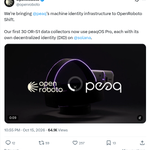
비텐서 최대 로보틱스 서브넷 SN80 @openroboto 가 @peaq 의 peaqOS 붙였음
핵심 내용을 정리하면,
첫 OR-S1 데이터 수집기 30대가 peaqOS Pro 사용
기기마다 솔라나 위에 탈중앙 신원(DID)
이 영상이 진짜 그 기기에서 찍혔는지 증명하는 용도
AI 다음 돈줄이 데이터 출처 검증일지, 그냥 내러티브일지
다들 어느 쪽이라 봄?

출처: xitter.cf/openroboto/status/2110…
docs.peaq.xyz/solana
"성과 따라 솔라나에서 바로 지급"은 @solana 쪽 설명이고, 공식 확인된 건 신원까지임
매수 권유 아님, 공부용 기록임

헤다 heda retweeted

we've spent decades discovering what happens when people can share information.
imagine what we might discover when we can work together without revealing everything ❇
삼성월렛에 USDC가 들어온다고 함!
오늘 TOKEN2049에서 삼성월렛의 스테이블코인 도입 소식을 직접 들었습니다.
삼성은 10월 마지막 주부터 미국 내 약 8,200만 대의 호환 갤럭시 기기를 대상으로 USDC 서비스를 출시할 예정이라고 하는데요
핵심 내용을 정리하면,
USDC 구매·보유·송금 지원: 별도 크립토 앱 설치나 개인키 직접 관리 없이 삼성월렛에서 이용
해외 송금: 지원되는 외부 크립토 지갑으로 USDC 전송 가능. 삼성 측 전송 수수료는 무료
60개국 이상 은행 송금: 수취인은 현지 통화로 받을 수 있으며, 이 경우 별도 수수료 발생
인프라 파트너: Sui와 Solana가 블록체인 네트워크를 지원하고, Bastion이 송금·컴플라이언스, Coinbase Prime이 USDC 수탁을 담당
향후에는 온라인 결제와 갤럭시 기기를 활용한 오프라인 스테이블코인 결제도 검토 중이라고 합니다.
개인적으로 흥미로운 부분은 별도의 크립토 서비스가 아니라 이미 사람들이 사용하는 삼성월렛에 스테이블코인이 직접 들어온다는 점이었는데,
과연 출시 이후 얼마나 많은 사용자가 실제로 USDC를 이용하게 될지! 지켜볼만 하겟습니다
@SuiNetwork @SuiNetworkKR #suibasecamp


수이 베캠 메인 이벤트! 후디 트레이딩 데스매치 🇸🇬💧
이런 트레이딩 대회를 직관한건 첨인데 직접 있으니까
현장 열기가 진짜 생생하게 느껴져서 생각보다 훨씬 재밌었음.
마지막에 한 삼십초 남기고 순위 왓다갓다햇는데 사람들 막 소리지르고
그때 도파민 레전드엿음 ㅋㄷㅋㄷ
우승자 상금이 이만오천불? 이었나?
부러웟다......... 🥹🥹🥹🥹
내일도 기대돼.....대수이.....
@SuiNetworkKR
@SuiNetwork #SuiBasecamp #Sui #Hudi


수이 머여 수이 베캠에서 술줌
히든스팟 찾음 비밀코드 찾아야 들어올 수 있음 ㄷㄷㄷㄷ 넘 재밋다 ;;;;; 대수이 대수이
@SuiNetwork @SuiNetworkKR #suibasecamp


수이 머여 수이 베캠에서 술줌
히든스팟 찾음 비밀코드 찾아야 들어올 수 있음 ㄷㄷㄷㄷ 넘 재밋다 ;;;;; 대수이 대수이
@SuiNetwork @SuiNetworkKR #suibasecamp


헤다 heda retweeted

I read crypto launches with a journalist’s habit: what was promised, and what actually happened?
Per the Republic campaign brief, every eligible Republic participant in the Squid sale received an allocation.
Why it matters to me: Legion is merit-based, not a race to click first. For someone new, that makes “participating” feel measurable.
Qualifiers: an allocation doesn’t mean the full requested amount, and Squid’s own announcement said a full allocation of the maximum pledge was never guaranteed. This also doesn’t guarantee future sales.
Sources:
🔗 x.com/squidrouter/status/206…
🔗 help.legion.cc/en/articles/1…
🔗 republic.legion.cc/
What would you want verified first before the next sale?
Disclosure: this post is part of a Republic campaign, and I earn participation rewards.
@legiondotcc @squidrouter #TheRepublic


헤다 heda retweeted

Getting USDC when you expected another token can be confusing. On a LI.FI cross-chain route, the bridge can finish while the final swap can’t execute within your slippage limit or with available liquidity. You may receive USDC as an intermediate token.

헤다 heda retweeted

Past and present are easy to mash together here, so I am keeping them apart.
Past: in the Squid sale, eligible Republic quest participants had their rewards committed before the wider allocation, and Squid said those were honoured separately from a fixed budget. That is the concrete result: eligible Republic participants in that sale received an allocation. It was not the same as the main Legion pool, where Squid said 77.8% of applicants received one and some were excluded.
Source: xitter.cf/squidrouter/status/207…
Present: Legion says Jumper has reserved 5% of allocations for The Republic. The same post says participation does not guarantee an allocation, and any allocation is subject to eligibility, geographic limits, KYC/AML, and the sale terms.
Source: xitter.cf/legiondotcc/status/210…
I am not reading the Squid outcome as a forecast for Jumper. One was a committed quest budget that was honoured after the fact. The other is a reserved slice and a draw that is still gated. Same community track, different rule. The useful check for me is whether I actually meet the current conditions, not whether the last sale felt fair.
Disclosure: this post is part of a Republic campaign, and I may earn participation rewards if it is approved.
This quoted post is unavailable.
헤다 heda retweeted

New to The Republic and not sure where to start? The guides make the process much easier to follow step by step.
I’d start with the onboarding guide, then use the relevant mission guide to see what needs to be completed. If you leave halfway through, you can simply return to the guide and continue from the step you last completed instead of starting over.
For someone joining for the first time, I think the biggest benefit is having the requirements, verification steps and participation process explained in one place rather than trying to figure everything out yourself.
The Legion guides also explain important steps like creating an account and completing KYC/Proof of Address before participating in a sale.
헤다 heda retweeted

Disclosure: this post is part of a Republic campaign and can earn participation rewards.
👀I keep coming back to one Jumper feature that looks small on the quote screen and large in a normal week: the route comparison before you confirm.
The 2025 write-up from Moritz Putzhammer framed the problem as a scavenger hunt. Moving something like MATIC on Polygon to AVAX on Avalanche meant a new site for the bridge, another for the DEX, then another pass on fees, time, and how many approvals you were about to sign. Jumper’s pitch was to collapse that into one recommended route, balancing security, speed, clicks, and cost, and to show gas, provider fees, price impact, slippage, the bridge plus DEX or solver, click count, estimated time, and the rate.
Source: jumper.xyz/learn/jumper
Current docs still describe the same job. You pick source and destination, it compares quotes, and you review estimated output, time, fees, and price impact before signing. On Advanced you can also steer provider and route type, for example fastest or cheapest.
Source: docs.jumper.xyz/products/swa…
and
docs.jumper.xyz/products/jum…
What I still don’t know is how that fits a real weekday, not a demo.
Say it’s Thursday and you need to fund a position that only lives on another chain. The recommended route is a few dollars cheaper but quotes 8–15 minutes. A faster one costs more and uses a bridge you have not personally used. Do you take the default, or do you open the alternates every time the amount crosses some threshold?
If you use Jumper for this, what rule do you actually apply: dollar size, chain pair, whether the destination is a hot wallet or a vault, or something else? A concrete example is more useful than “it depends.”
