
Retired geologist still with a curiosity about lumps of rock, especially if they came from the mantle in a kimberlite. Lived in lots of countries.
Harrogate, England
Joined July 2011
- Tweets7.4K
- Following700
- Followers256
- Likes6.3K







Richard J 🍞🍺 retweeted

🚨 IN CASE YOU MISSED IT: LUCY POWELL CAUGHT TAKING THOUSANDS FROM THE UAE GOVERNMENT!
Just in case you missed the latest Gulf money scandal taking over Downing Street, let me expose the latest politician caught in the web.
Education Secretary Lucy Powell pocketed 3,500 pounds in luxury hospitality paid directly by the United Arab Emirates government.
She also happily accepted free tickets on five separate occasions from Manchester City, the exact same football club Burnham protects from financial cheating charges.
Labour elites are raking in luxury foreign freebies while forcing brutal tax hikes onto working class families.
Retweet this immediately to expose the corrupt influence ring operating right inside the Burnham cabinet. 🇬🇧🔥

There is a lot of noise around about the developing El Niño. Projections are very uncertain, at the moment it is developing rapidly and 2026/7 may or may not be the strongest event since reliable measurements began in 1950.

Richard J 🍞🍺 retweeted

The 10°C-high Urban Heat Island. In 3D.
Now look at this and ask: does the climate community have <1°C accuracy using ~500 km avg grids and stations 99.9% in urban vicinity?
The unresolved time/spatial signal is an order of magnitude larger.
@cohler would say: untethered.


Richard J 🍞🍺 retweeted
8/ AROME runs slightly warm overall: +0.77°C.
Nice find: the Tour Eiffel thermometer is ~330 m above ground and reads ~3.5°C colder than AROME’s near-surface 2 m temperature.
That is almost exactly the expected atmospheric lapse rate: roughly 1°C cooler per 100 m of height.

Richard J 🍞🍺 retweeted
London, May 26th 2026: ~10°C 🔥urban 🌈 heat contrast.
Of course Kew Gardens sits inside that wider urban heat plume too. A patch of green does not create a separate rural air mass.
How are people still being fooled at this level?

Richard J 🍞🍺 retweeted

The UK record for consecutive Summer days without rain is Macclesfield in 1959 with nearly 90 days. However, there is no trend in drought periods at any long-term station in the UK. It's simply random weather events.


Richard J 🍞🍺 retweeted

How much does renewable energy cost us?
At least this much
Click on the picture to get it updated in real time!
subsidyclock.co.uk/

Average temperature in England has trended in lockstep with sunshine hours. Since temperature can't influence sunshine, it must be sunshine (albedo) dictating temperature.

Richard J 🍞🍺 retweeted

£26436.80 is the new min wage annual salary (40 hrs p/wk).
And as the min wage rises, regular salaries don't. So many people will begin to ask themselves 'why am I working this highly stressful job that needed qualifications and a tonne of bullshit paperwork and police checks just to earn 5k more a year than I would stacking shelves at Lidl?'

For England February 2026 was a relatively wet (16th wettest in 190 years), dull (6th least sunshine in 116 years) and warm (5th warmest in 142 years) month, but no records broken.


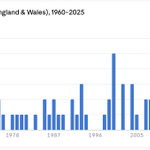
England mean temperature has increased by a little over 1 degree C so far this century. Sunshine hours and CO2 have both increased by over 10%. The relation of temperature to sunshine is much better than to CO2, however.

January 2026 in England was normal in all the key climatic indicators, against slowly increasing trends in sunshine, temperature and rainfall January was "typical".


Richard J 🍞🍺 retweeted

🚨Our film is up
We spent months making this👇
About how Britain shut down many of the factories we need to feed us and defend us.
Will have more to say on it in due course but in the meantime - pls watch, share and let me know what you think youtube.com/watch?v=PQ3hT8tq…


Climate data are in for December from @metoffice showing the month waas wholly unremarkable for December, in line with slowly warming, wetter and sunnier trend seen for over 100 years.


The December weather data for England are out from @metoffice and the close annual relationship of sunshine hours and mean temperature continues. Maybe the 🌞 has something to do with temperature after all?

November climate data for England are in from @metoffice and monthly temperature, rainfall and temperature were all within normal ranges consistent with a slowly warming, slightly wetter and slightly sunnier climate over the last two centuries.


