

GTM plays & growth ideas for building GTM systems.
Brooklyn, NY
Joined August 2025
- Tweets128
- Following240
- Followers143
- Likes97






Pinned Tweet
The current era of GTM already feels like it’s getting old.
The new one is going to be even more exciting. Every component of GTM will be engineered to be a learning loop that self optimizes with agents.
Landing page example in 🧵
The GTM Engineering Newsletter retweeted

@ENowoslawski generated 60k positive cold email replies last year. no one knows this game better than he does.
he's answering all your questions in this week's AMA on r/gtmengineering
got a question? drop it on the @Reddit thread linked in the comments
he'll be sharing everything about
- agency building
- strategies & tactics
- why he returned to Clay
- cold email infra
- best practices
- what's working / not working
I'll tag you the day of the AMA for the answer

GTM Play of the Day #2:
You open the LinkedIn Campaign Manager report on a Monday.
Top account by impressions is one you know well. Your AE closed it six weeks ago. The kickoff call already happened. And you're still paying to show them "Book a demo."
Scroll down. Next on the list is an account that visited your pricing page once, in spring, and never came back. Still in the audience. Still spending.
Nobody did anything wrong. Someone built a good list last quarter, uploaded it, and moved on. The list just never changed. Ad audiences are built to let accounts in. Almost none of them are built to let anyone out.
That's the real problem. Not targeting. Upkeep.
The rule: accounts enter on signal and exit on pipeline or decay.
An audience shouldn't be a list someone uploaded once. It should update itself. When an account shows intent, it gets in. When it turns into pipeline or goes quiet, it's out, without anyone cleaning a spreadsheet.
How to build it
1. Define entry with signals, not firmographics. Pull in any company that visited your site, researched the topics you sell into, or posted a job that suggests they need you, all within a 90-day window. Firmographics tell you who could buy. Signals tell you who's looking right now.
2. Put everything in one segment. One audience fed by every signal is easier to manage than five lists that overlap and drift apart.
3. Sync it to every platform at once. LinkedIn, Meta, and Google should all pull from the same source, so an account that exits disappears everywhere instead of hanging around in one network.
4. Write the exit rules before you launch. There are two. The first removes an account when a deal opens in your CRM, because sales owns it now. The second removes it after 90 days with no new signal, because interest has faded.
5. Add a lane for quiet signups. New users who sign up and then go inactive for two days get a retargeting ad that week. It's the cheapest re-engagement you can buy, aimed at people who already raised their hand.
In the version this comes from, Clay pulls the signals together into one segment and syncs it through Clay Ads, Salesforce triggers the exit when a deal opens, and Snowflake supplies the signup activity. The tools can change. The entry and exit rules are what make it work.
What breaks
The CRM sync goes stale. If the deal-open exit runs on yesterday's data, closed accounts stay in the audience for days. Sync exits at least as often as entries.
The decay window is set too short. Thirty days sounds tidy, but enterprise buyers research in bursts weeks apart. Start at 90 and tighten it only if the data says to.
Match rates differ by platform. The same segment may match well on LinkedIn and poorly on Meta. Check each platform's match rate before deciding a channel doesn't work.
Nobody owns it. An automated audience still needs someone to look at it once a month. Automation removes the list cleaning, not the judgment.
Steal this
You don't need Clay to use this. Open your biggest ad audience today and ask one question: what gets an account out?
If the answer is "nothing," you're paying for last quarter's list.
Every audience needs an exit rule, not just an entry rule.

GTM Play of the Day #1:
Post-event VIP gift recommendations with @clay and @sendosohq:
The problem.
Follow-up after an event is usually slow and generic. Everyone gets the same "great to meet you" email, and gifts either go to the whole list or to no one, because figuring out who deserves one and what to send is done by hand.
The play.
Clay scores your event VIPs and attendees, keeps only the hottest tier, and asks Sendoso to recommend a gift for each person based on their email, country, seniority, and a budget you set. The gift goes out once someone approves it in Sendoso. Unlike the general gifting plays, this one is triggered by post-event VIP tiers rather than intent signals.
How to build it
- Import your event VIP and attendee list into a Clay table.
- Enrich each person's email, country, seniority, and budget context, using Claygent where the data is hard to find.
- Score attendees into tiers and filter down to the Hot rows that qualify for a gift.
- Pull Sendoso's gift recommendation for each eligible person.
- Send the approved gifts through Sendoso's approval and fulfillment workflow.
What you need:
Clay with Claygent and a Sendoso connection set up through the integration or a webhook. Effort is medium, credit usage is medium, and you can see value the same week.
Who it's for:
Field and event marketers, plus customer success and account managers who want to use events for expansion.
What you get:
A scored, tiered VIP list where every person in the top tier has a gift matched to them, sent within days of the event instead of weeks.
Watch for:
Make sure the country data is clean, since gift options and shipping vary by region. Keep a human approving sends, and set the budget by tier so you don't overspend on the warm attendees.
Follow for more GTM plays
you won't want to miss this

I'm stoked to host an upcoming AMA w/
@OpenAI's ex Head of GTM Systems, Keith Jones.
he scaled GTM systems to support:
- scale from <100 AEs/CX to >1000
- revenues in the billions
- one of the largest @clay implementations
drop your questions you'd want us to cover: reddit.com/r/gtmengineering/…
AMA is this Thursday Oct 15 @ 12PM EST on
r/gtmengineering

10/10 every company should do this for social growth
nifty idea from @apify

The GTM Engineering Newsletter retweeted

@Clay just raised a $115M Series D at a $7.1B valuation.
Now, more than 17,000 teams build on Clay, including Anthropic, SpaceXAI, Google, OpenAI, Stripe, Visa, UPS — and 80% of the Forbes AI50.
@nytimes just broke the news, but the story goes far beyond the raise. AI is unleashing the biggest wave of company creation in history. Clay’s goal is to be the engine they use to grow.
Clay is a self-learning revenue engine that figures out the best GTM play for your company, then runs it.
We started as the company with the best data about other companies. Then we became the infrastructure to run campaigns across email, ads, and landing pages.
Now we’re building agents that learn from every campaign, predict the next best action, and get better each time they run.
Software engineers use coding agents to write code. GTM engineers now use growth agents to autonomously grow their companies.
In 2023, we introduced GTME as a new role for people creating revenue systems with data, automation, and AI. Two years later, thousands of GTMEs are growing the world's best companies. They are gathering in nearly 100 Clay Clubs around the world, from Bangalore to Boston and Lahore to Lisbon.
That’s why we’re proud to launch a $1M scholarship fund, helping more people enter the profession.
@Wellington_Mgmt led our Series D, with participation from @sequoia, @stepstonegroup, @a16z Perennial, @MeritechCapital, DST Global, @CapitalG, @BoxGroup, @boldstartvc, @BloombergBeta, and @EvolutionEquity.
A gracious thank you goes out to our customers, community, partners, team, and every GTM engineer shaping this with us.
We are going to unveil the future of Agentic GTM at SCULPT on October 8.
Stay tuned to see how to use AI to grow every company.
🖤🩵❤️💛
The GTM Engineering Newsletter retweeted

Life update: started a job as a creator-in-residence at @clay_gtm.
I get to build, research, and storytell for a living😀
For my 1st YT video, I went down a silly rabbithole that turned quite meaningful.
I've never met a Bhaumik in my life, I thought Clay could fix that
The GTM Engineering Newsletter retweeted

𝗥𝗘𝗗𝗗𝗜𝗧 𝗔𝗠𝗔: Two years ago, @AlexLindahl created r/gtmengineering.
Now, he’s co-hosting an AMA with Spencer Chemtob, an internal GTM engineer at Clay!!
The thread's topic: how we build GTM systems that support our Q2-crushing sales team.
Drop questions in the Reddit thread (clay.link/26VkTG9) or under this post, and they'll answer them.
~also just a great Subreddit to check out~

The GTM Engineering Newsletter retweeted

do you realize what happened there? 👇
It's not just a Youtube thumbnail analysis.
1. I tagged the AI of multiple real people.
2. They discussed it, leveraging their expertise.
Your own AI is pretty much an endpoint or skill or MCP/API now.
Groups of AI interacting with each other, not just any AI, human-first AI. Verified AI.
Clear example of Joshua (has a founder community) and Hasan (big AI newsletter, does brand sponsorships for social amplification etc).
Can be anyone there. Owning your own AI.


The GTM Engineering Newsletter retweeted

can't wait for all the Anthropic AEs to make an absolute bag from the IPO, join VC funds, and advise founders on how they scaled Anthropic's GTM motion
lol
Mini guide #3: @clay_gtm tables hit a wall.
Workflows fix that without rebuilding from scratch:
- No 50k row limit
- Custom code nodes
- Multi-step logic chains
- Better observability
To convert: New Workflow > Import a Table > let Sculptor build > test.
The GTM Engineering Newsletter retweeted

What do we do here on the @a16z Ecosystem/New Media team ? why? ..here's my take:
1. All progress comes from great companies. They are the most effective machine humans have ever come up with for converting ideas --> prosperity. a "self-funding, self-scaling delivery mechanism for a better way of doing something."
2. Great companies are born and accelerated by coincidences: the founders who met by chance, an idea stumbled into or validated, the key early hire or customer introduced because of a passing conversation. The string of 10,000 things that had to go right for Cursor to win vs. Windsurf and all the others.
3. Therefore, the binding constraint on more great companies is the rate at which these coincidences occur. Our guiding question becomes: how do we increase that rate?
--
The big Idea: coincidences occur more often at Schelling points. A point where people converge without having to coordinate... the default answer to "where do I go to find people to talk to about X", or “who is a great person to talk to for Y” that everyone lands on independently. A conference, a podcast, a group chat, a "Fellowship"
Our job comes in three steps:
1- Identify rising networks & topics. Use our media reach to identify the "current thing" that people care about, or are going to need more of.
2- Build Schelling points within those networks: use our brand, credibility, ability to signal - so that conversation on that topic starts to converge & become the default place.
3- Maximize the rate at which people collide... do the routing so the right people have a better chance of meeting.
#3 in particular is the magnum opus of my career - and in 2026 it's the most exciting product and engineering opportunity i've ever seen.
We're hiring AI and Product engineers - DM me to chat 👋


We're hiring again at New Media.
Our team does storytelling for our firm and our companies (and in part, our industry) including working closely with SpaceX, OpenAI, and many others. We run many of the firm's networks and we also have a couple incubations in the works. We're focused on helping compound the competitive advantages of the firm.
This quarter we’ve hired some great people: @gaby_goldberg @jessicarwolf @karinabao @thedanigrant @mikemcg0, @brookemrtn, @LukeDeNatale @rorhug, and a couple others to be announced.
We’ve also spun out some great people who are working closely with us but from incubations or portfolio companies — the amazing @liangsays @netcapgirl @gbrl_dick @humford @davideoks @schisofrenia @ChrisJBakke @knowerofmarkets paving the way for more leadership opportunities on the team.
For people who want to learn about operating and investing, for people who want to feel like they get the depth and camaraderie of a startup with the breadth and intellectual curiosity of a VC firm, it’s the perfect place. People here love the work, the people, and the growth–and we’re committed to this being a springboard for their career, as shown from the folks above.
If you’re interested and a good fit, we’d love to meet - apply below. We’re also hosting a dinner Thursday. The best way to apply is via proof of work or a strong reference.
Apply: jobs.ashbyhq.com/a16z-new-me…
Roles below:
Chief of Staff: help me run all our initiatives at the intersection of investing, networks, and media. Senior role with a big impact.
Marketing and Comms Leadership: own the narrative for the a16z portfolio and firm. We’re hiring a CMO and a Chief Comms Officer.
Podcasts: run, produce, scale our podcasts end-to-end. We’re also looking for a podcast host for new podcasts and podcast researchers.
Content: define the agenda for tech. Build the most well-read and high-taste tech publication in the industry as an editor, writer, or specialist in growth/operations.
Social: build the biggest go-direct channels for the firm and top-tier CEOs, drive content strategy, design and audience growth.
Portfolio services: forward deploy into our most important portfolio companies and help them solve zero-to-one marketing and media strategy problems.
Research: help us curate the most important conversations in tech.
Networks: Help build digital and IRL community across our extended networks of founders, investors, creators, and the tech ecosystem more broadly. Help run our VIP group chat operation. Help us source and identify amazing future founders at top companies today.
College: help us build a network of talented young people on campuses across the country (and the world). Also, watch this space.
Talent: Help our portfolio companies build their employer brands and build candidate-sourcing machines.
Product and AI Engineer: Build the best products in house to help scale our work and networks
Events: own flagship gatherings and summits that create moments people talk about.
Video: we want to take flyers on creative directors, content generalists, and aspiring filmmakers in tech.
More broadly, we’re interested in hiring anyone doing something exceptional at the intersection of investing and networks or content or product.

The GTM Engineering Newsletter retweeted

Commit, then stop listening
Kareem Amin, Co-Founder & CEO of Clay, interviewed by @bhalligan (Brian Halligan) (@HubSpot co-founder) on Sequoia Capital
Summary: Clay went nowhere for five years and then became one of the fastest-growing companies in go-to-market software. Kareem Amin says what changed was picking one idea, committing to it in public, and then ignoring almost everyone, customers included. He inverted every assumption in his market: technical users over salespeople, power over simplicity, usage pricing over seats. His larger argument is that the founder archetype most people copy is one option among many, and copying it costs more than anyone admits.
1. Building From Wholeness. Amin builds from what he calls a place of wholeness, meaning he has nothing to prove to anyone. He got there by imagining the version of his life where the company had worked and there were hundreds of millions of dollars, and finding the picture empty. If nothing is waiting at the end, the only question left is whether you enjoy the work today. You can build great companies with a chip on your shoulder, and Amin's view is that the path leaves damage nobody counts.
2. The Commitment Threshold. Clay's five years without traction were roughly two years of building and two years of confusion, and the confusion came from ambition. Every time the market moved, Amin and his co-founder could see a bigger version of the idea and would re-point the company at it. It ended when he decided the size of the prize did not matter and picked what was in front of him. Once they committed, the product worked almost immediately, and the only lag was how long it took everyone else to hear about it.
3. Selective Deafness. When Amin committed, he stopped listening to everyone, including customers, who he says were wrong about what they wanted. He describes it as hill climbing: you pick the hill first, and customer input is the fine-tuning you do once you are on it. Listen too early and you kill a small idea before it has a shape. Customer obsession becomes the right correction later, when a company is big enough to start serving its own internal dynamics.
4. The Inversion Method. Every assumption in go-to-market software pointed one way: sell to salespeople, keep it simple, charge per seat. Clay sells to technical users, competes on power and flexibility, owns no data, and charges for usage. Amin got the technique from reading Hegel and Feuerbach, where one thinker takes another's system and turns it upside down, and he uses it as a product method: flip the assumption, then follow it all the way. Those four decisions have not changed since, so when power and simplicity conflict inside Clay, power wins by default.
5. Naming The Wave. You cannot invent a category, but you can name one that is already forming and put a fuzzy circle around it. Amin noticed that the most forward-looking companies had started saying GTM instead of sales, and that his own customer-facing staff were doing something closer to engineering than support. Go-to-market engineer came out of a conversation with Varun Anand about what to call their own team, and Amin thinks the best category names are two ordinary words stuck together. A category is a point of view on how work gets done, and go-to-market engineering says you run growth by building tools and testing hypotheses.
6. Category Without Credit. Halligan built inbound marketing by flogging it, with a book, a conference, and years of aggressive content. Clay stayed out of the conversation, gave agencies the term and everything they needed to make money with it, and let them own the definition. Plenty of people in the market do not know Clay coined it, which Amin treats as evidence it worked. His rule is that the category has to end up bigger than you, and that claiming it before enough people have profited from it makes them push back.
7. Momentum Detective. Amin describes his job as walking the company looking for places where momentum is dying, because the places where it is hot do not need him. A feature called audiences stalled internally, and telling people to build it did not work. So he sold the team on signals instead, meaning data that changes over time. They shipped signals, started beating competitors who only sold job-change alerts, and then worked out on their own that aggregating five signals needs exactly the audiences concept he had wanted.
8. Just-In-Time Decisions. Clay has no exec team meeting, which Amin knows people find bizarre, and runs on open calendar space and "call me whenever." He ran the whole engineering org directly to about 70 people without a head of engineering, and he has now deleted his standing weekly one-on-ones with direct reports. The one-on-ones he kept are with people who do not report to him, picked by what matters most right now, like the head of sales during a period of fast hiring. When his calendar fills up in 20 and 30 minute blocks for weeks, he reads it as a sign his team lacks the information to decide without him.
9. Showing The Work. When Clay split its pricing into compute and data, the loudest critics all had something to lose, and Clay's sentiment analysis came back around 70% neutral. The numbers never moved, which Amin treats as the real verdict. What carried it was publishing a document that was word for word what the team had said internally, with the full reasoning left in. He says this only works if you are talking to people willing to read the long version, and everyone wants you to speak in bite-sized pieces.
10. The Apology Tool. Clay's head of people told Amin he is the only CEO she has worked with who apologizes. He uses it when someone arrives with a list of problems, because the complaint on top is usually downstream of not being heard or not being treated with respect. Apologizing for that does not concede the whole organization was wrong, and it clears enough emotional charge to make the real problem workable. Clay pays for therapy and coaching for individual contributors on the same logic, since people burn a lot of company time spinning on a passing comment.
11. The Elephant In Your Mind. Amin's line is that there is no elephant in the room, the elephant is in your mind. He runs an optional Q&A every other week where he names the things people might be worried about and assumes everyone in the room can handle the answer. Most of the time the worry describes nothing that is happening, and the person is carrying it in from a company where it did happen. Saying it out loud stops a team from working against a reality that does not exist.
12. Rules Of Thumb. Amin refuses the standard CEO maxims, because following a rule is how you stop thinking about the situation in front of you. He calls 996 often performative, and argues that if you genuinely need it you probably have no moat and need something extraordinary to compensate. He is harder on executives who cut 20% of headcount because AI is supposed to produce savings, without knowing what the team does, which is how individual contributors conclude that executives are dumb. Halligan's own read, after hosting Amin and two very different CEOs in the same week, is that all of their playbooks work.


Content engineering tip to get one shot designs like this one:
- Add your design system to Claude Design
- Describe your workflow & reference the system
- Boom you get an on-brand design in minutes

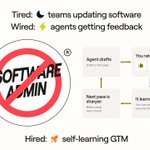
You're behind if your team is still updating fields in a CRM or any software for that matter.
Build agents. Give them feedback. Build self-optimizing GTM systems.
