

Swiss CTO @wonderful_ai
Zurich, Switzerland
Joined August 2009
- Tweets361
- Following454
- Followers1.4K
- Likes1.8K





Giorgio Zinetti retweeted

Terance Tao: Imagine prescribing a drug no one understood.
Medical community:


Giorgio Zinetti retweeted

Champions league

FC Bayern as a club never settles for anything less than world-class.
We are proud to share that Wonderful is now an Official Enterprise AI Partner of @FCBayern.

Giorgio Zinetti retweeted

𝐅𝐂 𝐁𝐚𝐲𝐞𝐫𝐧 𝐱 𝐖𝐨𝐧𝐝𝐞𝐫𝐟𝐮𝐥
Der FC Bayern und @wonderful_ai haben eine dreijährige globale Partnerschaft geschlossen. Als offizieller Enterprise-KI-Partner des FC Bayern wird Wonderful den Verein dabei unterstützen, KI in ausgewählten Bereichen des Vereinsbetriebs in die Praxis einzuführen, angefangen bei ausgewählten Fan-Services.
ℹ Mehr Infos: fcbayern.com/RtKnE
🤝 Paid partnership

Giorgio Zinetti retweeted

Wonderful has raised a $550M Series C at a $5 billion valuation.
This latest funding was led by @insightpartners, with @salesforce joining as new investors and @IndexVentures, @BessemerVP, @IVP, @VineVenturesLP, and @9yardscapital returning.
In 20 months since launch, we're in production with hundreds of agents, systems, and workflows across a dozen verticals in over 30 markets.
With this new capital, we’ll be overdelivering for our customers, hiring hundreds of cracked engineers, FDEs, and former founders, and expanding our product capabilities across the entire enterprise.
Stay tuned 👀

Giorgio Zinetti retweeted

The RL framework behind GLM-5.2 is fully open source.
The full post-training of GLM-5.2 ran on it in about two days. The same stack sits behind the entire GLM series, from 4.5 to 5.1.
It is called slime, and it is built around one idea. Keep a single RL kernel, and push all the variety into data generation.
Let me explain what that means.
Every RL run has two halves. One generates experience, where the model produces responses and something scores them. The other learns from it by updating weights.
The learning half is mechanical. It reads samples, computes a loss, and steps the optimizer, the same way whether the model solves equations or drives a browser.
What changes between tasks is generation. A math run answers in a single turn and grades the result. An agent run loops through tool calls, reads results, and only then earns a reward.
slime draws the line right there. The learning half stays fixed as one kernel, and everything that differs becomes a new way to generate data.
Under the hood, it wires Megatron for training to SGLang for rollout, with a Data Buffer between them that owns prompts, custom data, and generation.
Most RL stacks grow into a pile of disconnected trainers, rollout services, and agent frameworks. slime refuses that.
Multi-turn tool use, sandbox interaction, environment feedback, and verifier rewards all enter as data generation, not as forks of the loop. So an agentic workload runs on the same loop a math run uses, and the kernel never changes.
A few things follow.
→ It is battle-tested. The loop is validated by shipping real GLM models, and it also supports Qwen3, DeepSeek V3, and Llama 3.
→ Correctness comes first. RL bugs are silent, so slime keeps the dataflow explicit and treats CI, reproducibility, and fault tolerance as real engineering.
The proof is the ecosystem on top of it. Dressage, Miles, vime, Relax, OpenClaw-RL, P1, and TritonForge all build on slime without touching the core loop.
The lesson is not that RL needs a bigger framework. It is that the variety belongs in data generation, and the training loop should stay small enough to trust.
GitHub repo: github.com/THUDM/slime
(don't forget to star 🌟)
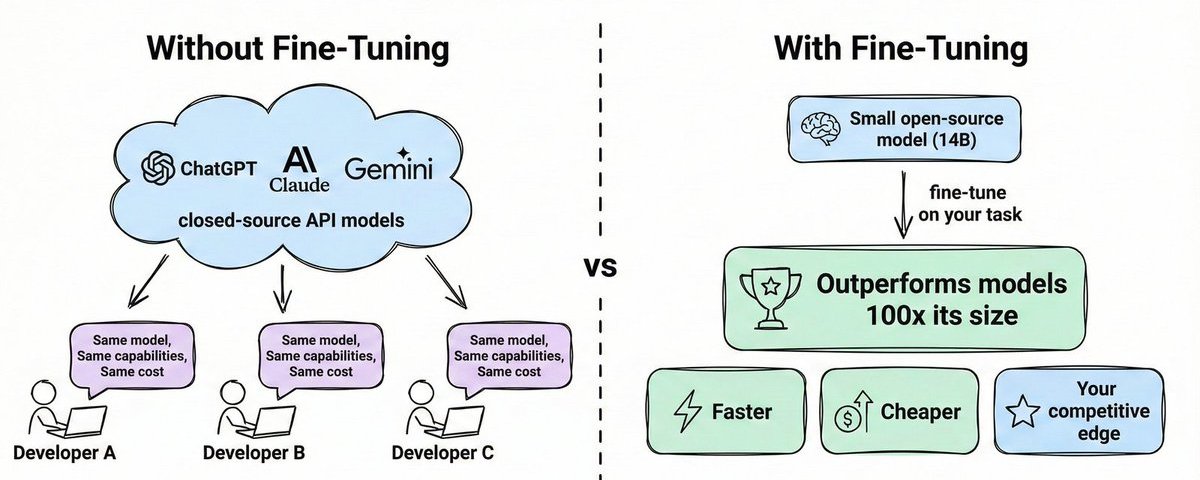
Since we're talking about RL, I wrote a full breakdown on fine-tuning LLMs with RL in 2026. Including how to skip manual reward engineering with automatic LLM-graded rewards.
The article is quoted below.


Giorgio Zinetti retweeted

🚨SecondFi: more than $20M stolen, or taken hostage - When the nonce is predictable, the key is public.
Last Tuesday, SecondFi wallets were drained at scale. Users were doing nothing exotic, just signing transactions like any other day. Then the funds were gone.
▶️What happened. Two waves. First, external attackers drained wallets: ~16M ADA plus NFTs, around $2.5M. Then a much larger move: ~129M ADA, around $20M, swept by SecondFi itself to a third party custodian, "to keep it safe."
Users were robbed by attackers, and users were swept by the platform!!
▶️The bug. Every signature scheme in this family uses a per signature secret number, the nonce. The one rule: it must be secret and unpredictable. EdDSA (Ed25519, what Cardano uses) makes it deterministic on purpose, derived from the private key and the message together. Deterministic, but secret. The secret input is the whole point. SecondFi's implementation derived it from public data alone. The nonce stopped being secret. Public in, public out.
▶️Why it is fatal. Call it what it is: worse than nonce reuse. Reuse needs two signatures from the same key to recover it. Here the nonce can be recomputed by anyone from data already on chain, so a single signature is enough to reconstruct the private key. Every transaction a user ever signed is a public disclosure of their key. I pulled signatures off chain and rebuilt the keys to confirm. One signature, every time. The chain was not attacked. It was read.
▶️The "rescue." The second wave was the platform sweeping ~129M ADA to a custodian, framed as protection. The fix for "your keys are cryptographically exposed" was "trust us to give it back." A cryptographic failure patched with a social promise. "We will return the funds" is not "we are cryptographically incapable of keeping them." The incident did not create that gap. It made it visible.
▶️The ownership trap. Once a key is publicly reconstructible, holding it proves nothing. Attacker, custodian, original user: three parties, same cryptographic claim. So how does a real owner prove it? The elegant exit is a zero knowledge proof of knowledge of the 24 words, the seed, without revealing it. Knowledge of the mnemonic is the one thing a chain scraper does not have. Prove the preimage, not the key.
▶️ How did it get in? Honest mistake, or planted? Dropping a single secret input from the nonce is a tiny change. Exactly what a tired engineer ships, and exactly what a supply chain or insider attacker plants, because it is deniable and pays out silently to whoever reads the chain. I do not know which one this was. The commit history will tell.
Cryptography does not care about good intentions. It enforces what you built. SecondFi built a scheme where the nonce was predictable, so the keys were public, so the funds were anyone's. The rest is just who read the chain first.
Stay safe.
--
(obv, Ledger users are not affected. Nonce and signatures are computed inside the secure element)
🤖 Made with AI

Giorgio Zinetti retweeted

Progress

JUST IN: Pyth Network is now fully LIVE on Cardano, FREE to all builders. 🔮
Every project on Cardano $ADA can get a free API key to get access to full institution price feeds for one year.
Good opportunity for anyone building DeFi on Cardano.


Giorgio Zinetti retweeted

The deal is signed. @FireblocksHQ is coming to Cardano. 🤝
More details coming shortly.

Giorgio Zinetti retweeted

Crypto's next phase will not be won by isolated ecosystems.
The largest interoperability deployment in Cardano's history is coming. Earlier this year, we announced that all of crypto would be connected to Cardano via LayerZero, creating a path for over 800 tokens to natively expand into the Cardano ecosystem.
The complex technical work will roll out in phases, from testnet and mainnet endpoints, to Stargate, to developer tooling that makes it easy for anyone to deploy, to product integrations across the entire LayerZero stack. By the end of this year, any asset will be able to deploy on Cardano.
While this work is in flight, we'll be teaming up with the Cardano teams to share more behind the scenes: a detailed roadmap, a deep dive on our partnership, and co-hosted digital and IRL events for the community.
We're excited for what this work means for both LayerZero and Cardano, and can't wait to share more in the coming weeks.
A connected Cardano. Done right.
iog.io/news/cardano-is-conne…

Giorgio Zinetti retweeted

Today, as agreed, we paid back to the Cardano treasury the ₳920.4K leftovers from our past treasury withdrawal.
We got lucky with the market this summer and didn't spend all our budget.
Note that some of the accounts still hold USDM, meant to pay remaining late 2025 invoices.
Giorgio Zinetti retweeted

Mainnet Incident Update
Cardano experienced a temporary chain partition today after a malformed transaction triggered a bug in an underlying software library.
The ecosystem moved fast in a coordinated response. Upgrades to node version 10.5.2/10.5.3 are restoring full convergence, with the healthy chain becoming dominant. A dedicated working group is reconciling data, and a full AAR will follow.
Huge thanks to all the SPOs, exchanges, engineers, and community contributors who rallied together.
Together with supporting entities and contributors, our initial report is out ➡️ bit.ly/network-incident-repo…
Giorgio Zinetti retweeted
Following an issue identified in the Preview environment yesterday, Cardano is currently experiencing a technical issue now on Mainnet.
Currently block production has slowed, and we’re working closely with @Cardano_CF and @InputOutputHK as we coordinate a technical response.
Node operators
- If you are running Node version 10.3.1 or higher please upgrade to Cardano Node 10.5.2. Link to repository github.com/IntersectMBO/card…
- If you are running a Cardano node below version 10.3.1 you do not need to take any action
- Daedalus users are unaffected
Thank you!

Giorgio Zinetti retweeted

Giorgio Zinetti (@giozzi) opened Day Two with some exciting announcements: a new Cardano stablecoin initiative and an upcoming @MasumiNetwork Hackathon in December. 💡
He set the tone for a packed day of builders, enterprises, and community energy here in Berlin.


Just announced at the @CardanoSummit 2025—a new step for stablecoins on Cardano.
Together with @brale_xyz, we are bringing regulated, custom stablecoin-issuance directly on-chain, opening new opportunities for builders, enterprises, and institutions.
brale.xyz

Giorgio Zinetti retweeted

Day 1 at Cardano Summit 2025 comes to a close.
In his closing keynote, Giorgio Zinetti (@giozzi), Chief Technology Officer at the Cardano Foundation, reflected on a full day of insights, announcements, and collaboration across every corner of the Summit.
From governance to AI integration, decentralized identity to enterprise adoption, today’s sessions showcased Cardano’s growing role as foundational digital infrastructure for secure, interoperable, and transparent systems.
Key highlights included:
• The launch of new research with the @BlockchainRI introducing the Digital Trust Infrastructure framework.
• Masterclasses on open governance, financial transparency, sustainability, and identity solutions like @VeridianID.
• New releases from @GeroWallet, bridging decentralized finance with real-world usability.
• The launch of the Cardano Academy course “AI and Blockchain for Business Leaders: Cardano Edition” on Coursera.
Tomorrow’s program continues with sessions on digital identity, regulated finance, supply-chain transparency, enterprise adoption, and fresh research from Gartner on AI-driven disruption.

Giorgio Zinetti retweeted

Today we’re launching the Chainlink Automated Compliance Engine (ACE) partner ecosystem, featuring 20+ leading compliance providers, frameworks, & regulators powering the next generation of onchain compliance ↓
The Chainlink ACE partner ecosystem is a network of trusted vendors whose solutions are now natively compatible with ACE.
These partners recognize ACE as the standard for onchain compliance and are integrating their data & services directly into ACE to unlock complete compliance, monitoring, & reporting solutions.
At launch, the Chainlink ACE partner ecosystem includes:
IDENTITY PROVIDERS
• GLEIF—Brings trusted global identity standards to ACE users.
• World—Connects its decentralized World ID to ACE users, allowing World’s proof-of-human protocol to be composed anonymously with data from other ACE partners.
• SumSub—Enables reusable digital identity for users to leverage within ACE through SumSub’s KYC/KYB.
• Persona—Allows ACE users to leverage reusable digital identity via Persona’s KYC/KYB verification.
• Proof—Provides cryptographically secure, verified digital identities for ACE users—both individuals & organizations—to sign and protect their transactions.
• Veridian by the Cardano Foundation—Enables ACE users to issue GLEIF’s vLEI-based credentials offchain, which are then delivered onchain in the form of CCIDs.
RISK SCORING PLATFORMS
• Chainalysis—Streams wallet and transaction risk scores directly into ACE policies for institutional-grade AML controls.
• TRM Labs—Provides real-time risk intelligence to ACE, enabling issuers and protocols to block sanctioned or high-risk activity.
• Hypernative—Provides real-time risk intelligence to ACE, enabling issuers and protocols to block high-risk activity.
• CipherOwl—Delivers risk scores into ACE to power agile, customizable compliance rules.
• Llamarisk—Audits ACE-enabled tokens to provide independent risk scores and assessments.
MONITORING & REPORTING
• Bluprynt—Designs, runs, and manages compliance policies directly on ACE for institutions, while also fulfilling regulatory reporting obligations via automated disclosures and regular or on-demand compliance reports.
• Hacken—Builds real-time security monitoring and alerting on top of ACE to detect threats and abnormal behavior.
• Kaiko—Delivers market data and analytics leveraging ACE transaction data logs.
• Hummingbird—Offers a case management and automated SAR reporting solution on top of ACE.
TOKENIZATION PLATFORMS
• Apex Group—Enforces end-to-end compliance across its tokenization infrastructure.
• Chintai—Uses ACE to define investor and transaction eligibility requirements for Chintai assets in public blockchain environments.
BLOCKCHAINS & LAYER-2 NETWORKS
• Ethereum for Institutions—Co-designs and drives institutional adoption of ACE.
• Linea—Establishes ACE as the standard for compliance in the Linea ecosystem.
• Taiko—Leverages ACE for tokenization use cases within the Taiko ecosystem.
INDUSTRY FRAMEWORKS
• ERC-3643—Unlocks compatibility with the ERC-3643 token standard with ACE’s offchain policy.
• ERC-7943—Co-authored by Build member Brickken, the ERC-7943 token standard uses ACE to power compliance and interoperability.
• Digital Securities Initiative (DSI)—Recognizes ACE as a trusted compliance standard, and is collaborating with Chainlink Labs to make ACE compatible with DSI's regulatory frameworks.
The Chainlink ACE partner ecosystem establishes ACE as the industry standard for onchain compliance, uniting identity, risk, and regulatory infrastructure into the most complete, modular, and enterprise-grade compliance network for digital assets.
Integrate your data & services directly into ACE:
chain.link/automated-complia…

Giorgio Zinetti retweeted

The OSAKA - Cardano by 2030 sponsored by @IntersectMBO and hosted by @ZengateGlobal is in full effect. Lots of awesome conversations. Good vibes.


Giorgio Zinetti retweeted

Setting up for the Cardano Governance Workshop with @giozzi @timbharrison @NicolasC3rny @LucasMacchia2 @dannyribar @JTelpner.


Giorgio Zinetti retweeted
We’re pleased to see Cardano Foundation included as one of the key supporters and anchor investors in the MCM Fund I by @members_cap.
MCM Fund I is the first tokenized institutional-grade reinsurance fund designed for both sophisticated digital asset investors and traditional allocators.
This fund expands access to the reinsurance asset class to qualified investors wishing to invest using eligible cryptocurrencies on the @Solana, @Aptos, @Cardano and @Base blockchains. It is supported by established financial and digital asset institutions such as @Coinbase, @ArchaxEx, Apex Group, @enveloprisk, Hannover Re, and Northern Trust.
The Cardano Foundation continues to support initiatives that expand the utility and reach of the Cardano ecosystem across diverse real-world applications.

Giorgio Zinetti retweeted
We welcome the publication of the investigative report on the ada Voucher Program released yesterday by @InputOutputHK.
We are happy that it confirms the redemption process was conducted correctly and diligently.
We further appreciate the clarity provided on the use of the remaining unredeemed ada for funding @IntersectMBO and then in turn contracting with Input Output Infrastructure, @Emurgo_io, and other Intersect contractors.
We hope this outcome provides peace of mind for the community and helps Cardano move forward.
Link to our previous post:
xitter.cf/Cardano_CF/status/1924…
Over the past few weeks, there have been many questions about the ada voucher redemption process run by @InputOutputHK after 2021.
Here’s what we know:
✅The effort to locate and support remaining voucher holders has been led by the IO team over the past four years, with no operational involvement from Cardano Foundation, beyond directing requests to the relevant IO teams.
✅While we received occasional updates on overall progress, such as the number of vouchers redeemed and on-the-ground activities for finding holders, we were not provided with detailed accounting information or the flow of funds.
✅Based on the information available to us and assurances provided, we have no reason to assume anything other than professional conduct on IO’s part in managing the process and associated funds.
✅To help address any uncertainty, we welcome the commitment by IO to a publicly available audit of the entire process by a professional and independent third party, including all related financial transactions. Until this work is done, we ask everyone to remain patient.
With this in mind, based on our audit expertise, we would recommend focusing on the redemption process and the associated flow of funds. This could include all inflows and outflows from the MIR request through to current balances, if any remain, as well as valuations and any returns generated from withdrawn funds during the administration period.
We are fully committed to the long-term success of the Cardano blockchain and working collaboratively across the community to support the growth and resilience of the ecosystem.