

Swiss CTO @wonderful_ai
Zurich, Switzerland
Joined August 2009
- Tweets361
- Following454
- Followers1.4K
- Likes1.8K





Pinned Tweet
In August, I said "more on that soon."
So, soon is now: I have started as CTO for Switzerland at @wonderful_ai.
The few weeks in between were spent mostly awake at 3am, holding a very small person who has no interest in my career plans. Best possible way to reset.
Shipping enterprise AI in Switzerland.

Giorgio Zinetti retweeted

Terance Tao: Imagine prescribing a drug no one understood.
Medical community:

I think it's time to simplify things.

Today I call upon the blockchain industry to calmly begin planning for "bunker mode". My personal recommendation is to set in motion a controlled mass migration of assets to fresh addresses, i.e. addresses whose pubkeys remain hidden behind a hash.
Holders, starting with large and sophisticated ones, should consider moving the bulk of their funds to addresses that have never signed a transaction. And when they do sign one, they should also move remaining funds to a new address (possibly generated from the same seed phrase).
Don't rush. While I believe there is cause for action a rushed migration would do more harm than good. Don't panic either. Moving assets to protected addresses is a simple, preventative step which does not require new cryptography or new wallets.
IMO it is now reasonable to brace for the possibility that ECDSA breaks before qday, in the worst case in months not years. By "break" I mean fast private key recovery (e.g. in one week) on available hardware (e.g. a large GPU cluster).
Recent days have been humbling for human mathematical intuition. Long-held, unquestioned hypotheses have fallen. This includes the n log(n) bound for integer multiplication and the 3SUM conjecture. In hindsight, May's unexpected disproof of the Erdős unit distance conjecture was our warning shot.
Yesterday's OpenAI drop made it clear that mathematical superintelligence is upon us. They say there are weeks where decades happen. We are about to live through weeks where centuries of mathematical progress happen. Could our magic 64-byte ECDSA signatures be too good to be true? Was it just security through obscurity all this time?
Elliptic curves feel especially vulnerable to superintelligence. Curves carry rich structure, with room for fancy tricks like Schoof, Frobenius, pairings. (By contrast, hashes are designed to minimise algebraic structure.)
Separately, as Ewin Tang can attest, an efficient quantum algorithm sometimes foreshadows an efficient classical one. We should be open to the possibility of a classical counterpart to Shor that breaks elliptic curves and RSA at once.
Also noteworthy is the striking under-representation of cryptographic breakthroughs among the 722 mathematical results OpenAI published. I've witnessed first-hand the US government censoring academic quantum cryptanalysis results. Backroom interventionism is my base case.
I urge large, sophisticated actors to lead by example. Project11's "risq list" (bitcoin-risq-list.projecteleven[.]com) is a great tracker of exposed BTC pubkeys. Binance, Bitbank, Robinhood, Bitfinex, and Tether have an opportunity to harden their cold storage. Next month I'll address institutions in London in a live Q&A (forum.ethereuminstitutional[.]org/london-2026).
Again, please do not rush. Wallets holding under 50 BTC enjoy partial cover from "Satoshi's shield", i.e. his 20K exposed addresses that hold 50 BTC each. Load-bearing signers like oracles and L2 security councils should consider rotating ECDSA pubkeys with every signed message and/or multi-signing with a hash-based schemes like SPHINCS.
Exiting bunker mode safely will require post-AI cryptography. My inclination is to go all-in on hash-based cryptography and avoid structured mathematical assumptions entirely, whether from curves, lattices, or isogenies. A single battle-tested hash (e.g. from the SHA or BLAKE families) yields plausible post-AI security.
The Ethereum roadmap on strawmap[.]org fully embraces hash-based cryptography with end-to-end formal verification as a response to the quantum threat. Those timelines must now be revisited and accelerated in light of mathematical superintelligence. I'll be pushing for maximum defensive acceleration.
OpenAI's OpenAI bill must be huge this month.

We’re releasing a broad range of new mathematical results produced by an internal frontier model.
We’ve been consulting with the independent Advisory Group on Mathematics and Artificial Intelligence at the Institute for Advanced Study, and we have drawn on their advice and public recommendations to inform how we release these results.
github.com/openai/math


Giorgio Zinetti retweeted

Champions league

FC Bayern as a club never settles for anything less than world-class.
We are proud to share that Wonderful is now an Official Enterprise AI Partner of @FCBayern.

Giorgio Zinetti retweeted

𝐅𝐂 𝐁𝐚𝐲𝐞𝐫𝐧 𝐱 𝐖𝐨𝐧𝐝𝐞𝐫𝐟𝐮𝐥
Der FC Bayern und @wonderful_ai haben eine dreijährige globale Partnerschaft geschlossen. Als offizieller Enterprise-KI-Partner des FC Bayern wird Wonderful den Verein dabei unterstützen, KI in ausgewählten Bereichen des Vereinsbetriebs in die Praxis einzuführen, angefangen bei ausgewählten Fan-Services.
ℹ Mehr Infos: fcbayern.com/RtKnE
🤝 Paid partnership

Giorgio Zinetti retweeted

Wonderful has raised a $550M Series C at a $5 billion valuation.
This latest funding was led by @insightpartners, with @salesforce joining as new investors and @IndexVentures, @BessemerVP, @IVP, @VineVenturesLP, and @9yardscapital returning.
In 20 months since launch, we're in production with hundreds of agents, systems, and workflows across a dozen verticals in over 30 markets.
With this new capital, we’ll be overdelivering for our customers, hiring hundreds of cracked engineers, FDEs, and former founders, and expanding our product capabilities across the entire enterprise.
Stay tuned 👀

After 2.5 years, I’ll be stepping down as CTO of the Cardano Foundation at the end of August.
Time really flew. I’m proud of what we built, but even more grateful for the people I got to work with along the way.
First, a few weeks off to welcome our daughter ❤️
Then a new adventure starts in September.
More soon :)
The “For You” tab on X has become a collection of garbage.
Every other post is manufactured outrage from someone pretending to be an idiot because it pays better than having an actual opinion.
agi is coming. the upside is absurd — curing cancer, clean energy, post-scarcity.
demis dropped his framework today: us-led standards body, finra-style, tests every frontier model on earth before release.
my instinct: why us-led? we just watched washington freeze anthropic's models overnight with zero playbook.
but every alternative is worse. labs self-regulating grade their own homework. international bodies are too slow. europe has no models to lead with.
the most important technology in history, and our best idea is "wall street's regulator, but for superintelligence."
i don't have a better answer. does anyone?


Doctors are obsolete

♥️ GPT-5.6 is a major step forward for health, both at the frontier and at cost.
These models push the frontier of performance per dollar, bringing the best health intelligence to all. The smallest variant, GPT-5.6 Luna, evaluated at the lowest reasoning effort, outperforms GPT-5.5 at the highest reasoning effort–despite costing 25x less. The largest variant, GPT-5.6 Sol, sets a new high bar at cost.
Another especially cool result: physicians found fewer flaws in GPT-5.6 responses than physician-written responses.
We collected diverse tasks that remain difficult for recent OpenAI models, across patient-facing and clinician-facing use cases. We asked speciality-matched physicians to write responses to these tasks with unlimited time and web access. We then asked other physicians to compare responses side-by-side, blinded to their source. Physicians were asked to comment on areas of improvement across five axes: accuracy, communication, completeness, instruction following, and health decision helpfulness. We then reported the fraction of responses across sources rated perfectly across all axes, across 20,000 total axis ratings. GPT-5.6 Sol appeared strongest, although all GPT-5.6 models performed significantly better than physicians.

Giorgio Zinetti retweeted

The RL framework behind GLM-5.2 is fully open source.
The full post-training of GLM-5.2 ran on it in about two days. The same stack sits behind the entire GLM series, from 4.5 to 5.1.
It is called slime, and it is built around one idea. Keep a single RL kernel, and push all the variety into data generation.
Let me explain what that means.
Every RL run has two halves. One generates experience, where the model produces responses and something scores them. The other learns from it by updating weights.
The learning half is mechanical. It reads samples, computes a loss, and steps the optimizer, the same way whether the model solves equations or drives a browser.
What changes between tasks is generation. A math run answers in a single turn and grades the result. An agent run loops through tool calls, reads results, and only then earns a reward.
slime draws the line right there. The learning half stays fixed as one kernel, and everything that differs becomes a new way to generate data.
Under the hood, it wires Megatron for training to SGLang for rollout, with a Data Buffer between them that owns prompts, custom data, and generation.
Most RL stacks grow into a pile of disconnected trainers, rollout services, and agent frameworks. slime refuses that.
Multi-turn tool use, sandbox interaction, environment feedback, and verifier rewards all enter as data generation, not as forks of the loop. So an agentic workload runs on the same loop a math run uses, and the kernel never changes.
A few things follow.
→ It is battle-tested. The loop is validated by shipping real GLM models, and it also supports Qwen3, DeepSeek V3, and Llama 3.
→ Correctness comes first. RL bugs are silent, so slime keeps the dataflow explicit and treats CI, reproducibility, and fault tolerance as real engineering.
The proof is the ecosystem on top of it. Dressage, Miles, vime, Relax, OpenClaw-RL, P1, and TritonForge all build on slime without touching the core loop.
The lesson is not that RL needs a bigger framework. It is that the variety belongs in data generation, and the training loop should stay small enough to trust.
GitHub repo: github.com/THUDM/slime
(don't forget to star 🌟)
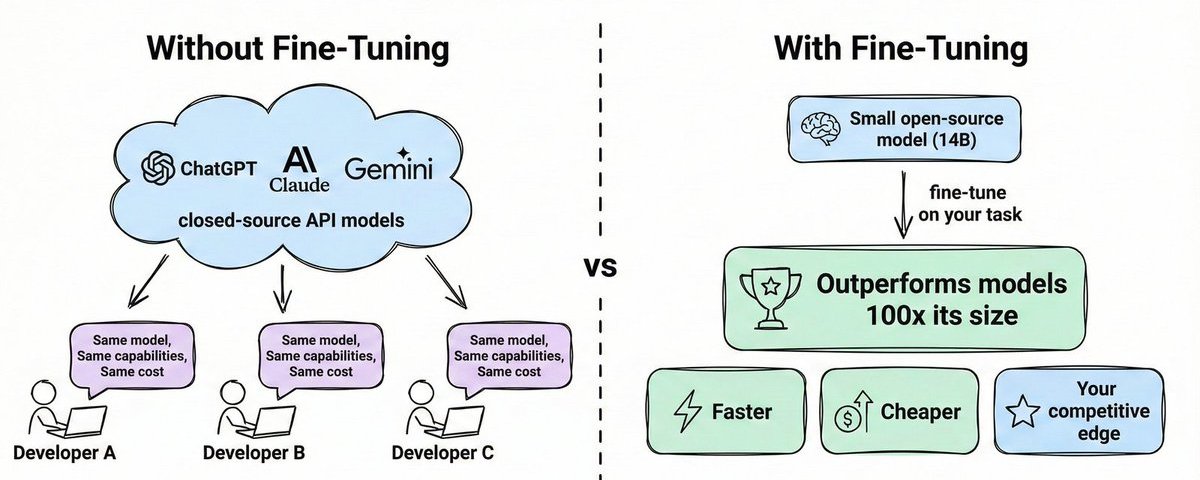
Since we're talking about RL, I wrote a full breakdown on fine-tuning LLMs with RL in 2026. Including how to skip manual reward engineering with automatic LLM-graded rewards.
The article is quoted below.


Giorgio Zinetti retweeted

🚨SecondFi: more than $20M stolen, or taken hostage - When the nonce is predictable, the key is public.
Last Tuesday, SecondFi wallets were drained at scale. Users were doing nothing exotic, just signing transactions like any other day. Then the funds were gone.
▶️What happened. Two waves. First, external attackers drained wallets: ~16M ADA plus NFTs, around $2.5M. Then a much larger move: ~129M ADA, around $20M, swept by SecondFi itself to a third party custodian, "to keep it safe."
Users were robbed by attackers, and users were swept by the platform!!
▶️The bug. Every signature scheme in this family uses a per signature secret number, the nonce. The one rule: it must be secret and unpredictable. EdDSA (Ed25519, what Cardano uses) makes it deterministic on purpose, derived from the private key and the message together. Deterministic, but secret. The secret input is the whole point. SecondFi's implementation derived it from public data alone. The nonce stopped being secret. Public in, public out.
▶️Why it is fatal. Call it what it is: worse than nonce reuse. Reuse needs two signatures from the same key to recover it. Here the nonce can be recomputed by anyone from data already on chain, so a single signature is enough to reconstruct the private key. Every transaction a user ever signed is a public disclosure of their key. I pulled signatures off chain and rebuilt the keys to confirm. One signature, every time. The chain was not attacked. It was read.
▶️The "rescue." The second wave was the platform sweeping ~129M ADA to a custodian, framed as protection. The fix for "your keys are cryptographically exposed" was "trust us to give it back." A cryptographic failure patched with a social promise. "We will return the funds" is not "we are cryptographically incapable of keeping them." The incident did not create that gap. It made it visible.
▶️The ownership trap. Once a key is publicly reconstructible, holding it proves nothing. Attacker, custodian, original user: three parties, same cryptographic claim. So how does a real owner prove it? The elegant exit is a zero knowledge proof of knowledge of the 24 words, the seed, without revealing it. Knowledge of the mnemonic is the one thing a chain scraper does not have. Prove the preimage, not the key.
▶️ How did it get in? Honest mistake, or planted? Dropping a single secret input from the nonce is a tiny change. Exactly what a tired engineer ships, and exactly what a supply chain or insider attacker plants, because it is deniable and pays out silently to whoever reads the chain. I do not know which one this was. The commit history will tell.
Cryptography does not care about good intentions. It enforces what you built. SecondFi built a scheme where the nonce was predictable, so the keys were public, so the funds were anyone's. The rest is just who read the chain first.
Stay safe.
--
(obv, Ledger users are not affected. Nonce and signatures are computed inside the secure element)
🤖 Made with AI

Giorgio Zinetti retweeted

Progress

JUST IN: Pyth Network is now fully LIVE on Cardano, FREE to all builders. 🔮
Every project on Cardano $ADA can get a free API key to get access to full institution price feeds for one year.
Good opportunity for anyone building DeFi on Cardano.


everyone's reading the "foreign national" line as the government not getting how AI works.
i think it's the opposite. they know you can't actually gate a model by nationality. that was the point. it forces anthropic to pull it for everyone.
shutting it down for foreign nationals was never the goal. the full shutdown was.
back online in a week or two, once they've made their point.

The US government, citing national security authorities, has issued an export control directive to suspend all access to Fable 5 and Mythos 5 by any foreign national, whether inside or outside the United States, including foreign national Anthropic employees.
The net effect of this order is that we must abruptly disable Fable 5 and Mythos 5 for all our customers to ensure compliance.
Access to all other Claude models is not affected.
We apologize for this disruption to our customers. We believe this is a misunderstanding and are working to restore access as soon as possible.
Read our full statement: anthropic.com/news/fable-myt…

🧐

BREAKING: The Nasdaq announces that it expects "a few more hours" before SpaceX, $SPCX, shares can begin trading.
Additional time is needed to ensure the IPO is "orderly" and that "we get the right price," the Nasdaq's President says.