

MD/MPH/PhD. UNC@Chapel Hill Alumna. Research CVD Epi/Preventive Cardiology. Teach research methods. Behavior Change Counseling. Traded tenure 4 sunshine. Dancer
The Beautiful Blue Planet
Joined September 2008
- Tweets2.5K
- Following546
- Followers384
- Likes11.6K





Pinned Tweet
Some of the things I do.
I enjoy building new collaborations, it's how we move forward.
scholar.google.com/scholar?h…

Georgeta Vaidean retweeted

🫀 Can coronary atherosclerosis actually regress?
Our new randomized FLOWPROMOTE trial analysis, published TODAY in JAMA Cardiology, shows remarkable coronary plaque regression with intensive LDL-C lowering!
Atherosclerosis is not necessarily a one-way process.
📄 JAMA Cardiology:
doi.org/10.1001/jamacardio.2…
#Atherosclerosis #LDL #Cardiology #CCTA

Georgeta Vaidean retweeted

Lots of debate this week on whether journals should ban AI in peer review.
We actually tested this in our new preprint, and the results were pretty clear to me.
For context, I've reviewed for most of the big journals and evaluated 1,000 human reviews as an editor. I love to read and evaluate science.
TLDR: From now on I won't do any peer review without AI. For clinical trials, I'd even call human-only review dangerous 🧵

Good read. It's like the saying...we have met the enemy and they are us.
"Perhaps the most under-discussed challenge in translational AI is the logistical burden of generating rigorous prospective evidence, ...the ‘infrastructure of evidence’."
nature.com/articles/s41591-0…

1
122
When attempts to find solutions to peer review backfire...
Paid to peer review: firms are paying researchers to assess manuscripts for journals nature.com/articles/d41586-0…

23
Georgeta Vaidean retweeted

Some very good points here. Perhaps the biggest abomination I see in #meded is emphasis on specificity and sensitivity; this is highly bizarre stuff, and I share Moon’s and Frank’s piece as much as I can pubmed.ncbi.nlm.nih.gov/1280…

"It's time to stop celebrating resilience"
Excellent piece here.
This is why any 'Resilience workshop' should come together with accountability and an institutional plan of action.
timeshighereducation.com/cam…

1
35
Georgeta Vaidean retweeted

💬 Perspective by Adam Sawatsky, MD, MS, and Andrea Leep Hunderfund, MD, MHPE: #PhysicianBurnout may reflect more than overwork. #Burnout can also indicate an identity crisis in #Medicine when market, managerial, and platform priorities conflict with professional commitments to patients and public trust.
Addressing burnout may therefore require structural changes in workflows, metrics, and technologies so that practice conditions support patient-centered care and professional judgment.
ja.ma/4dbnPQY


Georgeta Vaidean retweeted

Thank you @HypertensionAus especially President @markus_schlaich for inviting me to present at next month's webinar - #Gratitude & delighted!
Hope you will join us🙏
@NthSydHealth @KollingINST @thecsanz @HypertensionAus @CouncilonHTN @KidneyInCVD @WomenAs1 @HerHeartCharity @GlobalHeartHub @AHAScience @Ravinay @escardio @EAPCPresident

Guarding against (-) effects of AI use by students is not surveillance, indeed.
A thoughtful integration of AI in edu /#MedEd requires curricular re-design w/ high face2face interactions.
Med Schools need to understand what faculty: student ratios mean for quality education.

MIT published a brutally honest report on what AI is doing to students.
A committee of professors and students spent five months studying how AI changed learning on campus, and the findings read like a warning to every university on the planet.
Study groups are disappearing. Office hours are emptying out. Problem sets and take-home exams no longer prove anything, because AI can produce credible solutions to almost any written assignment in the undergraduate curriculum. Students who lean on chatbots lose mastery and confidence, and some slip into what the report calls cognitive surrender, reaching for AI at the first hint of struggle.
The numbers are rough. 46 percent of surveyed MIT undergrads use LLMs daily. 90 percent worry about their own overreliance. Undergrads who feel AI makes them replaceable now outnumber those who feel it makes them capable.
The committee's answer surprised me. They refused to fight AI with surveillance. The report calls AI detectors unreliable, says lockdown browsers feel like spying, and warns that policing students builds a classroom atmosphere of mutual distrust.
Instead, MIT wants to rebuild education around the things AI can't replace. That means oral exams, semester portfolios, in-person project work, and a required social component in every subject. The report even floats the idea of rethinking grades entirely, since without a GPA to optimize, much of the incentive to cheat with AI evaporates.
The committee warns professors against replacing undergrad research assistants with AI agents just because they're cheaper, because a university exists to grow people, not output.
The most famous tech school on earth admitted the machines broke its way of teaching. Its answer is more humans, not more software.

1
78
This thread should be part of Med School Foundations 101.
We are happy as long as we can maintain hope & idealism. We are over-identifying w/our careers for most of our lives. We need to learn & accept that real life requires better negotiations, before we reach mid-career

Georgeta Vaidean retweeted

🔬Using GWTG Clinical Registry Data to Address Gaps in Care of Patients with CVD or Stroke
This opportunity supports early career investigators interested in learning how to use GWTG data on the Precision Medicine Platform
•Up to $50,000 per award
professional.heart.org/en/re…

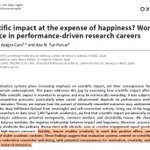
Great @OUPAcademic paper. At first, it's about faculty happiness, but it's more about systems. An efficient system is one which nurtures researchers autonomy, meaning & stability as conditions for creativity/ingredients of a genuine research enterprise.
academic.oup.com/rev/article…

This paper reminded me of your commitment to raise awareness about importance of meaning in work, authentic 360 well-being, and the systemic root causes of things @DrDimitrios
1
2
39

Georgeta Vaidean retweeted

Which is better at fueling endurance sports, keto- or carb-based approaches? The debate between keto and carb has dominated the sports nutrition world for decades. Here, in an excerpt from a longer discussion with @mackinprof and @gibalam , @LouiseMBurke sets up the fundamental reason why keto is so compelling.
Full episode:
realexercisescience.com/p/ca…
#carbs #keto #ketogenic #nutrition #endurance

Georgeta Vaidean retweeted

This is why we started our movement.
We are committed to being the most author-friendly and reviewer-friendly journal in the world.
-easiest submission process in existence
-rapid reviews and editorial decisions
And All our science is accessible to anyone, everywhere in the world, for free. Forever.
Join the movement!
Opensourcecardiology.org


Our lead author just pulled one of our papers from a prominent #MedEd journal because it’s been 8 months and the editors still couldn’t find any reviewers.
You were wondering when this #PeerReview model would hit its breaking point?
That time is now.
Georgeta Vaidean retweeted

If you just control for metabolic health tightly enough (selecting the youngest, fittest, leanest, healthiest etc. participants) then elevated ApoB/LDL-C doesn't explain plaque.
This is the healthy-of-the-gaps argument. The god-of-the-gaps argument applied to lipidology.
🧵1/9

wait, what on earth??
in listening to dave in that clip, what is he truly trying to say? on one hand, these people are (according to his criteria) "healthier than average" and some people like the woman he mentions or the other person with the high CAC before entering the study, may not have been healthy beforehand. ok sure, I get that. but they clearly were in different/better states of metabolic health by the time they entered the study and after a year of it were they not?
so now is it that LMHR does not appear to more substantially increase risk for plaque development if the person is a super healthy, fit athlete with little to plaque before starting eating keto?
this makes no sense.
the question at hand as I understand it is what happens when you go on keto regardless of your state of health beforehand, especially when we consider that many people choose this path because they are not in a good state of health. you could even make the argument, that the results on the less healthy people in their cohort are the MOST IMPORTANT OF ALL to pay attention to, when it appears as though he is trying to explain their rapid progression rates away based on their prior health metrics.
What an unfortunate title.
How about ~Residency publication pressures fuel a surge in low-rigor OS studies ~
How about actually listening to what #Medstudents have to say about research?
It's not them. It's us. (1/n)
science.org/content/article/…

1
4
466
#MedEd needs to take clinical and outcomes research education seriously. Knowing how to click through a database is not the same as knowing how to conduct research.
Research methods require dedicated curricular time and educators with genuine methodological expertise.
1
1
43
Perhaps it's time #MedEd acted accordingly. Otherwise, we're not educating future researchers, we're teaching bad habits. By failing to provide rigorous research education, we're disregarding our students' genuine intellectual curiosity & true potential.
It's not them. It's us.
2
35