
Full time Crypto Degenerate, Full time talking trash on X and expose Tax farming projects.
somewhere with a PC
Joined March 2023
- Tweets2.4K
- Following194
- Followers90
- Likes5.9K




G retweeted

'I support all meme coins. I might even buy (or sell) one or two in the next few weeks to test a few new things. May the best memes win! 🙏'
are you still going to test the few new things sir, @cz_binance? 👀
with Binance announcing the $MARSCOIN spot listing today, i think it is a good candidate for this test
it is also the first meme/stock pair to be listed on Binance, so it's on the frontier of one of the hottest crypto trends right now
plus you and your friend @elonmusk memed the idea into existence haha

G retweeted

No complexity. No accident.
10/10 was caused by irresponsible marketing campaigns by certain companies.
On October 10, tens of billions of dollars were liquidated. As CEO of OKX, we observed clearly that the crypto market’s microstructure fundamentally changed after that day.
Many industry participants believe the damage was more severe than the FTX collapse. Since then, there has been extensive discussion about why it happened and how to prevent a recurrence. The root causes are not difficult to identify.
⸻
What actually happened
1.Binance launched a temporary user-acquisition campaign offering 12% APY on USDe, while allowing USDe to be used as collateral with the same treatment as USDT and USDC, and without effective limits.
2.USDe is a tokenized hedge fund product.
Ethena raises capital via a so-called “stablecoin,” deploys it into index arbitrage and algorithmic trading strategies, and tokenizes the resulting fund. The token can then be deposited on exchanges to earn yield.
3.USDe is fundamentally different from products such as
BlackRock BUIDL and Franklin Templeton BENJI, which are tokenized money market funds with low-risk profiles.
USDe, by contrast, embeds hedge-fund-level risk. This difference is structural, not cosmetic.
4.Binance users were encouraged to convert USDT and USDC into USDe to earn attractive yields, without sufficient emphasis on the underlying risks. From a user’s perspective, trading with USDe appeared no different from trading with traditional stablecoins—while the actual risk profile was materially higher.
5.Risk escalated further as users:
•converted USDT/USDC into USDe,
•used USDe as collateral to borrow USDT,
•converted the borrowed USDT back into USDe,
•and repeated the cycle.
This leverage loop produced artificial APYs of 24%, 36%, and even 70%+, widely perceived as “low risk” simply because they were offered by a major platform. Systemic risk accumulated rapidly across the global crypto market.
6.At that point, even a small market shock was sufficient to trigger a collapse.
When volatility hit, USDe depegged quickly. Cascading liquidations followed, and weaknesses in risk management around assets such as WETH and BNSOL further amplified the crash. Some tokens briefly traded near zero.
The damage to global users and companies—including OKX customers—was severe, and recovery will take time.
⸻
Why this matters
I am discussing the root cause, not assigning blame or launching an attack on Binance. Speaking openly about systemic risks is sometimes uncomfortable, but it is necessary if the industry is to mature responsibly.
I expect there may be significant misinformation and coordinated FUD directed at OKX in the near future. Even so, speaking honestly about systemic risk is the right thing to do—and we will continue to do so.
As the largest global platform, Binance has outsized influence—and corresponding responsibility—as an industry leader. Long-term trust in crypto cannot be built on short-term yield games, excessive leverage, or marketing practices that obscure risk.
The industry needs leaders who prioritize market stability, transparency, and responsible innovation—not a winner-take-all mentality where criticism is treated as hostility.
Crypto is still early.
What we choose to normalize today will determine whether this industry earns lasting trust—or repeats the same mistakes again.


G retweeted

Working on a follow up article for those interested….
Just as Binance are nuking the market


G retweeted

The Time to Destroy Binance is now.
no more waiting, no more forgetting about it
Currently compiling data on all binance scams and misdoings and together we can expose the terrorists that is CZ.
If you have any info or screenshots drop them below
The Exposè is coming
G retweeted

Calling it now
CZ is the SBF of this cycle
Binance is a ticking time bomb like FTX
They already showed us they have the power to wipe out our balances on 10/10
Withdraw all funds from @binance immediately and send @cz_binance back to prison before it is too late

G retweeted

Binance was probably behind that massive October dump
This is my view and opinion based on onchain data, exchange notices, and timing:
On Oct 6, Binance publicly said it would change how it prices BNSOL and wBETH on Oct 14.
That created a 4-day window (Oct 10–14) where thin books could be smashed to nuke collateral across futures, margin, and loans.
The punch landed in a tight 40-minute window, ~21:36–22:16 UTC on Oct 10:
USDe on Binance printed as low as $0.6567 while other venues stayed around $0.90–0.95.
wBETH collapsed to ~$430 (≈-88% vs ETH parity) only on Binance.
BNSOL flushed to ~$34.9 (≈-82%).
Binance later paid ~$283M to users and rushed the oracle fix early (moved from Oct 14 to Oct 11).
In the 24–48h before the event, >$10B moved:
Big USDT/USDC inflows into exchange hot wallets around 05:30–06:30 UTC on Oct 10.
USDe flows tied to Binance labels: 0xdfd529 (Binance 7), 0x28c6c0 (Binance 14), 0x21a31e (Binance 8).
Coinbase didn’t list the weak links (USDe / wBETH / BNSOL) but did two things:
Moved 1,066 BTC from cold to hot minutes before the cascade ($130M at pre crash prices).
During the drop, large flow that couldn’t fill on Coinbase appears to have been routed out via market makers (Prime-style diversion).
Coinbase’s cbETH peg held; Binance’s wBETH collapsed.
Who provided liquidity?
The two biggest MMs (Wintermute, Jump) were basically absent in the three nuked assets during that window.
No meaningful USDe / wBETH / BNSOL footprints from their known entities.
Pull bids in those books while Binance marks collateral off those books, and the liquidation engine eats itself.
A new account there scaled to ~$1.1B notional BTC/ETH shorts in the last two hours before the nuke, with one ETH add ~1 minute before the tariff post;
PnL ~$160–200M.
Shorting wallets tied to the pattern I tracked:
BTC side:
0xb317d2bc2d3d2df5fa441b5bae0ab9d8b07283ae
ETH side:
0x2ea18c23f72a4b6172c55b411823cdc5335923f4
• Hyperliquid short wallets:
0xb317d2bc2d3d2df5fa441b5bae0ab9d8b07283ae
0x2ea18c23f72a4b6172c55b411823cdc5335923f4
We still seeing the problem even today, maybe the rumors and Fud around Binance are not that crazy


G retweeted

回想起来
cz进去的那段时间
天下太平
币安那段时间变得特别谨慎
把合规和用户放在第一
这条狗放出来
彻底变了味
一切都是为了收割
alpha垄断项目生产链,上线就砸盘
发一堆垃圾全线暴跌90%
人为导致1011全网暴跌,收割机构和做市商,自爆式袭击整个币圈。
这家伙是币圈本拉登
必须击毙
蹦跶不了多久了
G retweeted
“twisted FUD” (apparently)
Depeg stablecoin, $19B liquidations, orderbook collapse, manipulation of longs/shorts, shilling & dumping $ASTER tokens
As if it all didn’t happen
The usual “4” slop, never addresses any of the points raised
“No need to care”
sociopath


G retweeted

Funny how the loudest “concerns” about @binance @cz_binance @heyibinance always seem to arrive in perfect formation. Coordinated outrage is usually the tell. Builders keep building. Noise fades. History remembers those who actually moved the industry forward.
G retweeted
People have underestimated the impact of 10/10. The incident caused real and lasting damage to the industry.
An industry-leading company should focus on strengthening core infrastructure, building trust with global users and regulators, and protecting the long-term interests of the majority of crypto users, setting an example for others to follow. Instead, some chose to pursue short-term gains—repeatedly launching Ponzi-like schemes, amplifying a handful of “get-rich-quick” narratives, and directly or indirectly manipulating the prices of low-quality tokens, drawing millions of users into assets closely tied to them.
This has become their shortcut for attracting traffic and user attention. Legitimate criticism is then drowned out—not through facts or accountability, but via aggressive narrative control and coordinated influencer campaigns.
This approach does not build an industry.
It erodes trust—and ultimately, everyone pays the price.

CATHIE WOOD: THE WORST IS LIKELY OVER FOR BITCOIN
Cathie just laid it out pretty clearly and says the last 2–3 months were basically the aftershock from the Oct 10 flash crash -- a Binance software glitch that forced ~$28B of deleveraging across crypto. Bitcoin took the hardest hit because it’s the most liquid asset.
That unwind is mostly done & now the debate has shifted to the 4-year cycle. Are we still in the downside phase?
Cathie’s answer: probably not.
She sees $BTC likely basing in the ~$80K–$90K range, then moving higher once that consolidation does its job.
Institutions aren’t questioning if #Bitcoin belongs anymore -- they’re figuring out how to size it as a new asset class with low correlation.
The forced selling looks behind us. What comes next is positioning. 👀
G retweeted
Nice to see some industry leaders speaking out against @cz_binance & @cz_binance over 10/10
Crypto community for top to bottom slowly pulling together 👏

People have underestimated the impact of 10/10. The incident caused real and lasting damage to the industry.
An industry-leading company should focus on strengthening core infrastructure, building trust with global users and regulators, and protecting the long-term interests of the majority of crypto users, setting an example for others to follow. Instead, some chose to pursue short-term gains—repeatedly launching Ponzi-like schemes, amplifying a handful of “get-rich-quick” narratives, and directly or indirectly manipulating the prices of low-quality tokens, drawing millions of users into assets closely tied to them.
This has become their shortcut for attracting traffic and user attention. Legitimate criticism is then drowned out—not through facts or accountability, but via aggressive narrative control and coordinated influencer campaigns.
This approach does not build an industry.
It erodes trust—and ultimately, everyone pays the price.
G retweeted

Not sure how true this is, or what is going on with it.
But spreading for awareness. Actually a wild read with evidence. If this was me I would be gutted.
One thing that was respectable with MEXC and the whole White Whale thing, was that they addressed it publicly. Was it because he was a big figure with a voice? Sure. Was it because he caused a scene publicly? Sure. But at least they addressed it, and figured it out.
Binance, along with other major exchanges normally don’t even pay attention to stuff like this and the small guys always get hurt.
We need to help advocate for others in the community, became a force to help each other out. Imagine losing your life savings and no one even blinks an eye about it.
The only way things like this ever get resolved is if the noise is so loud that they are forced to take action.


G retweeted

Financial terrorists.
CZ - @heyibinance @binance have done all they can to steal from this industry for as long as they can.
They are terrorists.
Changpeng Zhao has caused suffering for millions.
Boycott Binance and do your part to grow crypto.

G retweeted
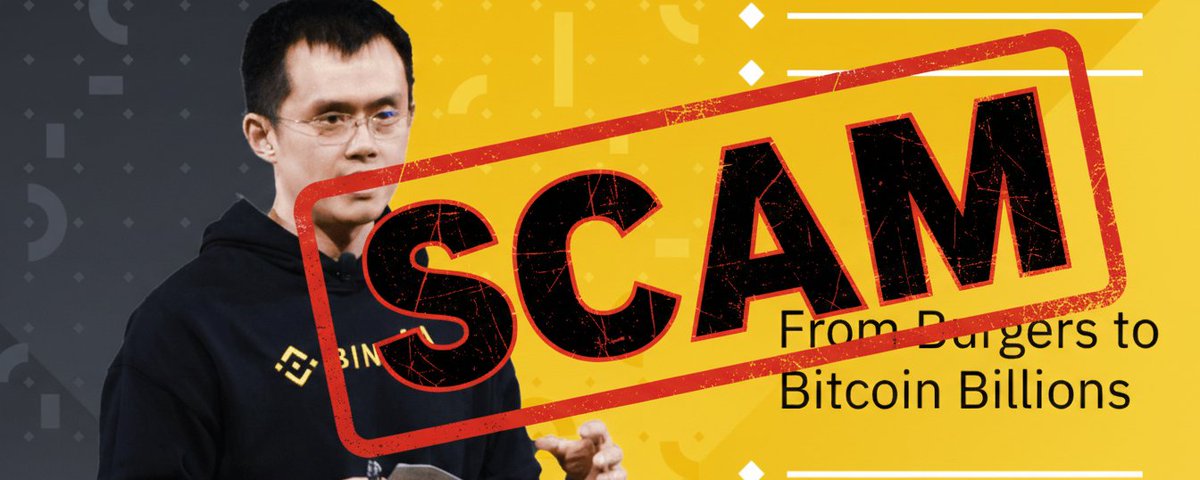
A reminder that @cz_binance is the biggest scammer in crypto history and has extracted billions from the trenches through market manipulation and insider trading
He should be broke and in jail not the 23rd richest person alive


G retweeted

Double top on the hairline. Bearish reversal loading. Still HODLing my hair tho... Ahh, CZ ah...


G retweeted
X NEWS: CZ Faces Backlash Over Buy-and-Hold Advice Amid Bitcoin Dip
In other news, average asset performance on @binance since @cz_binance was released from prison is -80%
"Supercycle" "buy & hold" yada yada


This post is from a suspended account. Learn more