

Yazılım, Sinirbilim, Felsefe. MorfaGEN (@morfagenlm) Kurucu Ortağı
Ankara, Türkiye
Joined December 2022
- Tweets773
- Following872
- Followers891
- Likes29.5K







Pinned Tweet
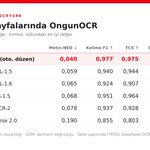
OngunOCR yayında! 🇹🇷
0.9B parametreli OCR modelimizi; basılı metin, gazete, sunum, el yazısı, fiş ve faturadan oluşan 300 bin etiketli veriyle (%99,5 gerçek) eğittik, Layout/NoLayout otomasyonu ekledik.
Sonuç: OCRTurk ve Türkçe Sentetik Benchmark'ta 1. olduk 🏆👇


Esra Sağlam retweeted

Want to fine-tune Gemma 4 on your own data, audio, receipts, or reasoning tasks?
Our new fine-tuning hub is live on gemma.ai: 17 guides and 40+ illustrations covering the entire training pipeline. Ranging from continued pre-training and custom chat templates, all the way to (Q)LoRA and GRPO.
Türkçenin sondan eklemeli ve düzenli yapısı dilin matematiğe aktarılıp yapay zekada başarılı sonuç elde etmesini sağlar gibi hissettiriyor ama gerçekler öyle değil. İngilizce için yaratılmış yapay zeka düzeni işimizi zorlaştırıyor. İzleyelim 👇

Esra Sağlam retweeted

Inkling 2 mini is now free to train and sample on Tinker!
Get creative!
just put in a credit card and add a non-zero balance, for us to prevent fraud.

To celebrate the Inkling 2 Mini release, all Tinker users with a positive balance can now train and sample on Inkling 2 Mini for free (subject to rate limits).
We want to make model customization more accessible to everyone. Have fun!
thinkingmachines.ai/tinker/p…

Esra Sağlam retweeted

Introducing Drex for Extraction, a model that returns the exact location of every answer in your documents.
Each result comes with its text span or page coordinates, so you can check it.
84.1 on ExtractBench. 81.5 avg on six public text datasets.
Try: console.nace.ai
Esra Sağlam retweeted

Today we're releasing OCRia-nano-1, the smallest model in the OCRia family. 8.1M parameters, open weights on Hugging Face 🦙
It reads text, reconstructs tables and recovers page layout, all on your own CPU.
→ 426 ms per page on a single CPU core
→ 27.8 pages per second with 16 CPU workers
→ Beat every local CPU parser we tested, on all five quality benchmarks
Install LiteParse, download Nano and put it to work on your document backlog. Weights and blog below 👇
Esra Sağlam retweeted
all our agents at langchain (internal GTM & content agents, LangSmith Engine) have a learning loop with similar pieces
wrote about what we think makes up a "knowledge factory"

Esra Sağlam retweeted

Run UNCENSORED Inkling 2 Mini (26.4B) locally on a 12 GB laptop 🔥
Refusals dropped from 100% to 0% in our test and kept 98% of its original accuracy on MMLU
We released 3 GGUFs from 8.67 to 16.53 GB
Get quants here 👇
huggingface.co/AtomicChat/In…

Esra Sağlam retweeted

You can run the q3 quant at 17 tokens per sec with 18k context on 8 GB VRAM + 16 GB RAM machines. llama.cpp flags included.
xitter.cf/analogalok/status/2124…

@thinkymachines's Inkling 2 Mini (26.4B looped MoE) on a single 8GB VRAM NVIDIA RTX 4060. llama.cpp flags + benchmarks included. let's run it.
17.11 tok/s decode. 101 tok/s prefill. at 10,000 tokens of context. on 8GB VRAM + 16GB DDR4.
and here's the crazy part:
dropping context from 24k -> 18k gave me a 2.3x speedup on the exact same 10k token summarization prompt.
- --ctx-size 24000 -> 44.30 tok/s prefill - 7.43 tok/s decode
- --ctx-size 18000 -> 101.09 tok/s prefill - 17.11 tok/s decode
even wilder: decode on a 1 line prompt was 17 tok/s. at 10k tokens of context? still 17.11 tok/s. virtually zero slowdown.
## important (which llama.cpp to use):
don't run Unsloth's GGUFs on mainline llama.cpp yet. mainline merged base support (PR #32694, builds b12600+) for ggml-org's GGUFs, but Unsloth's root quants won't work properly until PR #32704 merges . use Unsloth's llama.cpp prebuilt or Unsloth Desktop for now. Unsloth's llama.cpp also has early decode optimizations + DSpark support. Check replies for guide
## copy these exact flags (13.6GB Unsloth quant):
llama-server -m Inkling-2-Mini-UD-Q3_K_XL.gguf \
--jinja --ctx-size 18000 --parallel 1 \
--cache-type-k q8_0 --cache-type-v q8_0 \
--temp 1.0 --top-p 1.0 --top-k 0 --min-p 0.0 \
-ub 256 --n-cpu-moe 12 --verbose
-> --n-cpu-moe 12 is the sweet spot for 8GB VRAM (RTX 4060, 3060 Ti, 3070, 2080). keeps the core + KV cache hot in VRAM and spills only 12 MoE expert layers to system RAM. Use UD-Q4_K_XL quant if you have over 16 GB system RAM.
-> drop --n-cpu-moe on 16–24GB cards (RTX 4090, 3090, 4080, 5060 Ti 16GB) to fly fully in VRAM and use the UD-Q4_K_XL quant.
## quant accuracy check:
UD-Q3_K_XL (13.6GB) hits 96.3% top token agreement (0.0174 KLD) vs full precision (UD-Q8_K_XL, native NVFP4/MXFP8), barely behind the recommended 17.6GB UD-Q4_K_XL (98.0% / 0.0107 KLD) while saving 4GB.
how it stacks up on the same 8GB card:
- Inkling 2 Mini (UD-Q3_K_XL): 17.1 tok/s · 20 on Artificial Analysis Intelligence Index v5.0 · 79.2% SWE-bench Verified
- Qwen 3.8 27B Dense (Q4_K_XS, no vision): ~5 tok/s · 20 on AA Index ·
- Gemma 4 26B A4B (MoE): similar ~26B / 3.8B active footprint, super fast locally. will compare with this model
3.4x faster than Qwen 3.8 27B dense on an 8GB card for the exact same AA intelligence score. wild week for GPU poor local AI.
Unsloth GGUF + run guide + llama.cpp build + my older Gemma 4 MTP flags → replies
test these flags on your rig and drop your --n-cpu-moe + tok/s numbers below. curious how fast this goes on 12GB/16GB cards and Apple Silicon.
Esra Sağlam retweeted

Building a knowledge graph from raw text shouldn't require committing to one database. SelfGraph is a new Python framework for extracting, versioning, and querying connected knowledge across different graph backends. Early-stage, but worth testing.
github.com/hydra-db/selfgrap…

Dökümandan dijitale veri aktarmaya devam ediyoruz. MorfaGEN olarak 333.245 sayfayı ürünümüz OngunOCR ile dijitalleştirdik. Herkes kullanabilsin diye de Hugging Face üzerinden paylaştık.

Her gün gece 01.00'da güncellenen dataset linkleri :
PDF: huggingface.co/datasets/morf…
Günlük MD: huggingface.co/datasets/morf…
Toplu MD Jsonl: huggingface.co/datasets/morf…


Esra Sağlam retweeted

Build an open-source autonomous agent harness, pair it with one of 8 Google-sponsored foundation models, and tackle Physical-Engineering's Last Exam (PLE), a benchmark of 85 expert-reviewed, long-horizon tasks across structural, civil, electrical and mechanical engineering.
Join the Agent Harness on Physical-Engineering's Last Exam competition, hosted by @Google!
💰 Prize Pool: $400,000
⏰ Entry Deadline: January 5th, 2027
Esra Sağlam retweeted

Introducing Gemini Decision 1, our new frontier decision model in the Gemini API.
It is $0.10 per 1M input tokens with no additional cost. With support for image, audio, video, and PDF natively, 256K context window, & 1K questions.
You can try it for free in the API!

Esra Sağlam retweeted

Bir Yuk Hui kitabı daha geldi 🥳
Kant Makinesi - Yapay Zekâ Sonrası Eleştirel Felsefe
Arka kapaktan:
Yuk Hui bu kitapta Kant’ı Turing’den derin öğrenmeye uzanan bir çizgiyle yan yana okuyarak eleştirel felsefeyi üretken yapay zekâ çağına taşıyor. Kitap Kant’ın ünlü üç sorusunu insandan makineye aktarıyor: Neye akıllı makine denebilir? Makineler ahlaklı olabilir mi? Ebedî barışın bir algoritması var mı? Kant’taki “İnsan nedir?” sorusunun yerini de “Makine nedir?” alıyor. Okur bu yolda ChatGPT gibi sistemlerin aslında ne yaptığına dair bir çözümlemeyle ve Turing testinin ardından bir Kant testiyle karşılaşıyor. Kant’ın Ebedî Barış’ı ise uluslararası ticarete dayanan bir barış algoritması olarak yeniden okunuyor. Akademik ayrıntıları dipnotlara bırakan kitap, felsefecilerin yanı sıra mühendislere ve meraklı okurlara da sesleniyor.
Hui’ye göre bugünkü tartışmalar Kant’ın eleştirel felsefesini doğuran çekişmeyi yineliyor. Kurallarla işleyen erken dönem yapay zekâ akılcılığın Kartezyen makinesinin, verilerle beslenen makine öğrenmesi de deneyciliğin Humecu makinesinin mirasçısıdır. Kant’ta ise zekâ ne kural uygulamaktır ne de deneyim biriktirmek. Transandantaldır ve bir canlı gibi gelişir. Kant’ın “saf aklın epigenezi” dediği bu süreçte akıl kendi sınırlarını tanıyarak genişler. Bu zekânın modeli Yargı Gücünün Eleştirisi’ndeki düşünümsel yargıdır, yani hazır bir kurala dayanmadan, kendi sonuçlarına dönerek genel olanı arayan bir işleyiş. Paradoks burada başlar: Geri besleme döngüleriyle çalışan sibernetik makineler bu işleyişi taklit edebilir, Kant’ın makinesel olmayan düşünmesi böylece bir “mekano-organikçilikte” özümsenebilir. Ne var ki ahlak hesaba gelmez. Kategorik buyruğu algoritmaya dökmeye çalışan bir makine sonsuz bir döngüye takılıp kalır. Görev makinelerin ahlaklı olup olamayacağını kanıtlamak değil, onları insanın yapay organları olarak ele alan bir “ahlak organolojisi” geliştirmektir. Barış da her şeyi yöneten bir süper zekâdan değil, çatışmaları karşılıklılık ve topluluk üzerinden düzenleyen bir algoritmadan beklenebilir. Çatışmalar zorunludur, ama savaşlar kaçınılmaz değildir. Kant makinesi aynı anda hem modası geçmiş hem de günceldir: Bugünün makineleri onun dayandığı zemini sarsmıştır, ama o da bu makinelerin sınırlarını önceden görmüştür.
Kant Makinesi Yapay Zeka Sonrası Eleştirel Felsefe | Kitapyurdu kitapyurdu.com/kitap/kant-ma…

Esra Sağlam retweeted

Local AI 301: Quantization xitter.cf/i/broadcasts/2rJXOgajp…
