

biology: embryology, neuroscience, evolution, anthropology
Oakland, CA
Joined March 2018
- Tweets275
- Following897
- Followers249
- Likes2.8K





Pinned Tweet
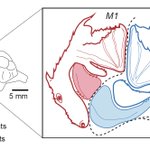
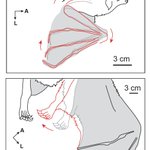
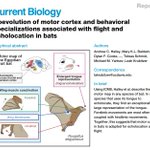
Ever wondered how motor cortex is organized in a bat? Hot off the digital press, the first full map of motor cortex in a species of bat, published today in @CurrentBiology. We found evidence that bat motor maps are organized to support flight and echolocation. 🦇🧠

Andrew C. Halley retweeted

My paper on motor cortex during free flight in bats is online. The dynamics look quite different from the usual picture. Maybe because flight is a hard control problem: hand-like wings, many degrees of freedom, millisecond precision.
cell.com/cell/fulltext/S0092…

Andrew C. Halley retweeted

🧬 Evolution meets neuroscience at #SfN25!
Learn how multi-omics approaches are revealing how evolution acts on cell types, underpinning neural circuitry and behavior changes across diverse species.
📅 Tues., 11/18, 9:30am–12:00pm
📍 Rm 6CF
📲 abstractsonline.com/pp8/#!/2…

Andrew C. Halley retweeted

An evolutionary view of the nervous system
[by Paul Cisek, via @andpru]
link.springer.com/article/10…

Andrew C. Halley retweeted

Yes.
Writing is not a second thing that happens after thinking. The act of writing is an act of thinking. Writing *is* thinking.
Students, academics, and anyone else who outsources their writing to LLMs will find their screens full of words and their minds emptied of thought.

Andrew C. Halley retweeted

Deep learning provides new view on 300 million years of brain evolution phys.org/news/2025-02-deep-v…

Andrew C. Halley retweeted

Interested in complex systems, brain evo-devo, and/or computational approaches to big questions in neuroscience? Check out new opportunities in our lab! 🧠🧬💻🦘🔬🏝️🏄♀️😍 Further details and deadlines will be announced soon! #PhD #Postdoc #NeuroJobs

Andrew C. Halley retweeted

Why is human brain development, and particularly neuron morphogenesis, so slow and how is this linked to evolution? doi.org/10.1101/2024.12.28.6…
We developed mouse brain organoid methods capturing differences to human and used these to address this. doi.org/10.1101/2024.12.21.6…
🧵 (1/n)
Comparative neuroscience is taking off, glad to see the larger community realizing the potential. Bring it to the @JBJohnstonClub, all the incredible scientists who studied weird brains before it was cool. thetransmitter.org/animal-mo…

Lovely writeup of @cj_charvet and colleagues' work on the Translating Time project, which I've used extensively in my own research, and which I absolutely love. nature.com/articles/d41586-0…

Andrew C. Halley retweeted

Curious about human brain development through an animal model? 🧠🐒Check out our new preprint on Brain Charts of the Rhesus Macaque Lifespan! We've mapped normative trajectories for macaque brains using 1.5k MRI scans from PRIME-DE and collaborators! biorxiv.org/content/10.1101/…

A tribute to the great Harvey Karten, an absolute giant in comparative neurobiology thetransmitter.org/neuroanat…

Andrew C. Halley retweeted

🧠 Comparing 3D images of living brains reveals limitations of using skull moulds to glean historic capacity for language and learning
Read more: 👇🏻
go.nature.com/3SyALWQ
#NatureAfrica
@JournalofAnat @abalzeau @BeaudetAmelie
Andrew C. Halley retweeted

👀👀@jonas_o_wolff invited me to join him in writing a dispatch on the beautiful work on eye evolution in spiders🕷️by @KaylinChong, @Lauren_hSR and co-authors recently published in @CurrentBiology. This was a total pleasure to write!👀👀
doi.org/10.1016/j.cub.2024.0…


Very excited to share my first paper is out! 🎉 We explore the evolution of the multiple eye pairs in spiders🕷️(cell.com/current-biology/ful…)
Couldn’t have done it without to the mentorship of the brilliant @Lauren_hSR!

Andrew C. Halley retweeted

Why are human brains so big and slow (to develop)? Illuminating to work with the brilliant @feline_lindhout @mad_lancaster and Katie Pollard on this perspective on cellular and molecular mechanisms of specializations in human brain development (1/7)
nature.com/articles/s41593-0…

Embryology of the fat-tailed dunnart, with lots of comparisons to eutherians, evidence for forelimb heterochrony similar to other marsupials. Very cool.

Our paper on the embryology of the dunnart is now up! Stunning images of these amazing little animals, helping marsupial conservation efforts!!
doi.org/10.1002/dvdy.711
@AxelHNewton @itiscolossal @BioSci_UniMelb @Jendometrium

Really amazing lineup of speakers on brain evolution, including @cj_charvet!

Join us at the @LakeConferences on Comparative and Evolutionary Neurobiology in Seattle, October 20-24, for #neuroscience discussions on conserved and species-specialized cellular and circuit makeup in the brain across mammalian species.
Apply by June 21 alleninstitute.org/events/la…

Andrew C. Halley retweeted

Fascinating timelapse of an alpine newt (Ichthyosaura alpestris) growing from a single cell, into a complete, complex living organism over three weeks.
📽: Jan van Ijken
Andrew C. Halley retweeted

🚨REVIEW ALERT!🚨 As the winner of best oral communication in #ECCN10 , @NeuroKarger let us publish a “bit opinionated” review about the existence of a phylotypic brain across vertebrates! 🦎🐁🐤 It has been a great journey! @PhyloBrain @NeuroKarger karger.com/bbe/article-abstr…

Andrew C. Halley retweeted

How did we lose our tail? A simple question.. but it wasn't really asked before! We discovered a plausible scenario for the genetic mechanism that led to tail loss. Amazing that such a big change may have been caused by such a small genetic event. nature.com/articles/s41586-0… @BoXia7

Andrew C. Halley retweeted

Reminded of this Richard Lewontin essay from 'Biology Under the Influence'

