

Prof @HWUEconomics , interested in #econhist, #landreform, #microfinance, #sustainabledevelopment, #health, #nufc & #Seinfeld (not necessarily in that order)
Edinburgh, Scotland
Joined September 2012
- Tweets2.2K
- Following1.1K
- Followers1K
- Likes8.6K




Pinned Tweet
After several years of research and writing, today I finally got to hold the first copy of "The Inclusive Wealth of Nations".
Grateful to everyone who helped shape the book along the way.


Here's a short piece I wrote for RTÉ comparing the geopolitical significance of the Strait of Hormuz in 2026 with the Suez Crisis of 1956. Just as Suez marked a turning point in Britain's position as a global power, could Hormuz represent a similar inflection point today?


It's framed around relative decline and superpower politics. It's based on an article I wrote about the Suez published in Contemporary Social Science (tandfonline.com/doi/full/10.…)

eoinaldo retweeted

What history tells us about the closure of vital waterways. Disputes over the Suez Canal in 1956 and the Strait of Hormuz 60 years later show geopolitical power is often no match for economic power, writes @eoinaldo @HWUEconomics @Researchirel rte.ie/brainstorm/2026/1015/…
eoinaldo retweeted

Congratulations to Panmure House Fellow Professor Eoin McLaughlin on the launch of his new book, "The Inclusive Wealth of Nations: Prosperity, Sustainability, and the Future of Economic Progress".
Professor McLaughlin was joined by @ProfGraemeRoy, Vice Principal and Head of the College of Social Sciences at the University of Glasgow, for a fireside chat attended by a sold-out audience.
The evening concluded with an engaging Q&A session, giving audience members the opportunity to explore the book's ideas and implications in greater depth.
To learn more about The Inclusive Wealth of Nations or purchase a copy, visit: bloomsbury.com/uk/inclusive-…

My comment on intergenerational justice was published in Nature yesterday, drawing on some of the ideas in my recent book, The Inclusive Wealth of Nations.


Governments should invest to develop all types of capital to improve the lives of future citizens and to protect the planet
go.nature.com/4yo5urM

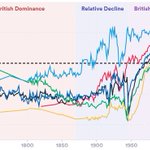
Short piece on Britain’s long relative decline


NEW on the Economics Observatory – The British disease: what explains the relative decline of the UK economy?
by Eoin McLaughlin (@eoinaldo) and Graham Brownlow (@GrahamBrownlow)
buff.ly/t88duAj

Economics at the Fringe!
I’ll be at the Library of Mistakes this Wednesday, talking about The Inclusive Wealth of Nations with @EconomyofHope
If you’re in Edinburgh, come along 👇


Available at Bloomsbury bloomsbury.com/uk/inclusive-…
Amazon: amazon.co.uk/Inclusive-Wealt…
Waterstones: waterstones.com/book/the-inc…
Barnes & Nobel: barnesandnoble.com/w/the-inc…
Target: target.com/p/the-inclusive-w…

The Thatcher government also had highest unemployment of post war UK
Governments.
And Britain still experienced relative decline under Thatcher. Britain wasted its oil boom and never set up a sovereign wealth fund.
open.substack.com/pub/eoinal…


Andy Burnham is effectively the UK’s Prime Minister-elect and he wants 'growth in every postcode'. The problem is that UK growth has been slowing for decades, regardless of which party is in power. Restarting growth in the UK will require a radical rethink.


Essay here: “Which Government Grew Britain the Fastest?” The answer matters less than Britain’s long-run failure to keep pace with comparable economies: open.substack.com/pub/eoinal…
eoinaldo retweeted
How loan funds helped Ireland deal with effects of Industrial Revolution. By the 1840s, Ireland had one of the densest networks of microfinance institutions in the world to help people adapt to economic change, writes @eoinaldo @HWUEconomics @Researchirel rte.ie/brainstorm/2026/0626/…

This week a group of economists and degrowth advocates argued in the Guardian that economic growth is a "doomed strategy". The piece is a good example of what I call advocacy bias: selecting evidence that supports a preferred policy while overlooking contrary evidence. (1/7)

My argument is that The Limits to Growth survived because it stopped being judged primarily as a forecasting model and became something more powerful: a moral narrative about limits, overshoot, and ecological constraint. (6/7)
I explore that history and what it can teach us about advocacy bias in public discourse in my latest essay: open.substack.com/pub/eoinal… (7/7)