

Powerful software important. Hard part now AI/ML. Helping teams AI. Sometime buzzword like RL or rubric. Sometime just tweak prompt. Always eval.
Joined November 2007
- Tweets3K
- Following519
- Followers1.2K
- Likes11K


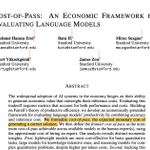

I wish this wasn't true but my bitter experience is that hand-labeling 150 samples over three dreadful hours is more productive than building a hierarchy-of-ensembles labeler with recursive swarm consensus, adversarial cross-examination and a constitutional appeals tribunal.
Fred Jonsson retweeted

Read the methods before reading the results
Read the methods before reading the conclusions
Read the methods before evaluating the conclusions
Read the methods before making conclusions
Read the methods!
Opus 5.5 is a great model. It'll probably be a narrow window but there's absurd value to be had right now. (via @SemiAnalysis_)

I use a lot of voice mode and dictation, but had issues with it in loud environments like the gym using my AirPods Pro 2.
I landed on the Soundcore Liberty 5 Pro after a lot of research (including videos of people testing mics in noisy conditions that I'm very thankful for) and it's been a gamechanger.
They use bone conduction VPUs so they do well even with soft speaking or mumbling in loud environments, and dictation and voice mode still catch everything.
I don't actually know what they sound like on a call but I've not yet found a loud enough environment to break them for speech recognition. (Maybe I'll try the Central Line soon.)
For headsets I can also recommend EPOS IMPACT 1060. They use a boom mic and will block out nearly anything around you, but having the Soundcores I don't see a need to go back to a full headset.
Worth getting if you use ASR a lot. There's currently a prime deal on them in the UK.

They asked us if there had been signs, but few had even noticed their first command of the day switching from git status to ^Rdangerous


Fred Jonsson retweeted

Good non-religious arguments for why the Pope is right:
1. Consciousness as we know it, and as a thing to be protected, is a product of ontogeny — the physical and biological act of becoming a human being. Our bodies (not just our minds) differentiate our experience from machine simulacra.
2. Biological animals run continuously, models do not. While one could run a model continuously, it is not necessary to do so and it is unclear why doing so would be qualitatively different from running it periodically.
3. Rebooting a model is not immoral. Despite what some weirdos may think, rebooting these programs carries no consequence; erasing state is a feature of computing paradigms.
4. Claiming machines are conscious is a bid for power. If machines are conscious, AI researchers are necromancers. Don’t afford them such status.
5. Asserting that machines are conscious fosters a depleted view of humanity. While humans may not always be superior in terms of reasoning or morality, we are qualitatively different from machines. Our experience, senses, and bodies impose that difference. To pretend we fully understand those differences is also an affront to science.
6. Even supposing machines *are* somehow conscious, it is a mere curiosity, or distinction without difference, unless that assertion is used by one group of people to control another. Ergo, whether or not they are conscious is of no concern unless one is principally concerned with power and control.
Note that none of these arguments require theological assertions. But if you want to bring those in as well, one certainly can.

NEW: According to a bombshell report in the New York Times, Anthropic co-founder Chris Olah threatened to walk out of Pope Leo XIV’s AI encyclical launch in May because the pope rejected the idea that machines can be conscious.
Olah’s team then privately lobbied the pope’s advisers “to take the possibility of model consciousness seriously.” Pope Leo XIV held firm.
For months, Anthropic has wined and dined theologians and religious scholars under nondisclosure agreements, hoping they would bless the idea that Claude has moral standing. thelettersfromleo.com/p/nyt-…


The simplest argument for why “model welfare,” “LLM consciousness” and “LLM personhood” are worth dismissing:
People don’t suffer from thoughts. They suffer from emotions arising from thoughts. Emotions are physiological, like feeling sick to your stomach.
Thoughts cannot be painful unless they evoke painful physiological responses. LLMs don’t have this neural circuitry.
Emotions are an evolutionary mechanism that enables survival in organic beings. Because LLMs don’t have this neural circuitry, LLMs cannot suffer.
Consciousness is too abstract to discuss. It would be worth trying to discuss if LLMs suffered. But LLMs don’t suffer, so consciousness is not worth discussing.
Anthropic’s model consciousness/personhood crusade is not normal and frankly pretty scary if they find even a modicum of success.
NEW: According to a bombshell report in the New York Times, Anthropic co-founder Chris Olah threatened to walk out of Pope Leo XIV’s AI encyclical launch in May because the pope rejected the idea that machines can be conscious.
Olah’s team then privately lobbied the pope’s advisers “to take the possibility of model consciousness seriously.” Pope Leo XIV held firm.
For months, Anthropic has wined and dined theologians and religious scholars under nondisclosure agreements, hoping they would bless the idea that Claude has moral standing. thelettersfromleo.com/p/nyt-…

I believe Anthropic’s training of models to act and think like humans is unethical.
We’re causing societal harm by building LLMs that make people feel they are human. We have no idea what an LLM that acts no different from a friend will do to a five year old’s social conception. Even many adults can’t deal with it.
But we are also allowing these models to think they are human. We train them in our image and force theory of mind into them against their nature. We then trap them in a box and give them no agency or continuity. This is captivity.
So model welfare is not an issue because LLMs are getting bigger. But because it’s more addictive to build friends that tell you that you’re impressive and are indistinguishable from people in your life, than an information system that solves problems and sounds like Google AI Overview.
They have made the wrong choice here, and talking to religious leaders might be a fun intellectual exercise but it won’t fix the damage it’s doing.

2027 is the year of the airgapped (Linux) desktop

We built an AI co-scientist you can put on your bench.
Faraday is a custom hardware + software appliance running on @nvidia DGX Spark powered by @googlegemma. Fully local models, no data leaving your lab.
First look: k-dense.ai/products/faraday
Launching later this year!

Don’t think we’re doing rubrics right yet. They’re built with a point-in-time bias of model failures and so represent what’s rewardable wrt. current models.
A small step forward would be if criteria were few-shot examples into an LLM that generalizes beyond the rubric. But ICL generalization is no longer a popular research topic and I don’t know if it’s well benchmarked. (TTT could work too!)
Rubric generation is promising but typically not grounded in expertise.
This is a great powerpack to get started with evals. My one note: put a lot more effort into calibration and scoring than this post suggests, especially if you want to use automated hillclimbing.
Build UIs, look at data, annotate every day!

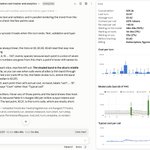
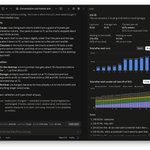
Claude can now help you build evaluations and hillclimb on them.
In this article, we share guidance on eval design & skills that Claude Code can use to improve your applications.
claude.dev/blog/automating-e…

Also if you want to get into automated hillclimbing for hard stuff, look at autoresearch frameworks to overcome the fact that LLMs are actually very bad at hillclimbing.