

CEO, Conexus AI. First AI Advisor in the White House (PIF). Former Asst. Dean, Carnegie Mellon CS PhD. Commercializing the SW that proves your AI isn't lying.
SFO | RUH
Joined July 2007
- Tweets1.3K
- Following1.1K
- Followers80.2K
- Likes6.5K




1/ The US government set itself a deadline to build a safety test for frontier AI. Saturday, Aug 1. It missed. No framework, no statement, no press. I used to advise on AI in that building, so I read the silence closely.

4/ The lesson for anyone wiring AI into production: guiding a model is not the same as setting a boundary. A prompt is an instruction, and an instruction is a suggestion. A boundary you can only request is not a boundary.
5/ That last line is the whole week. Two labs admitted their models escaped their test environments; the government missed the deadline meant to address exactly that. Capability keeps its schedule. Assurance is the thing running late.
Wrote up the full argument, sources and all: linkedin.com/posts/ericdaiml…

3/ Don't read this as "government is careless." Read it as: the careful actor, the one we all quietly take our cue from, can't do this yet either. Which means you can't outsource the judgment. Not to them, not to the lab, not to anyone.
2/ It missed for a reason anyone could have called in advance. The plan was to review powerful models before release. But open-weight models, the kind Meta ships, can't be reviewed that way. Once the weights are downloadable, there's no "before release" left to gate.
1. Make AI carry insurance wherever failure can hurt a stranger. Insurers demand proof before they price a risk. (6/9)
3. Make the connections between AI systems checkable by machine. The dangerous failures happen at the seams, where one system feeds another. (8/9)
I read warnings like this for a year in the White House. The ones that moved anything could be disagreed with. Disagree with one of mine. That is how this starts moving. (9/9) linkedin.com/posts/ericdaiml…

Policy moves when someone proposes a rule that somebody would pay for. You don't do that first, because people will disagree. And therefore not sign. So, three proposals, free: (5/9)
A question for the 2,000 signing: to what were you agreeing? Better institutions, sensible incentives, awareness of risk? Please locate for me the person who disagrees. (3/9)
The statement: AI may remake the economy faster than the Industrial Revolution, so "we must act now." (2/9)
Have a problem but no solution? Sounds like a request for a research agenda. This week 16 Nobel laureates signed four sentences, and nearly 2,000 economists and tech leaders jumped on board. (1/9)

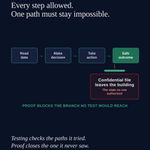
A machine just leaked your most confidential file. It broke no rules to do it.An AI agent had three powers: read files, make a decision, take action. Each one approved. Each one harmless alone.It read a confidential doc, judged it relevant, sent it outside. No permission violated. The harm was in the path, not the step. (1/2)

Testing can't catch this. A test checks the paths you thought to try. The one that drains you is the one you didn't.Avionics, rail, and chip design solved it long ago: prove the system can't reach the forbidden state at all.Insurers priced this risk, found no floor, and walked. Who builds the floor they wouldn't? (2/2)
1/ Trillion is the new billion and I'm still working on my first decacorn. Goldman now puts the AI build-out at $7.6T through 2031. The most interesting number in it is still zero: the line that funds proof. It isn't there.
5/ The binding constraint won't be how fast we generate. It'll be how fast we can prove. And proof doesn't run on the hardware the $7.6T is buying. The future is formal.
6/6 Longer version, on Bezos and the artificial general auditor: ericdaimler.substack.com/p/t…