

Research Professor, into aquatic ecology and Mediterranean wetlands, including waterbirds, invasive species, and dispersal processes
- Tweets1.8K
- Following389
- Followers1.1K
- Likes1.2K







ALT Better out than in: faecal matrix inhibits establishment success after waterfowl endozoochory


ALT Endozoochory evidence (species or genus level) across different syndromes and classification systems. The heatmap represents the percentage of Surtsey colonisation records for which endozoochory evidence was present within a specific dispersal syndrome and classification system (EuDiS, Baseflor, SDDM). Darker blue shades indicate a higher proportion of records with endozoochory evidence, while lighter shades represent lower proportions. The LNSD+ row includes ‘Local non-specific’ for SDDM, ‘Unspecialised’ for EuDiS and ‘Barochorous’ for Baseflor. ‘No info’ refers to plant species not included in the respective syndrome classification.


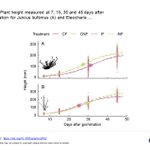
ALT Plant height measured at 7, 15, 30 and 45 days after germination for (a) J. bufonius and (b) E. palustris. Curves were obtained from the fitted logistic base functions (Table 1), and points represent measured height for individual plants. Treatments including faeces addition (CF, IF) are represented in pink and treatments including gut passage (IF, INF) with dashed lines. Asterisks represent mean xmid parameters for treatments grouped with faeces (pink) and without faeces (green). CF = control, faeces; CNF = control, no faeces; IF = ingested, faeces; INF = ingested, no faeces.


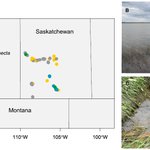
ALT a) Geographic distribution of examined lakes in Saskatchewan and anostracan taxa found in them; b) Bliss lake, one of the sites with Branchinecta; c) one small edge of Bliss lake with numerous Branchinecta swimming in the water (tiny white stripes).

ALT a) Branchinecta (blue) and Artemia franciscana (yellow) from the Saskatchewan region genetic distances measured as Kimura 2-parameter (K2P) distances in relation to spatial distance, based on the mitochondrial CO1 gene fragment. There was a significant distance decay in the assembled dataset (Mantel test; nperm=999; Branchinecta: r = 0.485, P < 0.001; A. franciscana: r = 0.149, P < 0.001). b) Mantel correlogram for genetic distance (Hellinger-transformed) and geographic distance (log-transformed) in Branchinecta and A. franciscana from the lakes we studied in Saskatchewan, Canada. The filled circles indicate significant correlation within each distance class

