Postdoc at MIT BCS, interested in language(s) and thought in humans and LMs

Joined March 2022
Andrea de Varda retweeted
New blog post! I wrote about why I think it's useful to use metaphorical (and anthropomorphic) terms to describe AI. I start by describing the role of metaphor in language and cognition, and how metaphors can help us to efficiently understand relations and make predictions 1/2
8
13
5
159
10,774
Andrea de Varda retweeted
Congrats to @devarda_a, named one of the 2026 #STATWunderkinds by @statnews! Andrea is doing groundbreaking work in @ev_fedorenko + @roger_p_levy labs to understand how brains and machines process language. Learn more: statnews.com/wunderkinds/and… @mitbrainandcog @ScienceMIT
3
11
949
Andrea de Varda retweeted
Why do neural networks become modular? Our paper is now out in Nature Machine Intelligence! @NaturePortfolio We show that multi-task learning promotes modularity under limited capacity and task demands help explain features of brain architecture in addition to the spatial constraints. Great thanks to all the co-authors. @WHYWYH007 @yifannnwu @DaniSBassett @marcelomattar rdcu.be/YJ12NBxvrHsa
8
56
5
247
11,081
Andrea de Varda retweeted
📄👀 Check out our new survey on Eye Tracking and NLP, where we reflect on past work in this space, and outline a roadmap for what's next. Not needless to say - it's fully human written. The humans are Lena Jäger, David Reich, Omer Shubi and me. zenodo.org/records/22933169
2
1
30
1,867
Andrea de Varda retweeted
📢 The CORE COGNITION lab (core-cognition.github.io) is looking to hire another PhD student, working on automated scientific discovery and knowledge representation in cognitive science. Starting date: March to September 2027. 🙏 Please share widely!
3
40
2
163
10,727
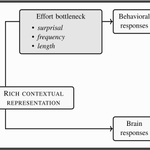
Go, @devarda_a! A beautiful and comprehensive study!🔑 finding: behav. measures are ~fully reducible to simple predictors of effort (surprisal, word length+frequency), but for 🧠 measures, LLM embeddings carry additional predictive power, likely capturing aspects of meaning.
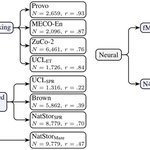
New preprint! 🧠👀🤖 Behavioral and brain responses to language reflect different levels of linguistic representation w/ @whylikethis_ , @ev_fedorenko , and @roger_p_levy (1/10)
1
9
52
3,672
Andrea de Varda retweeted
Wonderful work by @devarda_a linking behavioral and neural manifestations of language comprehension using language models. With @roger_p_levy and @ev_fedorenko
New preprint! 🧠👀🤖 Behavioral and brain responses to language reflect different levels of linguistic representation w/ @whylikethis_ , @ev_fedorenko , and @roger_p_levy (1/10)
2
13
828
Andrea de Varda retweeted
Since many are starting grad school soon, let me re-share my One Big Tip™️ for research! Research involves many skills - collaborating, writing, presenting, etc. But many of these skills can be unified under a single overarching ability: theory of mind Blog post link in reply
7
18
127
6,991
Andrea de Varda retweeted
New preprint, w/ @KarolinaADrozdz Understanding language requires internally modelling what's happening where, even when unstated We built a new task to measure this ability in language models and people, and find it emerges at model scales far smaller than previously thought
5
22
1
86
5,196
Andrea de Varda retweeted
New paper out! 🎉 Can preverbal logical inferences scaffold the early acquisition of logical words? We asked this question with Mahham Fayyaz, Grace Pavalko and Nicolò Cesana-Arlotti, focusing on disjunction: escholarship.org/uc/item/3pf….
2
1
10
322
Andrea de Varda retweeted
Now out in @NatureComms w/ @ev_fedorenko: across many people (>1k) and tasks (>300), the the brain's language network reliably shows up in the functional connectome (correlated activity in fMRI). 1/
3
33
1
120
8,662
Andrea de Varda retweeted
🎉 Thrilled that our #CogSci2026 paper won the @cogsci_soc best paper award in computational modeling of language! 📄 "On convexity and efficiency in semantic systems" 🔗 infocoglab.github.io/convexi… 1/3
2
14
79
4,239
Andrea de Varda retweeted
First up in the Glushko Dissertation Prize Symposium: Andrea de Varda @devarda_a examines what multilingual neural language models can reveal about language and cognition. #CogSci2026
8
43
2,126
Andrea de Varda retweeted
McGovern neuroscientists have discovered that you don't need language to think logically. People with severe language impairments solve complex reasoning puzzles perfectly and brain scans show language areas remain silent during logical reasoning. mcgovern.mit.edu/2026/07/06/…
11
95
14
298
36,420
Andrea de Varda retweeted
Replying to @DKryvosheieva
@DKryvosheieva is presenting our work on syntactic agreement in LLMs--across diverse agreement phenomena and across 57 languages--at #ACL2026 tomorrow! July 6, 9.10am PST, Oral Session D @aclmeeting
How do LLMs process syntax? Do different syntactic phenomena recruit the same model units, or do they recruit distinct model components? And do different languages rely on similar units to process the same syntactic phenomenon? Check out our new preprint (to appear at ACL 2026)!
1
18
1,036
I am so excited about this finding from @pengrui_han and @devarda_a, also with @jacobandreas! Perhaps modularity is inevitable in intelligent systems, biological or in silico. :)
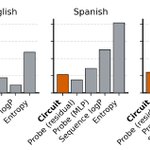
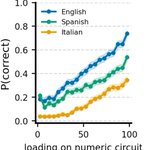
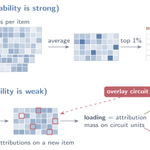
The human brain is strikingly modular, with distinct networks for language, formal reasoning, social reasoning, and physical reasoning. Is this a fundamental principle of how intelligent systems are built, or an accident of biological evolution? In our latest preprint, we find that a similar modular organization emerges in Large Language Models, another class of intelligent system. Brains and LLMs are shaped by entirely different kinds of optimization (biological evolution vs. gradient descent). That they arrive at the same modular design anyway suggests modularity may be a fundamental property of intelligent systems. 🌐 Web: pengrui-han.github.io/LLM_Mo… 📄 Paper: pengrui-han.github.io/LLM_Mo… 💻 Code & data: github.com/Pengrui-Han/LLM_M… Using circuit analyses across 46 tasks spanning four cognitive domains, we find: 1️⃣ Tasks that draw on the same network in humans recruit overlapping units in LLMs, while tasks drawing on different networks recruit distinct units. 2️⃣ These units are causally linked to model behavior. Ablating the units critical for one domain impairs performance in that domain (−26% accuracy) but barely touches the others (−2.5%). This project has been in the works for a while :) Huge thanks to my advisors @jacobandreas @ev_fedorenko @devarda_a, and to @Nancy_Kanwisher for valuable conceptual input and feedback throughout. #MIT
6
25
1
214
30,878
Andrea de Varda retweeted
The human brain is strikingly modular, with distinct networks for language, formal reasoning, social reasoning, and physical reasoning. Is this a fundamental principle of how intelligent systems are built, or an accident of biological evolution? In our latest preprint, we find that a similar modular organization emerges in Large Language Models, another class of intelligent system. Brains and LLMs are shaped by entirely different kinds of optimization (biological evolution vs. gradient descent). That they arrive at the same modular design anyway suggests modularity may be a fundamental property of intelligent systems. 🌐 Web: pengrui-han.github.io/LLM_Mo… 📄 Paper: pengrui-han.github.io/LLM_Mo… 💻 Code & data: github.com/Pengrui-Han/LLM_M… Using circuit analyses across 46 tasks spanning four cognitive domains, we find: 1️⃣ Tasks that draw on the same network in humans recruit overlapping units in LLMs, while tasks drawing on different networks recruit distinct units. 2️⃣ These units are causally linked to model behavior. Ablating the units critical for one domain impairs performance in that domain (−26% accuracy) but barely touches the others (−2.5%). This project has been in the works for a while :) Huge thanks to my advisors @jacobandreas @ev_fedorenko @devarda_a, and to @Nancy_Kanwisher for valuable conceptual input and feedback throughout. #MIT
49
428
37
2,334
228,909
We know from behavioral studies that LLMs suffer from content effects, similarly to humans… but why? In our #ACL2026 paper (findings), we provide evidence that this may stem from how LLMs encode judgments of validity and plausibility.
2
1
14
599
Andrea de Varda retweeted
It is tricky to characterize the features represented by human language cortex. This work is a step toward doing so. Using small, interpretable feature sets, we explain language-network responses and show a shared feature basis across regions with variation across individuals.
This Post is from a suspended account. Learn more
11
69
7,159
Andrea de Varda retweeted
Excited to announce that I'll be starting my own lab in Tübingen this October! Hiring at all levels: Postdoc, PhD & RA. Want to work on computational cognitive science at scale? Apply: core-cognition.github.io/ Reposts and shares much appreciated 🙏
17
48
5
342
29,121