







I had the privilege of speaking on a panel with friends from @Visa , @meshpay , and @bitvavocom at the @Visa TZero event in Amsterdam last week. There were some spicy takes - but we all seemed to be on the same page - regulation is allowing Europe to move and the time is now!

devan retweeted

I encounter this type of thinking a lot: "X is just rent-seeking."
You should not try to think this way.
It's often more helpful to start from the place of asking: what if X is not rent-seeking, and is in fact a subtle equilibrium discovered by the market?
I don't think interchange is rent-seeking. I say this after a decade+ of being a stablecoin investor. If you don't understand what you're trying to disrupt, you have no shot of actually succeeding in disrupting it.
So zoom out. What is interchange and why does it exist?
When a consumer swipes a card, the merchant pays a fee. For US credit cards, it averages to a bit over 2%.
Of that Visa/MC take only about 0.15% in network fees. The lion's share, roughly 1.9%, is what's called interchange—it's the piece that the merchant pays to your issuer (that is, whoever gave you your card). Since that's ~80% of the fee, I'll use "interchange" loosely for the whole thing.
So when you buy something from some Shopify store you've never heard of on a credit card, by far the biggest payment is that merchant paying your card issuer 1.9% of your purchase.
What is your credit card issuer doing with that 1.9%? Well, they're rewarding you (more than half of it goes to rewards, this is a huge arena of competition), they're protecting you from fraud and settling disputes, and, of course, they're extending you credit. After all that, issuers are taking home in profit about 10% of their slice of interchange. (Note: Issuers make their real money on interest, not interchange.)
So why does interchange exist? Why do merchants agree to pay it? Is it "rent-seeking"?
The reason why merchants pay it is because without interchange, consumers would be much less willing to buy things.
1. Consumers like to buy items on credit. Don't think I need to explain this too much. The bundling of credit into the moment of payment with zero friction massively changes spending patterns compared to cash / stablecoins.
2. Chargebacks let consumers say "this merchant defrauded me." Visa default sides with the consumer, and steps in if there's a dispute to resolve. This is effectively a private legal system, collectively funded by merchants. But unlike normal law, Visa's law says the merchant is guilty until proven innocent. Turns out, this is great! Siding with the consumer is the optimal equilibrium to stimulate spending in a consumer economy.
This part is even bigger than it seems. Because chargebacks also allow small, untrusted merchants to compete with large ones. Consumers can now have confidence in trying out new vendors, because Visa's legal system is rigged the consumer's favor. Any whiff of a merchant behaving badly and they are punished. This allows new honest merchants to thrive. There's a sense in which big companies don't need this protection, because big companies already have public reputations. It's small mom and pop shops and startups that need this insurance, and the administration of this whole private legal system is paid for by interchange.
3. Theft protection: if your card gets stolen, there are fraud prevention algorithms that detect this and will generally make you whole on losses. If you were using cash or stablecoins and your wallet got stolen, that's obviously not happening. In a world proliferating with more hacks and scams and fraud, you can also think about this as a private police function.
4. Last and most obviously, cards are ubiquitous and international, so accepting cards and the interchange system gives you access to a gigantic network of consumers worldwide.
So merchants are charged a 2% tax (actually less because not all cards are credit, but simplifying) to make this whole scheme work. Of course, the economics of tax incidence says that if merchants are getting taxed, they'll raise their prices and pass the tax along. So merchants pay some of the tax, consumers pay some of the tax in the form of higher prices. And yes, the card networks get a cut for sitting in the middle.
But most of the system is actually about the transfer of risk between consumers and merchants. Interchange has persisted because it serves an important market function that would otherwise have to be filled some other way.
That said, do the card networks do anticompetitive stuff? Yes! The honor-all-cards rule, no-discount rules, anti-steering rules, collectively set rates, and more. They keep losing or settling antitrust cases because they are wily coyotes.
But the core of interchange is actually a market trust function. It's not likely to go away just because you invented a different clearing system. Yelling "rah rah stablecoins, boo rent-seeking" and expecting everything to change is only going to leave you confused at why that's not happening.
Stablecoins play a very important role in how money will move. They are massively more efficient than the correspondent banking system. That's part and parcel of Rain's edge over the incumbents.
But if you want to displace interchange, you have to rebuild the other stuff it does: a worldwide dispute system with a default consumer bias, fraud protection, and a consumer-side subsidy that makes people want to spend with your thing.
Stablecoins alone are only a single piece of that.

Great rebuttal from @Cdempsey44 from Rain that should be read. We likely agree on more than we disagree. Rains products clearly solve important problems, that’s why they are growing so much.
But I stand firmly on the belief that interchange is just rent seeking and will go away.
After almost 4 years at @AlgoFoundation, it's time to move on to a new challenge.
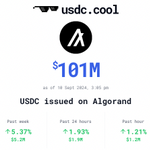
I'm extremely grateful and proud to have led efforts to enable stablecoin access on Algorand across @coinbase, @krakenfx , @binance and more - alongside many other initiatives over the years.
Huge thanks to @StaciW_DC, @mintwt , and @eric_ldn for their leadership and support throughout.
Staying in this space - excited to share what's next soon.
When do we think this will cross $1m? @alphaarcade?

Over $600,000 in volume across Algorand.
Our recent @AlgoFoundation integration on Allbridge enabled seamless two-way USDC transfers with other networks.
Multichain without barriers

Finally!
This has been extremely fun to work on with the amazing folks at @krakenfx
A top tier venue, with extensive fiat rails, supporting USDC on #Algorand


A real pleasure working with @Allbridge_io team to make this happen.
We're at ~$20k bridged right now, lets get that number up so we've got a proof point for @circle ;)
The @Allbridge_io Algorand integration is now live.
Users can now bridge USDC to Algorand from several chains, including Solana, Avalanche, Base, Ethereum, Sui, Stellar, and more.
Interoperability on Algorand is here 🤝
Learn more below.

This will allow native USDC bridging to & from supported chains. This is a big win for stablecoin accessibility on Algorand.
Algorand is integrating with @Allbridge_io to launch a dedicated stablecoin bridge in Q4 2025.
This will give users and developers seamless access to stablecoin liquidity across multiple blockchains, strengthening Algorand as a hub for on-chain finance.

devan retweeted

Algorand is integrating with @Allbridge_io to launch a dedicated stablecoin bridge in Q4 2025.
This will give users and developers seamless access to stablecoin liquidity across multiple blockchains, strengthening Algorand as a hub for on-chain finance.
devan retweeted

🚨 New Staking Asset!
🪙 $ALGO is NOW AVAILABLE for staking.
Earn up to 4% when you stake #ALGO on Uphold.
🌐 @AlgoFoundation is an L1 that ensures transaction finality within seconds, supports high transaction throughput, and maintains low transaction fees.
👇 Start Staking.
devan retweeted

This is why these wrapper models for tokenizing public stocks make no sense; they only introduce fragmentation of liquidity due to the non-fungible nature of all those wrappers with different counterparties and models involved. We should do native tokenization of the stock so there is only one token that represents the actual shares like we already do with @exodus
This quoted post is unavailable.


Algorand support coming to @wormhole NTT! This allows Algorand projects to launch multi-chain tokens, and for us to entice existing NTT projects to deploy on #Algorand.
This was much needed!
Shoutout to @sarahxmary who cut through the complexity to get this done.
Algorand is now natively multichain, through Wormhole NTT.
⚡️Powered by @wormhole.
🔨Built by @FolksFinance.

Part II of our partnership with @cryptocom. Again, a big shout out to @RayanKhalil who lead the charge on this important staking accessibility partnership!
Algorand staking is now live on @cryptocom.
Head to the @cryptocom app to begin your staking journey today.

One of only 10 assets enabled for this program!
So many users utilise @binance as their primary wallet (or bank account). This allows them to help secure the Algorand network without having to navigate to the 'Earn' program and actively commit.
Staking accessibility!
Algorand soft staking is now available on @binance.
Over 275 million Binance users can now soft stake ALGO with:
🟢 Full Flexibility
🟢 The ability to Withdraw or Trade anytime
🟢 Daily Rewards

There are two key 'pillars' for the @AlgoFoundation partnerships team in 2025 - to improve accessibility, and support strategic initiatives
We're always trying to utilise resources efficiently, balance opportunity costs, and balance between short-term and long-term wins. We're not perfect at it, but we're constantly improving.