

Animal animal: a weekly letter to you & the kid: https://xitter.cf/t.co/Uz1hbl7ir1 Writer\Book designer\Fulbright scholar\He/him. Kids’ book: https://xitter.cf/t.co/DjN3Yr2eRr
New Zealand
Joined October 2009
- Tweets6K
- Following2.1K
- Followers712
- Likes32.5K







Pinned Tweet
Hi. I started a newsletter called *Animal animal*.
It’s partly for the small kid in your life: animal limericks, facts, drawings--
--and partly for you: books, art, online treasures.
Pop by and read edition 001 here: tinyurl.com/2zumzwfz
I hope you’ll sign up!

On in a few hours and looks cool. In the same vein as Suzanne Simard's work maybe, where she makes the case that cooperation is a major driver in forests, based on her Mother Tree work. I am going to cut work and learn. I love Fridays.

[Tomorrow 10/22] In-person tickets are sold out, but you can still tune in via the livestream: na2.hubs.ly/H08v7Hr0
“On Interdependence” a conversation with @blaiseaguera and @baratunde on how AI symbiosis and Indigenous principles will shape our collective survival over the next 10,000 years.
More info here: na2.hubs.ly/H08v7Ht0

Deshan Tennekoon retweeted

Japan Rail has deployed two goats to take care of an overgrown lot near Yotsuya (famous for Yokai)
Two goats Nagi ♂and Pokke ♀will be “working” in the area until around December (or the grass runs out)
A college freshman who was interviewed says she’s been stopping by every day after class and feels healed by watching the one and two year-old goats munch on grass


Deshan Tennekoon retweeted

Insect feet mostly are a short chain of tarsal segments ending in claws. Some end in a single hook. Some carry paired claws, padded lobes, combs of spines, or dense fields of adhesive hairs. Same class of structure. Completely different solutions.
At this magnification the differences stop looking ornamental. The foot is where an insect meets the surface, and the surface is never one thing. Bark, leaf, flower, prey, soil, and the body of another insect each ask for a different grip. Claws lock into roughness. Pads and setae hold on smoothness. Spines brace, rake, or keep the leg from slipping sideways. A foot built for walking is not a foot built for holding, climbing, or seizing.
Comparative work across orders shows that segment count, claw shape, pad size and the hairs between them occupy a very large design space. There is no single hidden insect foot underneath the variation. The legs we notice first are usually the long ones, or the ones with colour. The working end is easier to miss. That range is old. Once legs could specialise, the tip split into hooks, cushions, brushes, and tools that are barely feet at all. Joints, sockets, pigment and structural colour repeat as themes, not as copies.
This is why insect feet keep rewarding extreme macro work. The subject is not rarity. It is variability packed into millimetres.


Deshan Tennekoon retweeted

高速で転がって逃げるヘビの驚きの逃避行動について、共同筆頭著者として参加した論文が出ました!常識ではありえない動きをしていて、めっちゃ面白いので、ぜひ動画だけでも見てください!
authors.elsevier.com/c/1nzOJ…
Deshan Tennekoon retweeted

Sadly we bid farewell to a king. Kavanthisa was the biggest tusker in Sri Lanka. Complications due to a gunshot injury. As a nation we failed him, he should have been treated as a national treasure, instead he died in a paddy field. – at Sri Lanka

If you're in New Zealand next March, come listen to me ramble about books and what they can be. Tickets on sale now:
nzdesignweek.com/event/desha…

Deshan Tennekoon retweeted

Quite a thought that a fin de siecle Glasgow artist inadvertently inspired Alien.
HR Giger greatly admired Art Nouveau. Margaret Macdonald Mackintosh was a pioneer of its fusion of human forms with abstract shapes.
(1964-1933)


Deshan Tennekoon retweeted

I spent two weeks in the laboratory with @NickDesnoyer and he taught me how to “paint” flowers. I would literally dip a brush into an Eppendorf tube containing a clear liquid, then lightly tap it against white, floral buds that hadn’t opened yet.
At first, I thought this was extremely weird. I definitely did not think the flowers would change, because I had barely touched them with this liquid. But when we came back the next day, the buds had opened and were a mottled mix of white and pink. Everywhere I had touched the petals with the liquid — containing a molecule called dexamethasone — the cells had turned purple.
You could actually see the color spreading along the veins as the molecule moved through the petals. Wherever it reached cells, it switched on an introduced gene that activated pigment production. We were, in other words, painting flowers by turning genes on, using small molecule inducers.
Now Nick is taking this strain of petunia and adding two more inducible genes so he can turn on yellow and cyan pigments, too. The idea is that you could basically do CMYK printing on flowers. If you touch two different small-molecule inducers to the same part of a petal, you'd switch on both genes and thus get a blend of colors.
The whole interview is filled with thought-provoking stuff, which feels weird and egotistical to say because it’s my podcast. But talking to Nick about flower design completely opened my eyes to the breadth of what biotechnology can do.
We’re so used to thinking about therapeutics and binders and small molecules, but if you zoom out and look at how nature uses genetic diversity to create new functions, you start to see how evolution creates these interactions that can be exploited to build new functions. Nick is basically just observing those functions, finding the genes behind them, and moving them into flowers to get the effects he wants. All of this is created by repurposing genes that already exist in nature.
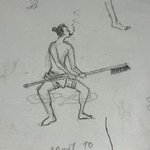
Nearly done pencilling a new batch of yaksha and motley beasts. Looking forward to showing you all six, when inked...

Dressed appropriately for the first time in his life, I see.

Seeing convicted clergyman Gnanasara’s in prison uniform has prompted wider public debate over whether jailed monks should be denied robes. @NalindaJay says 63 other convicted monks have also been stripped of saffron robes. Will the Buddhist hierarchy formally defrock offenders.
Deshan Tennekoon retweeted

A new study has shown that the 2,800-year-old palace at Yeha, Ethiopia, could have supported 16-19 floors.
For context, Aksum's famous stelae represent multi-story buildings with about 9 to 13 floors
allthatsinteresting.com/ethi…


Deshan Tennekoon retweeted
My book is available on the Jam Fruit Tree website now 😍✨
thejamfruittree.com/poetry/i…

Deshan Tennekoon retweeted

Itō Jakuchū's 'Frog' of 1790 for me is the iconic image of numbed uncomfortable bafflement at the predicament of existence in the coming modern world, much as Munch's 'Scream' expressed it through horror.

Deshan Tennekoon retweeted

In the early part of the 20thC, the Swiss artist Hans Emmenegger began making recurrent themes of enigmatic, dark forest interiors, exploring the optical effects of light and colour. This work was painted in 1933.

At this week's production meeting I will refer to technical issues as 'technically shoes' to see if anyone notices.
Kiwi friends, catch this exhibition if you can. Small number of pieces but exciting to see how modern China is responding to their ancient painting traditions.

Thinking about Yaksha and Makara and teeth and blood.
Preparations for a new set of ink drawings for Regular Devils.
Hoping to have them on sale for Christmas. There are still a few unsold pieces in the shop: onlinedesho.com/shop/origina…


