

Detection, Classification, Localization & Density Estimation of #MarineMammals using #PassiveAcousticMonitoring workshop 🌴See you soon for O'ahu 2022! 🌴
Joined February 2022
- Tweets130
- Following0
- Followers125
- Likes0



Just a reminder to make your #dclde2022 purchases before March 25 when the shopify online store closes!! #2daysaway
dclde2022.myshopify.com/

A big #mahalo to all our #dclde2022 sponsors including @acousticsorg , @NOAA, @USNavyResearch, @USNavy's Living Marine Resources, & @googlecloud!

The first #dclde2022 #hybridworkshop was a huge success! 172 attendees participating both in-person or virtually, had the opportunity to listen to 84 talks & engage in meaningful discussion. So great to see all your faces as we advance the field of marine mammals #acoustics!

Taylor LeBlond from Fisheries and Oceans Canada uses music information retrieval techniques for automatic detection and identification of various #cetacean calls #dclde2022
Tyler Heble developed a new generalized sonar detector using a shallow learning net. Detector performed well on evaluation datasets from #SanctSound #dclde2022
Dclde retweeted

Such a great experience at my first in-person conference presenting my PhD research on deep learning for soundscapes. @dclde is such a great community, Im already excited for 2024!!

More than a whistle: @OceansE11en uses PAM data collected worldwide to build a multi-sound source CNN detection model as part of the @Compass_MPA project to broaden the ecological information extracted from PAM data, for use in #marinemammal conservation #MPA #dclde2022
Dclde retweeted

Last day of #dclde2022 It’s been a fantastic week of science and connecting with colleagues and friends both in-person and virtually. Thanks to all the @dclde team!
What's all that noise? In noisy #Singapore waters, @arlnus @harivn and @nparksbuzz use #MachineLearning to clean snapping-shrimp noise and detect marine-mammal vocalizations using ConvNets. Singapore gets visits from marine mammals including Pink #dolphins and #dugongs
David Mellinger @OregonState introduces "FindPorpoises", a deep-learning system for detection, classification, and reporting of harbor porpoise sounds. #dclde2022
Pu Li from @SDSU presents a 3 stage-wise generative adversarial network model to extract whistles in #passiveacoustic data #dclde2022
Join us for our last #dclde2022 session, Machine Learning Applications in ‘Noisy’ Environments, featuring Pu Li, David Mellinger, Hari Vishnu, Tyler Helble, & Taylor LeBlond. 30 min discussion to follow. Tune in #live or through app. Talks available online by the end of the day.
Distributed acoustic sensing in submarine fiber optic cables is an exciting new technology for recording baleen whale low frequency calls. Community DAS experiment on @NSF @OceanObserv @OceanObserving Regional Cabled Array operated by @UWOcean is putting data into public domain.

Eavesdropping at the speed of light? @LeaBouffaut presents how a fiber optic cable in #Svalbard can be used to monitor #bluewhales at the doorstep of the #Arctic #fiberoptic #DistributedAcousticSensing @NTNU, Center for Geophysical Forecasting @CornellBirds @listenforwhales
Join our next #dclde2022 session, Distributed Ocean Sensors, featuring Léa Bouffaut, and William Wilcock. 12 min discussion to follow. Tune in #live or through app. Talks available online by the end of the day.
Can we really tell who`s calling? To improve individual cue rate estimation, @dombroski_julia & @ACCURATEProject collaborators (@ParksLabSU, @NTNUnorway & @_SMRU_ ) are testing reliability of accelerometer signals to attribute calls to tagged baleen whales #dclde2022 #biologging
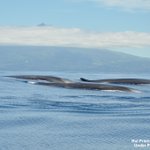
A new study lead by @AzWhaleLab in collaboration with other 12 researchers show how #FinWhale songs changed over two decades in the #Atlantic Ocean, challenging cue rate measures for acoustic density estimation in this species. @MiriamRomagosa #dclde2022

Join our next #dclde2022 session, Counting Sounds for Counting Critters, featuring Cameron Martin, Miriam Romagosa & Julia Dombroski. 12 min discussion to follow. Tune in #live or through app. Talks available online by the end of the day.