

NSF's OOI is a science-driven ocean observing network that delivers real-time data from more than 900 instruments to advance ocean science.
Joined May 2010
- Tweets1.9K
- Following415
- Followers2.3K
- Likes761





🌊 New to OOI data? Not sure where to start?
Our Data Explorer tutorials show how to find, visualize, and compare freely available ocean observations.
Watch the four-part video series, each under 8 minutes!
Learn more: bit.ly/4yTKji6
#NSFFunded #OOI

🎃October Instrument Spotlight: Acoustic Doppler Current Profiler (ADCP)
How do scientists measure ocean currents?
OOI's Acoustic Doppler Current Profilers use sound waves and Doppler shifts to measure current velocity in three dimensions.
Learn more: bit.ly/4jmTZga
🤖 Made with AI

18 months of plankton imagery from OOI’s Pioneer Mid-Atlantic Bight Array are now available for analysis.
Explore millions of images alongside environmental data to study plankton communities and changing ocean conditions.
Learn more: bit.ly/4hBUPo1
#OceanScience #OOI

🌊 What should NSF consider as it plans for the future of ocean observing?
What should NSF know about why sustained ocean observations matter—and what else should be part of the conversation?
Responses due tomorrow, Sept. 30: bit.ly/3SX9gtm
Photo: Maya Moran (OSU)

🌊 What does the value of ocean observing look like?
Beyond scientific publications, how should NSF consider the broader value and impact of sustained ocean observations?
Share your perspective by Sept. 30: bit.ly/3SX9gtm
#NSFFunded #OOI #OceanObserving

Preparing a proposal that uses OOI data/observations?
OOI has published updated guidance for researchers planning work during Program Year IX (Oct. 2026–Sept. 2027).
Researchers are encouraged to continue developing proposals using OOI data.
Learn more: bit.ly/3TezLL2

Instrument Spotlight: pCO₂ Air-Sea Sensor
OOI’s @ProOceanus pCO₂ sensor measures CO₂ in surface seawater and the air above it, helping researchers study carbon exchange between the ocean and atmosphere.
Learn more: bit.ly/4wHoQaj
#NSFFunded #OOI #OceanObserving
🤖 Made with AI

🌊 How does ocean observing support you?
NSF is seeking input on the future of ocean observing. You don’t need to answer every question—share how OOI/ocean observing supports you or your organization.
Respond by Sept. 30: bit.ly/3SX9gtm
#NSFFunded #OOI

The OOIFB is hosting virtual Ocean Observing Exchanges to support community discussion around NSF’s DCL on future ocean observing priorities.
The first session is Sept. 11, with more throughout September.
View the schedule & register: ooifb.org/meetings/ocean-obs…
Ocean Observatories retweeted

We have been busy all month, preparing for our first expedition with @endurancegeo.
We'll be deploying their Adélie generator inside the Axial Seamount and connecting it to the @NSF @oceanobserv Regional Cabled Array @OceanObserving!
📸: @janetmfr


OOI joined the 2026 Woods Hole Science Stroll, where more than 2,500 visitors explored marine science up close! 🌊
The OOI booth offered a hands-on look at the instruments and technology used for sustained ocean observing.
Read more: bit.ly/3V9MJKn
#NSFFunded #OOI

The U.S. National Science Foundation is seeking community input on future ocean observing priorities.
OOI encourages those who use or benefit from ocean observations to review the Dear Colleague Letter and provide input by Sept. 30.
🔗 oceanobservatories.org/2026/…
#OceanObserving
🤖 Made with AI

🌊 New Science Highlight: How well do ocean reanalysis models capture heat transport in the subpolar North Atlantic?
A recent study compared models with OSNAP observations, including data from OOI Irminger Sea Array moorings.
Read more: oceanobservatories.org/2026/…
#NSFFunded

🔊 Instrument Spotlight: Hydrophone
OOI's Broadband Acoustic Receivers are underwater microphones that listen for sounds from marine mammals and rain to earthquakes and human-generated noise.
Learn more and explore the data: bit.ly/4wHoQaj
#NSFFunded #OOIDataMatters
🤖 Made with AI

NSF OOI technology recently helped map two historic shipwrecks in 3D. 🌊
Using an OOI-provided Falcon ROV, the team captured detailed imagery of Quest and Terra Nova during the Heroic Age Expedition.
Read more: bit.ly/4xP1u3u
📷 Ken Kostel, @WHOI

The 2026 Operations & Maintenance expedition for the NSF OOI Regional Cabled Array is underway! 🌊
Aboard the R/V Roger Revelle, the team monitors ROV Jason approaching hydrothermal vents at Axial Seamount.
Follow the expedition + live dives: interactiveoceans.washington…

The NSF Ocean Observatories Initiative (#OOI) will begin the phased redeployment of the Endurance Array, restoring critical ocean observations.
Glider deployments are already underway with additional mooring redeployments planned for October.
Learn more: bit.ly/4bZAS7m

🚨 New @NSF funding opportunity!
The Unlocking Dataset Value for AI-Enabled Scientific Discovery solicitation supports AI-ready scientific datasets, including long-term observations like those from OOI.
📅 Proposals due Nov. 4, 2026
🔗 bit.ly/45idnTb
#NSFFunded #AI

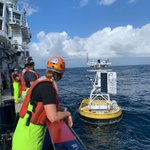
NSF OOI-CGSN technicians Dan Bogorff and Nico Llanos, working with the @osnap_updates team, successfully recovered and re-deployed the Irminger Sea Array Flanking Moorings.
Thanks to the OSNAP team and the crew of the R/V Neil Armstrong for supporting this effort.
📸: @WHOI


The ocean is changing every day. 🌊
Continuous ocean observations provide the long-term data scientists rely on to better understand our changing ocean and prepare for what's ahead.
Explore OOI: oceanobservatories.org
#NSFFunded #OceanScience #OOIDataMatters #OpenData
