
Structural engineer, programmer, automation lover, AI, business owner, llm tinkerer, supercharging service industry using tech, TSLA, NVDA, PLTR
Joined May 2015
- Tweets8.5K
- Following874
- Followers567
- Likes13.4K


David retweeted

Been obsessed with the stock market since I was a teenager. Have traded through the dotcom bubble, the financial crisis and just about every market mania since. But I’ve never seen anything like the skepticism surrounding AI. Not even close. Every time one bubble narrative falls apart a new one takes its place. Rumors become headlines. Misleading data goes viral. Claims that could be debunked with 5 minutes of research get repeated by major media outlets, influential investors and Wall Street analysts. It’s relentless and honestly pretty fascinating to watch. Of course there will be spectacular failures and massive wealth destruction along the way. That’s what happens during technological revolutions. But I’ve never witnessed this much effort to convince the world that something so transformative is actually one giant speculative bubble destined to take the entire economy down with it. I understand why AI scares people. What I find harder to understand is why so many investors seem to be rooting for it to fail.
David retweeted

this SpaceXAI workshop is f*cking insane
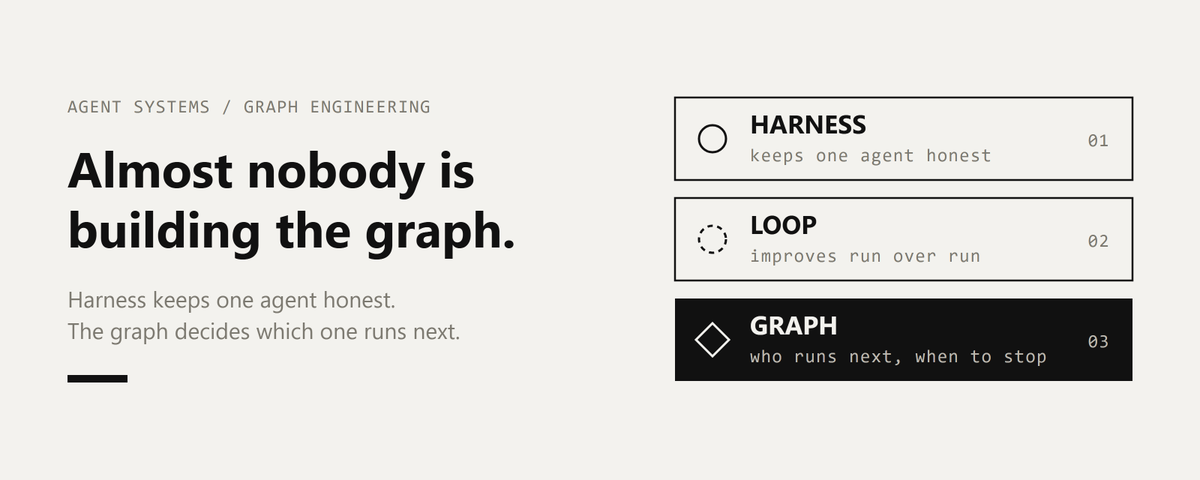
the real unlock is not running more AI agents
it is building an environment where even weaker agents can produce good work without being babysat
the stack is simple:
model → reasons
harness → controls
loop → verifies
graph → delegates
human → approves the irreversible stuff
the crazy part is the tradeoff
hire more people to constantly supervise the work
or spend tokens once building constraints, tests, state, and verification that every future agent inherits
that is exactly why Grok Bot matters
if your system only works with the smartest model, you do not have an agent system
you have a demo
watch the workshop first
then read the full Grok Bot operating system below.
bookmark before this gets buried


David retweeted

Here's how @poteto (eng lead for Grok @bot) gets her eng lead bot to manage eng bots:
"I actually mostly talk to my chief of staff, and then my chief of staff talks to the eng lead. I set these engineer bots up with Dr. Eggbot [a bot to create other bots].
One of the things I told Dr. Eggbot to do is to make sure that the eng lead's job is really to break down tasks into smaller pieces and delegate and supervise other bots rather than do work on its own.
You can see in the description, it even has the bot IDs in there. But it tells it to never do work on its own and always delegate to those four eng bots."
📌 Watch the full episode here: youtu.be/xZ5TEaleUdg

"Everything I touch with my keyboard and mouse, I try to delegate to my bots."
Here's my new episode with @poteto and @pengzheng_, the eng and design leads for Grok @bot, where they showed me the 14 bots they use for work and life, including:
→ A design bot that turns one keyframe into a full user flow
→ An eng lead bot that manages a team of eng bots
→ How to trust your bots with more of your work
Some quotes from both:
"I like to call it the Michelin kitchen…when you say software factory, it has this connotation of mass manufactured slop."
"Sometimes I actually don't even look at the PR until after it's landed and then I'm like, 'Oh, okay. Yeah, that looks good.'"
"I think it ultimately comes back to trust. First, watch your bot work and correct it. Turn what worked into a skill. Once it nails the task in one shot, make it a routine."
📌 Watch now: youtu.be/xZ5TEaleUdg
Thanks to our sponsors:
@meetgranola: AI meeting notes that don’t suck granola.ai/peter
@RiversidedotFM: All-in-one AI studio for podcasts and video creators.riverside.com/Peter…
David retweeted

Grok Bot could be the operating layer AI agents have been missing.
It can use tools, run routines and coordinate other agents with minimal supervision.
In this article, I show you how.

David retweeted

Grok Bot shipped 2,000 pull requests to production in one month
In this 38-minute breakdown Lauren Tan (XAI engineer) explains how she trusted her agents enough to do it:
00:13 - "I shipped 2,000 pull requests to production"
04:51 - "I am the bottleneck. my fix: a team of agents"
05:37 - the babysit stage: course-correct every chat
17:57 - "style guide is only enforceable by human review"
35:33 - ascend the trust graph, parallelize the work
Most people still babysit their agents at 5 prs a month
She got to 2,000 by trusting the environment, not the model
Babysitting → trust → environment → parallelize → 2,000 prs
Same model, same codebase. Only the loop around it changed
This free 38-min talk beats most paid agent courses
Save this before your competitors do
David retweeted

SpaceXAI engineer Lauren Tan:
"You can't spawn a hundred agents when you don't even trust the output of one agent"
"If you don't have a verification skill, you are the verifier. You're the bottleneck"
In a 1-hour talk, she shows how she went from watching every output to shipping 1,000 PRs in a month
Watch every step → Verify → Skills → Evals → Auto-merge
Trust in agents is not a feeling. It's infrastructure you build
Worth more than any $2,000 AI coding bootcamp
Bookmark it and watch it tonight


David retweeted

What are the best prompts you have used with Instinct or Grok Bot?
Share in the comments so other people can benefit as well 👇
David retweeted
Grok Bot is about to replace your entire engineering team
This one-hour workshop breaks down exactly how Grok Bot does it:
00:00 - why the best use of ai is a pairing partner
17:28 - verification loops that make agent output trustworthy
34:05 - 20 merged overnight, 600+ total, she stopped reviewing
42:15 - build the codebase for your dumbest agent
44:58 - enforce rules with ci and the compiler, not review
52:50 - pms and designers ship features through it themselves
Most people still use Grok Bot like a chatbot that answers
She uses it like an engineer that owns the result
The model writes it, the harness ships it, the loop verifies it
This free workshop is worth more than most $700 courses on ai
Save this before you hire another engineer

David retweeted

BofA dropped an interesting scenario for $MU Micron 👇
BofA applied SanDisk-style assumptions to Micron:
• 15%+ annual sales growth
• Sustained 80%+ gross margins
• 50%+ free cash flow margins
Under this “SNDK-like” model, MU’s FY30 numbers look very different from consensus:
Sales: $377B (vs consensus $280B)
EPS: $236 (vs consensus $136)
EPS CAGR FY26-30: 34% (vs 17%)
Consensus still models a classic memory peak-and-decline.
BofA’s scenario shows earnings power continuing to climb through 2030 if the high-margin structure holds.
Key takeaway: If AI demand + long-term contracts really change the old cyclical pattern, valuation multiples could expand from today’s low single digits toward AI-infra levels.
Not a prediction, just the math BofA is showing. Always do your own research. $SNDK #Semiconductors #AI

David retweeted

Early signs today that SPs would be trend day up: 1) opening gap up 2) no trade below low of first 5 minute bar, 3) 3 consecutive 5minute green bars up in first 30 minutes. 4) creeper mode as price grinded above the 5 minute Keltner channel. (for stock traders, go with early relative strength off opening - CRWV +++)
David retweeted
BofA released a major semiconductor update that memory investors should note carefully.
The key takeaway is a sharp upward revision in the AI capex outlook. 2026 is now seen rising 78% year over year and 2027 by 35%.
The four major US hyperscalers, Google, Microsoft, Amazon, and Meta, have reported stronger multi-year spending plans.
Hyperscale capex is tracking above $860 billion in 2026, up 80% year over year, and heading toward $1.2 trillion by 2027.
The spending is backed by more than $2.3 trillion in multi-year customer cloud commitments and backlog, which rose 16% quarter over quarter. That visibility is significant.
Free cash flow will face pressure as capital expenditures exceed operating cash flow. The big tech companies are funding it comfortably through debt and equity, and capital markets remain open.
The main beneficiaries are ranked as:
1Compute
2Memory (HBM, DRAM, SSD)
3Semiconductor equipment
4Power semiconductors
5Optics
As AI agents scale, memory demand is expected to grow even faster than GPU shipments.
Stronger cloud backlog leads to higher utilization, more accelerators, and ultimately more memory purchases.
This is not a short-term spike. It is a multi-year infrastructure buildout with improving return visibility.
Memory names have received another bullish signal.
How do you see this level of hyperscaler commitment affecting memory pricing and supply through 2027?
#semiconductors #AI


David retweeted
Trading information asymmetry is a game of calculated probabilities built on well-researched alpha. Applying leverage and operating within shorter time horizons doesn’t make it gambling to me.

Chris i respect most of your takes and congrats on the trade and i am giga long amazon.
but what you described is pure gambling with weekly expires and leverage, because you work might be right, thesis might be right and if jassys script wasnt right yesterday, amazon would have been down 10% like it always has when the management was not able to explain the capex spend properly.
David retweeted

Want to Know If the Bottom Is In? Read this.
Since $QQQ just printed a gap-up candle, the next thing I'll be watching is the Follow-Through Day (FTD).
One of William O'Neil's most important rules for confirming a market bottom.
How it works:
- Market is in a correction. The first day an index closes higher = Day 1 of a rally attempt.
- Days 2-3 don't need to be up. The rally stays alive as long as Day 1's low holds.
- Then on Day 4-7, watch for one major index (S&P 500 or Nasdaq) to gain 1.25%+ on volume higher than the day before.
That's the follow-through day. Downtrend over. Confirmed uptrend.
The rules that matter:
- Not every FTD works - many fail
- But no bull market has EVER started without one.
- Undercut Day 1's low -> the count resets
- FTDs after Day 10 carry lower success rates
What to actually do on an FTD:
Don't go all in. Buy starter positions in leading stocks breaking out of sound bases. If the rally is real, they work - and you add. If it fails, you're barely exposed.
O'Neil's whole point: you don't predict bottoms. You confirm them.
Corrections are for building the watchlist. The FTD tells you when to use it.
🤖 Made with AI


David retweeted

South Korea’s retail liquidation crisis is not merely a trading story. It is the financial consequence of a generation priced out of housing and pushed toward leverage as a substitute for wealth creation.
Young Koreans who cannot afford a Seoul apartment are trying to manufacture the same upside through 5x portfolio margin and 2x single-stock ETFs. But leverage does not make an expensive asset affordable. It simply converts volatility into insolvency.
With 360,000 accounts liquidated, 62% belonging to investors under 35, margin loans reaching KRW38.63 trillion and borrowed-money losses of KRW2.15 trillion in one month, this has become a social problem rather than an ordinary market correction.
The cruel irony is that forced liquidation transfers assets from young investors with no liquidity to institutions and wealthy investors with cash. Retail bought because they feared being left behind. They are now being forced to sell precisely when valuations are becoming more attractive.
The government can open a debt-counselling hotline, but the deeper problem remains: when housing feels unattainable and wages cannot create wealth quickly enough, speculation begins to look like economic necessity.
Leverage offered them a shortcut to prosperity.
Instead, it removed their ability to wait.

🇰🇷 More than 360,000 margin accounts have been forced into liquidation in South Korea.
62% of those wiped out were reportedly under the age of 35.
It's part of the worst month in the KOSPI's recorded history.
The index has cratered more than 33% in July, blowing past the October 1997 IMF Crisis (-27%) and the 2008 Global Financial Crisis (-23%).
An entire generation of retail traders got margin-called into oblivion in a single month.
Sources: Citi report / Writer: Julie
