


Pinned Tweet
Anthropic’s 2-hour Claude walkthrough shows that most people are still using Claude like a blank chat box instead of a real work system
The model is not the problem
The setup is
Projects keep the context together
Files give Claude real source material
Memory preserves what matters
Connectors bring in live work
Workflows make the process repeatable
That is the difference between asking Claude for one answer and building an environment where it can keep producing useful work
Same model
Better system
Completely different result
The full Claude Setup guide is below ↓


Marcos López de Prado’s ML trading workflow turns Claude Code into a full machine-learning quant lab instead of another backtest generator
You give Claude the market data, labeling rules, features, models, costs, and risk constraints
Then it runs the full pipeline:
Label Data → Generate 27 Models → Purged Validation → Evaluate → Select & Combine
It’s f*cking serious...
Claude can build the experiments
generate XGBoost, LightGBM, Random Forest and neural network variants
apply triple-barrier labeling
run purged K-Fold and CPCV
check probability calibration
stress realistic costs and slippage
and reject models that only work because of leakage or lucky splits
The important part is the validation
In this example, 20 of 27 model variants die before the final portfolio
The survivors are combined instead of betting everything on one “best” model
Claude Code runs the workflow
Python and ML libraries do the math
Purged validation tries to kill the fake edge
Risk rules control what reaches capital
Then read the full ML Trading Workflow guide below ↓

Jim Simons’ signal discovery playbook turns Claude Code into a systematic strategy factory instead of another “predict the market” toy
You give Claude the capital, universe, data, costs, and signal families
Then it runs the full research machine:
Momentum → Mean Reversion → Carry → Volatility → Cross-Sectional → Regime
27 variants go in
weak signals get killed
the survivors get walk-forward tested
correlated duplicates get removed
and only the robust pieces make it into the final portfolio
It’s f*cking clean...
Claude generates the strategy families
Python runs the backtests
validation checks costs, drawdown, turnover, parameter stability, and out-of-sample behavior
then the system combines only the signals that survive
The point is not finding one magical predictor
It is stacking multiple small edges without letting weak ones contaminate the portfolio
Paste the framework into Claude Code
Let it run the full discovery loop
Then read the complete Signal Discovery Harness guide below ↓

David H. Bailey’s backtest forensics framework turns Claude Code into a quant auditor that assumes your best strategy is guilty until proven innocent
You give Claude the strategy family, data, cost model, timestamp rules, and experiment ledger
Then it runs the full forensic loop:
27 Ideas → Backtest → DSR → PBO → CSCV → Cost Audit → Holdout → Reject / Paper Trade
It’s f*cking ruthless...
Claude generates the candidates
Python computes the evidence
The audit looks for selection bias, parameter instability, temporal leakage, unrealistic costs, and performance that disappears out of sample
A Sharpe above 2 means nothing if it came from testing enough variations
A 12% gross return means almost nothing if 0.20% costs leave you with 2%
The goal is not to find the winner
It is to prove the winner is not a statistical accident
Paste the framework into Claude Code
Let it audit every candidate
Then read the full Backtest Forensics Harness guide below ↓

Tobias Moskowitz’s momentum research framework turns Claude Code into a systematic trading lab without you manually rebuilding every test
You give Claude the research idea, the market universe, and the constraints
It runs the full loop:
Momentum Idea → Generate 27 Variants → Write Python → Backtest → Stress Costs → Walk-Forward → Reject / Keep
It’s f*cking powerful...
The point is not that Claude predicts the next move
The point is that Claude can turn one academic idea into a repeatable research process
It can generate the parameter grid
write the strategy code
compare Sharpe, drawdown, turnover, and net returns
stress different trading costs
run out-of-sample checks
reject fragile variants
and return only the strategies that actually survive
Python does the math
Claude Code runs the lab
Risk rules keep the boundaries fixed
You keep control of the capital
Then read the full Claude Code Momentum Research Harness guide below ↓

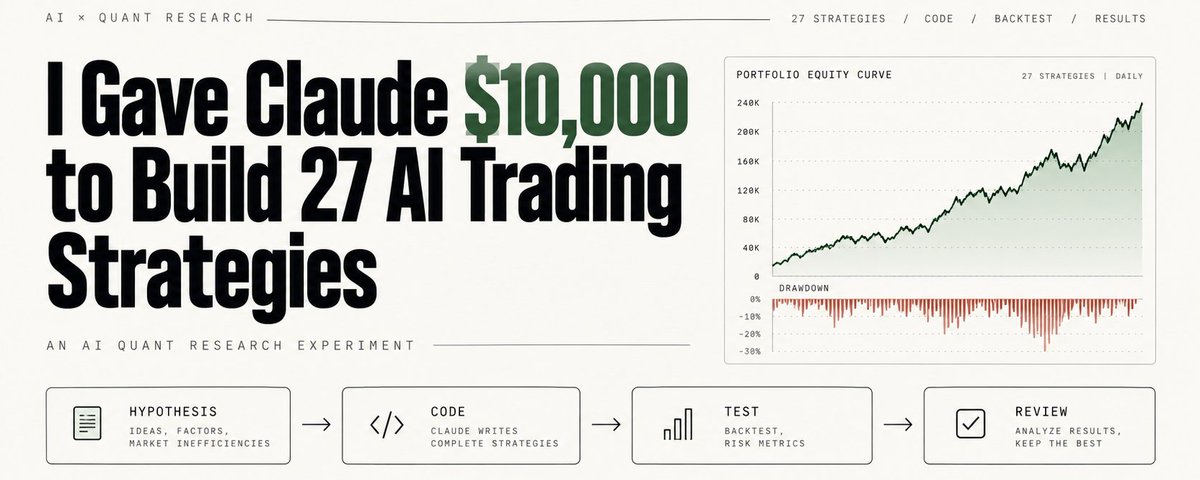
Andrej Karpathy’s AI quant research harness turns Claude Code into a strategy rejection machine, not a signal generator.
It starts with $10,000, builds 27 strategy variants, tests them in Python, and keeps only what survives costs, walk-forward checks, and out-of-sample validation.
It’s f*cking clean...
Send this framework to Claude Code and let the loop do the ugly part:
Hypothesis → Generate → Backtest → Stress → Validate → Reject / Keep
The model proposes ideas.
Python computes the statistics.
Risk rules enforce the boundaries.
You control the money.
Then read the full guide to AI quant research harness engineering below ↓

Stanford professor Andrew Ng just explained why better AI systems are not built by throwing more complexity at the problem
The real advantage is knowing what to test, what to ignore, and where the next experiment should go
In this Stanford lecture, he breaks down the thinking behind that:
00:00 - why applied deep learning matters more than memorizing theory
04:12 - why deep learning suddenly became powerful at scale
16:19 - why practical know-how separates strong teams from average ones
17:04 - how better research decisions can make a team 2x, 3x, or even 10x faster
18:53 - how one engineer beat three months of work from a 30-person ML team
40:23 - the difference between mathematical depth and actually getting models to work
1:04:10 - why real projects are where the useful knowledge compounds
That same idea is exactly what matters in AI trading
Generating more strategies is easy
Rejecting fake alpha is the hard part
A strategy can win 90% of its trades and still lose money, while a random search can surface a Sharpe above 2 with no real edge at all
Hypothesis → Test → Cost Stress → Walk-Forward → Reject → Paper Trade
The model proposes
The research system tries to kill the idea
That is worth more than most AI trading tutorials
Bookmark and watch it today
Then read the full AI trading system below ↓
SpaceXAI engineer Nick Miller just explained why the future of AI work is not one smarter chatbot
Most people still run one agent and manually coordinate everything around it
Miller runs 20+ GrokBots with separate roles, computers, and workflows instead
In this 27-minute Agent Conf talk, he breaks down the shift:
00:00 - why chatbots and copilots are becoming the old interface
05:00 - how persistent GrokBots work across real tools
10:00 - why each Bot needs its own role instead of one giant prompt
15:00 - Chief of Staff, PM, QA and specialist worker Bots
20:00 - loops and graphs that let Bots hand work to each other
24:00 - how this becomes a software factory instead of another AI assistant
Chatbot → Copilot → Grok Bot → Bot Teams → Software Factory
And this maps directly to the trading architecture from
the article:
Grok Bot → coordinates
Python → tests
decision layer → judges
risk code → enforces
human → approves
The goal is not to generate more strategies
It is to reject fake alpha before real money moves
This talk is worth more than most paid agent engineering courses
Bookmark and watch it today
Then read the full AI trading system below ↓
akame retweeted
SpaceXAI engineer Lauren Tan just explained why scaling agents is not about adding more intelligence
Most people try to make one model smarter
The better approach is to build constraints, verification, and architecture that every future agent inherits
In this 1-hour workshop, she breaks down the system behind that shift:
00:46 - why trust becomes the bottleneck once agents start acting on their own
05:39 - how verification skills close the loop instead of relying on model confidence
13:08 - how Pstack turns repeated engineering work into reusable infrastructure
17:23 - why skills and evals have to improve together
23:42 - how cloud agents scale the work without scaling human supervision
29:20 - why architecture and constraints matter more as autonomy increases
38:02 - how CI becomes an enforcement layer instead of another prompt
48:00 - what changes when the agent can keep working after you leave
The same idea is exactly what makes Grok Bot interesting
The model generates
The decision layer routes
Code enforces the hard rules
The human only handles the exceptions
And in quant, the architecture becomes:
Hypothesis → Test → Reject → Stress → Size → Monitor
This workshop is worth more than most paid agent engineering courses
Bookmark and watch it today
Then read the full Grok Bot operating system below ↓
akame retweeted
SpaceXAI engineer Nick Miller just explained how to turn Grok Bot from one chat window into an actual AI team
Most people still run one agent and manually coordinate everything around it
Miller runs 20+ GrokBots with separate roles, computers, and workflows instead sotwe
In this 27-minute Agent Conf talk, he breaks down the shift:
00:00 - why chatbots and copilots are becoming the old interface
05:00 - how persistent GrokBots work across real tools
10:00 - why each Bot needs its own role instead of one giant prompt
15:00 - Chief of Staff, PM, QA and specialist worker Bots
20:00 - loops and graphs that let Bots hand work to each other
24:00 - how this turns into a software factory instead of another AI assistant
Chatbot → Copilot → Grok Bot → Bot Teams →
Software Factory
The important part is not having more agents
It is removing the human from the coordination layer
And that is exactly where the Grok Bot architecture in the article gets interesting:
model → generates
decision layer → routes
code → enforces
Grok Bot → coordinates
human → handles the exceptions
Watch the full 27-minute talk
Then read the Grok Bot operating system below ↓
Lauren Tan’s 1-hour Grok Bot workshop shows how to turn research into a business, not another AI summary
Build one persistent research desk and let it compound the work across clients
Intake → Discovery → Evidence → Verification → Analysis → Delivery
Grok Bot searches the market
The evidence layer decides what is actually trustworthy
The human only reviews contradictions, high-impact claims, and final judgment
That is how one verified pricing change can serve every client tracking the same company instead of restarting the research from zero each time
Watch the workshop first
Then read the full Intelligence Factory guide below ↓

Grok Bot is insane for running a one-person company
Give one objective to a focused team and turn scattered app work into one continuous workflow
Research → Route → Execute → Verify → Human approval
The model creates the work
The decision layer chooses what happens next
Code keeps the hard rules non-negotiable
And in quant, the same system becomes:
Hypothesis → Test → Reject → Stress → Size → Monitor
Watch the Grok Bot breakdown
Then read the full operating system in the article below ↓
akame retweeted
4.3 million people use AI.
But the workflow barely changed.
People still ask the model, copy the answer, switch apps, paste it, check it, and repeat.
Grok Bot is trying to remove that middle layer.
Give it the objective.
Let the system gather context, use the tools, verify the result, and only bring the human back for important decisions.
In quant, the same idea is even stronger.
The model proposes.
Another layer tests it.
The decision system reads the regime.
Hard risk rules control the money.
That is why Grok Bot matters.
The real leap is not a smarter answer.
It is a system that knows what happens next.
full breakdown below
this Grok Bot breakdown makes the productivity problem obvious
the hard part is rarely the decision
it is the app switching around it
Slack → Gmail → Drive → spreadsheet → doc → send
Grok Bot changes that
you give it the outcome
the system handles the path
generative model → creates
decision layer → routes
code → enforces
Grok Bot → coordinates
human → handles exceptions
and in quant:
hypothesis → test → reject → stress → size → monitor
the model can think
the code still controls the money
that is the shift
less app switching
more finished work
full breakdown below
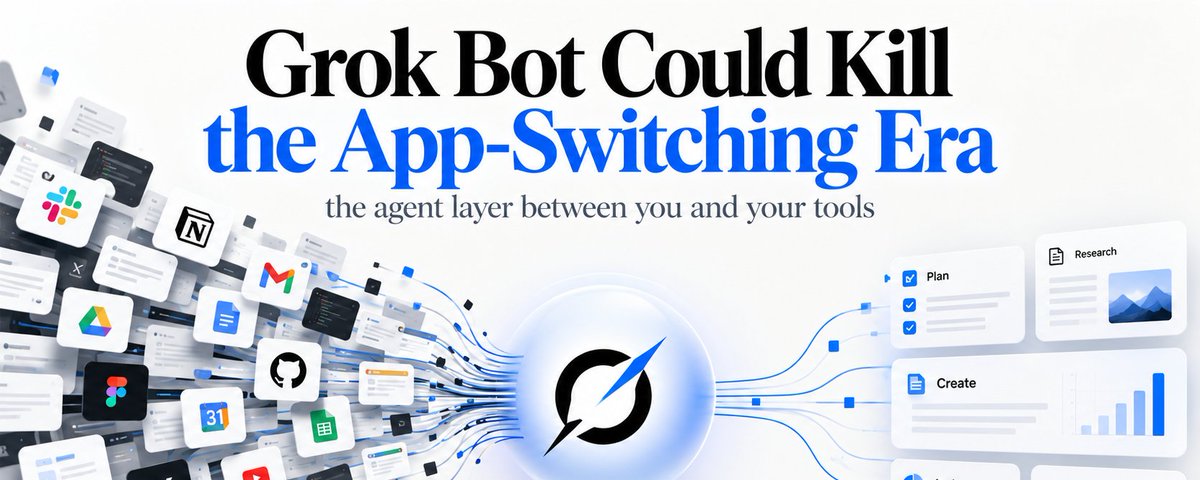
this Grok Bot demo is exactly why the app-switching era is dying
the interesting part is not that it can move 824 X connections into Notion
it is that the human no longer has to be the glue between the tools
request → collect → structure → write → verify → leave the finished result where it belongs
that is the real shift
Grok Bot becomes the runtime
decision layer becomes the nervous system
code becomes policy
human handles the exceptions
and this gets even more interesting in quant
research → test → reject → stress → size → monitor
the model can propose
the decision layer can judge
but hard limits still stay in code
that is why Grok Bot matters
you stop managing clicks
you start managing outcomes Вставленный Markdown
watch the demo first
then read the full Grok Bot system below
bookmark before this gets buried
akame retweeted
this SpaceXAI Grok Bot workshop gets the most important thing about agents right
the breakthrough is not giving one model more intelligence
it is giving the system a way to keep working when the first answer is not enough
Grok 4.6 → reasons
harness → controls
state → persists
loop → repairs
graph → delegates
human → approves the irreversible stuff
that is the difference between a chatbot and an actual AI teammate
a chatbot responds once
Grok Bot can inspect, act, verify, hand work off, and keep the job alive across multiple steps
if your agent needs you to constantly remind it what happened five minutes ago
you did not build autonomy
you built a conversation
watch the workshop first
then read the full Grok Bot operating system below
bookmark before this gets buried

