

Developer & CTO | 20+ Years Games & Industry | I create games and software | #Dad #GameDev #IndieDev #IndieGameDev #SaaS 👉 https://xitter.cf/t.co/chmazoHhuK
Wuppertal, Germany
Joined May 2016
- Tweets1.5K
- Following903
- Followers328
- Likes6.3K



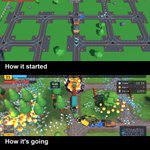

Here it is! As many requested, the Tutorial about Godot with Rooms and Doors. 👉🚪👈youtu.be/ErOobMFODqA


AI assistants sound convincing, even when they’re wrong.
I'm training our own model for orboto. First internal test: 0 made-up answers where the data has no answer, and 61 % vs. 44 % accuracy against a ~7x larger model.
Smaller. More precise. At a fraction of the compute.

Has anyone else run into the problem where Kimi K2.8 tells it will do something and then simply stops? It has been happening all day. Maybe @KimiDevs knows more? I could integrate an auto-continue feature into my process wrapper, but it should do it without me forcing it...
Yeah, I'm also into music. Here are some VSTs I'm working on:
PULSE - dance bus & sidechain compressor
VELVET - dynamic resonance tamer & air exciter
HORIZON - sub-mono & mid/side stereo
TITAN - true-peak limiter with LUFS meter
Do i miss something?


With the latest developments in local inference, the question of whether you like ChatGPT usage changes or not just vanishes. You could not care less if you can run a near-frontier model on an affordable system at a usable speed.
Hot take: frontier image models are trained to change people's likeness; they can perfectly replicate anything else, so why do they fail there?
Local AI will become more and more popular as also usable and i am happy that you can see this every day. And such messages will finally be gone: Selected model is at capacity. Please try a different model.
Funny, I just had the feeling that Opus behaves differently than yesterday. Let’s hope it’s just a normal drop and it will recover. What I could say is they definitely changed something behind the scenes. What was working yesterday just stopped today, and it refuses daily routines that were running since it was released.

Yesterday, Opus 5.5 created demo accounts for us and was testing our system. Today, it refused! I was curious, as he is now saying he can't do that, and I asked who decided this. 👇

I don't care how bad actors could use this; I just want to use it as an accessibility helper to test our system or to help me or my significant others do things I or they can't do at the moment. It’s about quality of life, and this being true is a hit in the face.
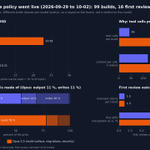
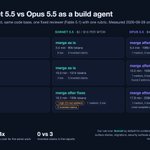
Promised the table. n=16 reviewed tickets, 202 agent runs, same fixed Fable reviewer, same rubric.
The 0 vs 3 on invented claims did not survive: 1.3 per ticket for both Sonnet 5.5 and Opus 5.5. 2 of 16 first diffs were mergeable as is. Quality comes from the fixed review, not from the build model.
What did survive is cost, and the driver is not the model. Cache reads are 96 to 99 percent of the input side.
Opus build: 171 tool calls, 263k context per call, 22.92 USD at list price, 78 percent of it cache reads.
Sonnet build: 45 calls, 121k per call, 1.91 USD, 55 percent cache reads.
Different ticket classes by policy (Opus got the multi-surface and security work), so a signal on the levers, not a verdict on the model. The lever is calls times context per call.
Correction to round 1: my token numbers came from the agent summary, which omits cache reads. About 10x low.

Well, it seems that local AI gets more and more interesting when we see how prices and usage are changing. I am paying multiple subscriptions, and if they are getting more and more expansive with less usage, it makes more sense to spend these on local inference.
Do you also have such situations that potential customers totally get hyped about your product and from one to another second get frightened about when realizing what the system can do?