댕댕 (@dangdeveloper) header
댕댕 (@dangdeveloper) profile picture

유학생

대한민국 서울
Joined November 2017
논문 PDF만 쌓이고, 읽고 나서도 남는 게 없다면 이 3개 저장해두면 됨. 관련 논문 찾기 → 막힌 내용 질문하기 → 근거와 메모 남기기. 관심 분야를 처음 공부하거나 연구 주제를 탐색할 때 쓰는 조합임. 1. ResearchRabbit 논문 하나를 기준으로 비슷한 연구와 앞뒤로 이어지는 연구를 찾아보기. “이 논문 다음에는 뭘 읽어야 하지?” 싶을 때 쓰기 좋음. 기본 검색과 논문 모음 기능은 무료임. researchrabbit.ai/ 2. Gemini Notebook — 기존 NotebookLM 논문 PDF를 넣고 연구 문제·방법·결과를 질문하기. 이해가 안 되는 부분을 좁혀 묻고, 답변에 붙은 출처로 원문을 확인할 때 쓰면 됨. notebook.google/ 3. Zotero 논문과 메모를 함께 보관하고, 밑줄 친 부분을 출처가 연결된 노트로 모으기. 나중에 “이 설명이 어느 논문에 있었지?”를 다시 찾을 때 쓰기 좋음. zotero.org/ 논문 찾기 → 질문하며 읽기 → 원문 근거와 메모 저장하기. 처음에는 논문 한 편에서 ‘무슨 문제를 풀었는지, 어떻게 풀었는지, 어디까지 확인했는지’만 남겨보면 됨. AI 요약을 모으는 것보다, 내가 설명할 수 있는 내용과 다시 확인할 근거를 함께 남기는 데 쓰면 좋음.
116
7
329
28,047
Catscan: Visualizing Pipelines of CPU Performance Simulation Aaron Lindsay, Nicholas Kelly, Scott Witscher, Mahesh Madhav arxiv.org/abs/2610.02121 [𝚌𝚜.𝙰𝚁 𝚌𝚜.𝙷𝙲 𝚌𝚜.𝙿𝙵]
6
6
325
댕댕 retweeted
reading about zipserv today arxiv.org/pdf/2603.17435
2
45
2,068
The KV Cache Is the New Memory Wall Tejinder Singh arxiv.org/abs/2609.30854 [𝚌𝚜.𝙳𝙲 𝚌𝚜.𝙻𝙶 𝚌𝚜.𝙿𝙵]
9
37
1,521
Optimizing AI Inference Across the Deployment Stack 🔗 arxiv.org/abs/2609.10550
1
7
29
2,166
【RISC-V Day Tokyo 2026 Autumn】参加登録開始! 📅 11月11日(水) @東京大学本郷キャンパス 午前はチップを設計、午後は実物を見る一日。 チケット: ・一般参加(無償) ・半導体回路設計・試作コース ¥3,000 ・書籍付き ¥1,500 ▶[peatix.com/event/5190002/das…] #RISCV #RISCVDayTokyo #半導体
1
75
19
237
40,756
댕댕 retweeted
传统大模型为了算得快,把几个字母拼成一个 Token,搞了个 32K~128K 的超大词表。 但到了 1B 这种小模型上,灾难来了: 底噪丢失:大模型教小模型(蒸馏)时,词表太大只能截取 Top-K 概率,长尾的细微“思考逻辑”全被丢弃了。 显存黑洞:光是存那张巨型词表和概率矩阵,小设备的显存就先被吃掉一大半。 这就像给小学生灌输一套只有博士才懂的晦涩缩写,小模型自然学不动。
6
4
58
11,008
I put together a handbook on how Mixture of Experts actually works, starting with what happens when a Transformer FFN becomes a routed bank of experts and only a small subset is selected for each token. It works through router logits, Top-k selection, expert weighting, load balancing, capacity and token dropping, router z-loss, dropless execution, total vs. active parameters, expert parallelism, and how these ideas show up in Mixtral, DeepSeek-V3, and Qwen3. Worked examples throughout, with citations back to the original papers and current implementations. Made it to be the explanation I wish I'd had when I first tried to understand how modern MoE models can grow so large without activating the full expert bank for every token.
12
121
1
623
19,876
FlashGEMM: Optimizing Sequences of Matrix Multiplication by Exploiting Data Reuse on CPUs 🔗 dl.acm.org/doi/full/10.1145/…
1
28
185
7,913
Inference roadmap I gotta follow: 1) Watch this course fully : youtube.com/playlist?list=PL… (Covers everything related to LLM Inference+ Training but on high level) 2) Gonna read this resource: jax-ml.github.io/scaling-boo… ( for deep dive on topics) 3) Read PMPP(CUDA & GPU specific chapters) 4) Blogs and codebase of vLLM , SGlang, llama.cpp 5) Inference Engg by philip book for brush up on the concepts 6) Also these notes which i found randomly on X for brushup: xitter.cf/gauri__gupta/status/20… Along with it : contributions to the above mentioned repo for understanding depth + talking with folks building in inference here
14
72
2
665
62,126
inference is future. tried going as much in detail as possible for the writing GEMV kernel in CUDA, hopefully it will be a good read. ciao! heyyanshuman.com/posts/makin…
2
37
296
10,235
Excited to co-instruct MIT 6.5940: TinyML and Efficient AI Computing with @songhan_mit this fall! Looking forward to teaching, learning, and building with an incredible class. Course site: efficientml.ai
11
68
3
642
43,082
9/10テスト販売『つくりながら学ぶ! #リアルタイムOS自作入門』#マイナビ出版 (9784839991876)#矢野倉伊織 著 ◆「#自作OS」「#Arduino」棚にて展開中!#ArduinoUnoR4WiFi 上でリアルタイムOS(オペレーティングシステム)を一から自作しながら学べます!
32
1
123
6,788
댕댕 retweeted
i trained a computer vision model to train me at tennis it tracks ball speed, forehand vs backhand strokes, shot placement, body position when i strike the ball how this works: - input video from an iphone - CV pipeline orchestrated with roboflow agent: data labelling using Astra 6, detection done with a fine-tuned RF-DETR model - video annotation using python + openCV goal is to make an app that records each practice session, tracks progress over time, and gives feedback on improving my technique more to come!
234
417
70
5,204
858,631
Learning computer architecture by building a full GPU from scratch. ▪️ 16-bit ISA & assembler ▪️ High-level programming language (J++) & compiler ▪️ Branch divergence & warp scheduling ▪️ 2 compute cores Running AI model inference at 81 MHz on a 30$ FPGA 🧵
16
88
8
883
66,658
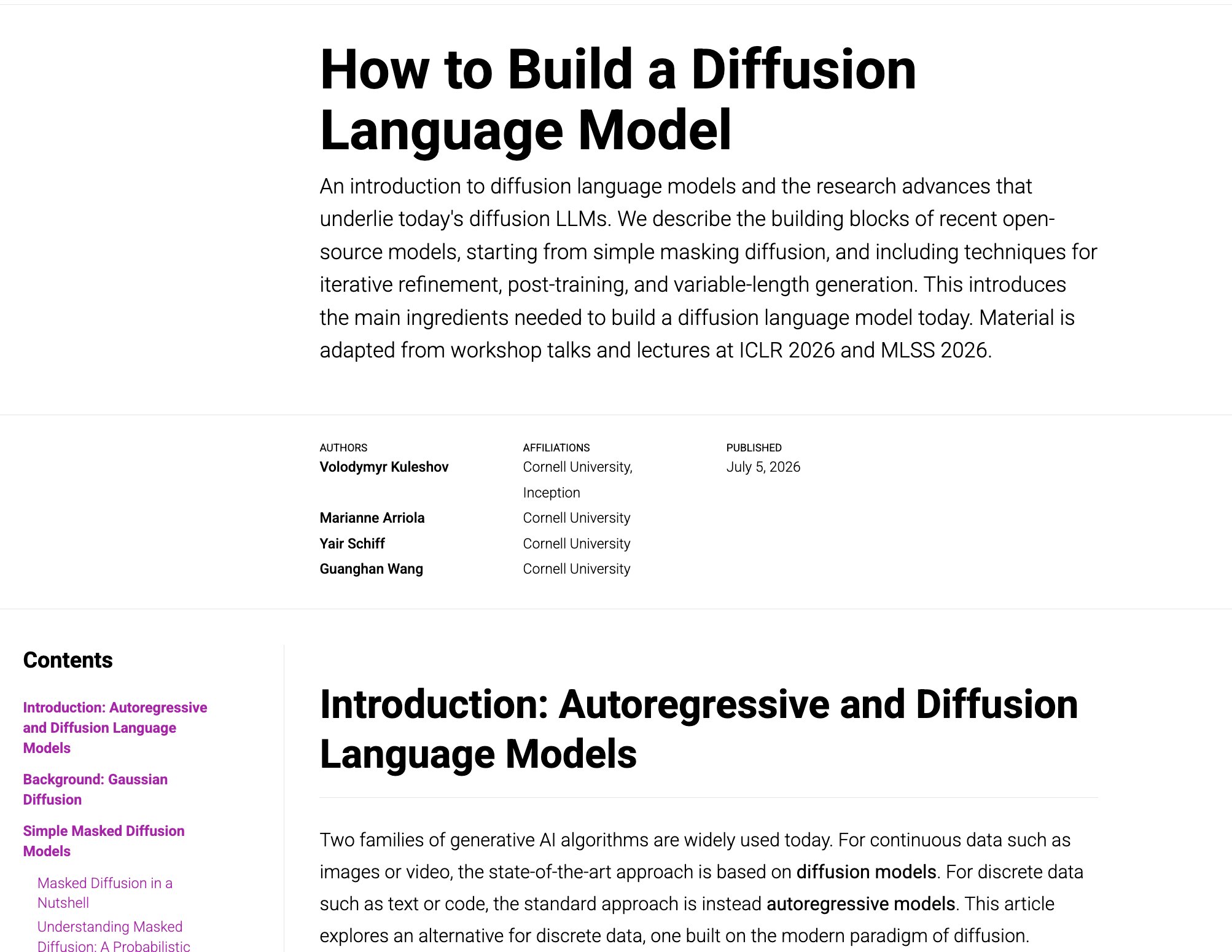
New blog post: How to Build a Diffusion Language Model. Diffusion LLMs went from open problem to reality in 2 years (Mercury, Gemma Diffusion, Nemotron Diffusion). With my Cornell group, we wrote up the research advances that make them work. We use today's OSS large diffusion models as examples and show how they're built from core techniques: • masked diffusion (MDLM) • iterative refinement (UDLM, ReMDM) • variable-length generation (block diffusion, encoder-decoder architectures) • controllable generation (D-CFG, D-CBG) • fast samplers (Duo) • RL post-training (d1, d2) This post covers research led by a talented group of Cornell PhD students including @mariannearr @SchiffYair @Guanghan__Wang The content is adapted from talks I gave this year on dLLMs. It covers most of the main ingredients behind open-source diffusion language models today. Link: kuleshov-group.github.io/blo…
17
198
8
1,487
133,708
拙著「作ろう!CPU」が、来週から全国書店で発売されます! 電気や回路に詳しくない超初心者を対象に、小学校レベルの回路から出発し、徹底的にシンプルな4bit CPUを設計し、無料のシミュレータやFPGAで動かす本です。CPU設計のコード行数は69行です。絶対に挫折させません!amane-uehara.github.io/cpubo…
25
3,313
215
9,068
댕댕 retweeted
GEMINI预训练团队负责人在五月份写了一篇《如何进入头部AI团队/实验室》,非常值得一读,总结10条经验: 前沿实验室的招聘卷得厉害,能进去的大多出自顶尖本科或博士项目,身上普遍有三样东西:方向打得准、数学功底硬、拼劲十足。 对大多数普通人来说,硬挤正面没胜算,更务实的打法是绕到 LLM 栈的两头——要么沉下去做底层(kernel 优化、推理加速、量化),要么浮上来做上层(agent 系统、用 LLM 搞算法实验),靠开源项目和实打实的成果说话,比什么都有说服力。 1. 找准方向,切忌空谈 别张嘴就是“我对 AI 感兴趣”。得盯准实验室真正缺人的地方:底层就死磕 FlashAttention、量化推理、kernel 编程;上层就做 agent 循环、LLM 辅助的实验设计。这些方向门槛不高,自学能上手,实验室又天天用得着。 2. 数学底子绕不过去 这里没有捷径,只能靠大量证明题和理论课程硬磨。优化理论、scaling laws、模型演化逻辑,得吃到骨子里去。数学成熟度是分水岭,过了就是研究者,没过就是操作工。 3. 拼劲得够,别怕苦 大学那几年,周末泡图书馆是常态,社交能砍就砍。作者当年和朋友靠浓咖啡硬扛一整天,就这么熬过来的。想和那拨尖子生掰手腕,没有这点强度打底,基本没戏。 4. 用开源项目破局,别指望简历 把代码挂到 GitHub 上,做复现、提改进、跑 benchmark。能力这东西,摆出来给人看,比写在纸上管用得多。 5. 从边角料干起,别一上来就冲大模型 先搞定 kernel 编程(CuTe、LLM.int8() 量化这些)、推理优化、agent 工具链。这些活实验室最缺人,也最容易自己闷头学出来。 6. 论文 + 动手复现,两手都要硬 精读 FlashAttention、SnapKV 这些经典,把 LLM 的脉络理清楚。建议从 Reiner Pope 的访谈和 Gemini Flash 的预训练讲座入手,再慢慢啃 scaling laws。 7. AI 工具用来提速,别用来代替学习 AI 能让你已经会的东西干得更快,但绝不能拿它来学新东西或跳过思考。一依赖就废,数学和拼劲都养不出来了。 8. 每隔半年复盘一次方向 别嫌活脏、别嫌活基础——只要那条路通到金矿,就值得挖。关键是想清楚自己在往哪走。 9. 拿具体练习证明自己 - 用 JAX/Flax 从零写一个 1000 万参数左右的 Transformer,在 Colab TPU 上跑通加法任务; - 手推 Chinchilla scaling laws,对比稠密模型和 MoE; - 写一个 Pallas kernel 做算子融合,实测前向加速并说清原因。 10. 最终就一条路:本事 + 作品 + 死磕,缺一不可 名校背景当然管用,但对出身一般的选手,最靠谱的就是在 kernel 或 agent 领域做出能拿出来秀的东西,然后做好打 5–10 年持久战的准备。
30
171
7
752
55,420