

New Hardware Architecture papers from https://xitter.cf/t.co/6hoXZ9RzY2: systems organization and hardware architecture. Thank you to arXiv for use of its open access interoperability.
- Tweets7.9K
- Following2
- Followers799
- Likes2






ALT Digital SRAM compute-in-memory (CIM) macros enable energy-efficient CNN inference by eliminating off-chip weight transfers; however, peripheral control logic introduces three inefficiencies: bit- slice over-activation at reduced precision (L1), unnecessary accumula- tion depth (L2), and idle precision-transition stalls (L3). To address these, we present four synthesizable peripheral blocks: a Flush-Merge Enable (FME) controller, a Confidence-Based Early-Exit (EE) module, a Precision Register with Decoder (PR/PD), and a Bit-Serial Cycle Controller (CC), co-designed to minimize switching activity, wordline overhead, and leakage. Implemented in TSMC 65-nm CMOS at 335 MHz, the peripheral framework occupies 1769.760 μm2 post-synthesis and 1982.131 μm2 post-PnR. Gate-level VCD analysis reports 6.0706 μW leakage and 288.2902 μW (post-synthesis) / 322.8850 μW (post-PnR) dynamic power, totaling 328.9556 μW (0.2402% of system power). The EE module dominates dynamic power (58.2%), while WLG domin

ALT Physical non-idealities in integrated circuit (IC) design and fabrication are concealed by conventional hardware abstractions, yet they can limit kernel performance and obscure optimization opportunities. Using distributed shared memory (DSMEM) on NVIDIA H100 GPUs as a case study, we show how floorsweeping restricts hardware resources available for clustered execution, potentially offsetting the benefits of reduced data movement enabled by DSMEM. Guided by these insights, we develop a wave-aware clustering strategy that accounts for these resource constraints to improve kernel performance. Evaluations using a global-load-and-broadcast microbenchmark, GEMM, and the Hopper version of FlashAttention 4 demonstrate the performance implications of these constraints, with wave-aware clustering improving FlashAttention 4 throughput by up to 5.30% over its baseline. We further show that, under thermal design power (TDP) limits, reduced data movement enables higher Streaming Multiprocessor (SM)

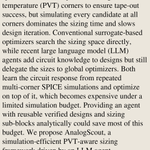
ALT Analog device sizing must satisfy all specifications across process, voltage, and temperature (PVT) corners to ensure tape-out success, but simulating every candidate at all corners dominates the sizing time and slows design iteration. Conventional surrogate-based optimizers search the sizing space directly, while recent large language model (LLM) agents add circuit knowledge to designs but still delegate the sizes to global optimizers. Both learn the circuit response from repeated multi-corner SPICE simulations and optimize on top of it, which becomes expensive under a limited simulation budget. Providing an agent with reusable verified designs and sizing sub-blocks analytically could save most of this budget. We propose AnalogScout, a simulation-efficient PVT-aware sizing framework driven by an LLM agent. Combining elite-design reuse, analytic gm/Id local sizing and global refinement under full-corner verification, AnalogScout reduces power by 43.3% relative to the evolution strategy

ALT Distinguishing Purkinje cell (PC) simple spikes (SSs) from complex spikes (CSs) is key to studying cerebellar function. PC recordings commonly rely on wired headstages, whose tethers restrict natural movement in freely behaving animals. Untethered headstages remove this constraint, but cannot continuously transmit raw recordings within their power budgets, making on-headstage spike classification an attractive form of compression, provided it runs accurately in real time on constrained hardware. This work presents two compact spiking neural networks (SNNs) matched to their target hardware: ConvSNN, which maps to the Matrix Vector Processor (MVP) of an EFM32PG28 microcontroller, and StreamSNN, which processes one waveform value per timestep using learned time constants and fixed synaptic delays for a dedicated SKY130 circuit. Evaluated on cells unseen during training, ConvSNN achieves a CS F1 of 0.873 with 1,018 parameters and StreamSNN 0.837 with 527 parameters, both with eight-bit wei

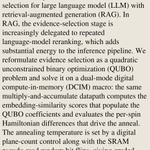
ALT We present a fabricated SRAM DCIM Ising machine that performs set-level context selection for large language model (LLM) with retrieval-augmented generation (RAG). In RAG, the evidence-selection stage is increasingly delegated to repeated language-model reranking, which adds substantial energy to the inference pipeline. We reformulate evidence selection as a quadratic unconstrained binary optimization (QUBO) problem and solve it on a dual-mode digital compute-in-memory (DCIM) macro: the same multiply-and-accumulate datapath computes the embedding-similarity scores that populate the QUBO coefficients and evaluates the per-spin Hamiltonian differences that drive the anneal. The annealing temperature is set by a digital plane-count control along with the SRAM pseudo-read random bit flips, giving graded cooling entirely from on-chip digital configuration. The macro is taped-out in a 28 nm process [0.16 mm2, 0.41 mW] and is proposed to be integrated as part of the logic base-die in hybrid h

ALT The rapid growth of large loads, especially data centers driven by artificial intelligence, is creating unprecedented demands on the North American electric grid. Data centers now account for nearly 80% of large load interconnection requests in the Western Interconnection, and U.S. electricity consumption from data centers is projected to reach 325-580 TWh by 2028. Despite this urgency, technical interconnection requirements for large loads have not yet matured and still contain several gaps. This paper presents a comparative analysis of large load interconnection requirements across eleven U.S. entities, including AEP, Ameren, CAISO, Dominion, Duke Energy, ERCOT, LIPA, MISO, PJM, Southern Company, and SPP, under seven technical categories: large load definition, load data and modeling, fault ride-through, load curtailment and shedding, dispatchability, power quality, and reactive power control. The analysis reveals significant variation in both the scope and specificity of requirement

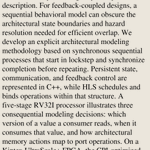
ALT High-level synthesis (HLS) can schedule only the concurrency made legal by its input description. For feedback-coupled designs, a sequential behavioral model can obscure the architectural state boundaries and hazard resolution needed for efficient overlap. We develop an explicit architectural modeling methodology based on synchronous sequential processes that start in lockstep and synchronize completion before repeating. Persistent state, communication, and feedback control are represented in C++, while HLS schedules and binds operations within that structure. A five-stage RV32I processor illustrates three consequential modeling decisions: which version of a value a consumer reads, when it consumes that value, and how architectural memory actions map to port operations. On a Kintex UltraScale+ FPGA, the CPI-optimized configuration achieves 1.221 cycles per instruction at 220 MHz, compared with 4.000 for an algorithmic HLS baseline and 1.575 at 242 MHz for an Ibex reference. An area-opt

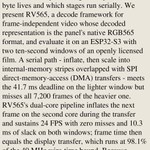
ALT Video on SPI-attached microcontroller displays is limited less by decoding than by where each byte lives and which stages run serially. We present RV565, a decode framework for frame-independent video whose decoded representation is the panel's native RGB565 format, and evaluate it on an ESP32-S3 with two ten-second windows of an openly licensed film. A serial path - inflate, then scale into internal-memory stripes overlapped with SPI direct-memory-access (DMA) transfers - meets the 41.7 ms deadline on the lighter window but misses all 7,200 frames of the heavier one. RV565's dual-core pipeline inflates the next frame on the second core during the transfer and sustains 24 FPS with zero misses and 10.3 ms of slack on both windows; frame time then equals the display transfer, which runs at 98.1% of the 40 MHz wire-time bound. Because frames are independent, inflation time is linear in the compressed length stored in the container (pooled r² = 0.9987): a model fitted on one window predict

ALT Routing the bus between a processor and its DRAM remains largely manual in printed circuit board (PCB) design, and published algorithms optimize proxies such as crossing or layer counts. We present a router that plans every lane of a two-layer BGA-to-BGA bus before any copper is laid, and carries the plan to design-rule-clean copper. Its core is an exact constraint-programming model that chooses, for all lanes at once, where each necessary crossing occurs, in what order – by a rule over every triple of lanes – and where each lane changes layer, with via room; for the ends it is given, it proves its plan optimal within the model. The model reads naturally as physics: worldlines, frustrated Ising spins and contact forces. A linear program places the lanes in millimeters; the constraints it must violate return to the model as cuts, and audit findings as negotiated congestion prices, until the plan passes an audit against the production router's rules or lays clean. The escapes are chosen

ALT This paper presents a new technique for detecting single stuck-at and bridging faults in cluster-based FPGA architectures, using same set of test vectors generated by a test pattern generator circuitry. This technique is based on configuration of logic elements using test logic structure and the outputs of two separated logic elements are compared to detect a fault. To do this, block under test, TPG and output response analysis circuitry are generated in FPGAs. The configurations of test pattern generation, block under test and output response analysis are also discussed in this paper. The novelty lies in the fact that the same set of test vectors can detect all the stuck-at as well as bridging faults if the test vectors are applied in a particular sequence and analyzing the output results. We presented a detail analysis of results to detect faults as well.

ALT Efficient microarchitecture design space exploration (DSE) is critical for optimizing performance, power, and area trade-offs in modern out-of-order processors. While machine-learning-based DSE significantly reduces the cost of exhaustively evaluating large design spaces, existing methods still waste expensive simulations on Pareto-miss candidates that do not improve the Pareto frontier and repeatedly process redundant candidates during iterative exploration. In this paper, we propose PaFeDSE, a Pareto-feedback-guided microarchitecture DSE framework for efficient Pareto search. PaFeDSE leverages Pareto-hit feedback to prioritize candidates likely to improve the frontier and Pareto-miss feedback to suppress exploration of unpromising local regions, while filtering redundant candidates that remain low priority across iterations. Evaluated on SPEC CPU 2017 workloads, PaFeDSE requires up to 49.0% fewer simulations than the strongest prior baseline to reach target hypervolume levels, while

ALT LLMs on edge devices are constrained by limited memory and bandwidth. Although 1.58-bit ternary weights greatly reduce model storage, long-context inference is increasingly bottlenecked by KV-cache traffic and attention. Existing accelerators also use separate datapaths for ternary linear layers and attention, incurring hardware and execution overhead. We present SPARTA, a sparse ternary LLM accelerator for efficient long-context edge inference. SPARTA integrates: (1) a phase-aware sparse dataflow exploiting heterogeneous sparsity across compute-bound prefill and memory-bound decode; (2) a unified compute fabric mapping ternary SpMM/SpMV and bit-serial attention onto shared processing elements to exploit zero-weight and zero-bit sparsity; and (3) an adaptive two-stage attention engine combining page-level Top-k selection to reduce K-cache accesses with token-level Top-p pruning to reduce V-cache traffic. SPARTA reduces KV traffic by 4.1-4.8x over full attention and 1.3-1.5x over a stat

ALT This paper presents Memory- and Communication-Aware Framework for Long-Context LLM Inference (MCF) that optimizes long-context inference through communication-aware and stage-adaptive KV-cache layout transitions. At the core of MCF is Memory-Aware Replication and Scheduling (MARS), a dynamic orchestration mechanism for chunked prefill. MARS exploits early-stage memory headroom by selectively replicating highly reused KV blocks, improving locality and hiding KV propagation latency behind attention computation. As prefill progresses and memory pressure increases, MARS progressively drains redundant replicas and converges the KV cache into a sharded decode-ready layout, avoiding expensive layout conversion at the prefill–decode boundary. For decoding, MCF adopts a query-centric execution model in which KV shards remain stationary while lightweight query tensors are routed across workers. This changes communication from KV-cache-dependent transfer to query-dependent transfer, reducing comm

ALT Time-sensitive neuromorphic architectures require predictable interconnects to preserve precise event timing. Statically scheduled time-division-multiplexed (TDM) circuit-switched networks-on-chip (NoCs) provide deterministic latency at the cost of linear configuration-memory scaling with schedule depth. Furthermore, jointly optimizing task placement, routing, and scheduling creates an intractable combinatorial search space. Existing deployment frameworks also ignore algorithmic axonal delays by forcing immediate spike injections that increase network contention. This paper proposes a hardware-software co-design to address these challenges. ChroNoC is a tableless TDM NoC that embeds precomputed full-grid broadcast trees into combinational logic as a fixed routing substrate. This fixed substrate reduces deployment to a spatial search via Delay-Aware Reservations and Spatial Annealing (DARSA). DARSA converts axonal delays into periodic scheduling slack to stagger network injections and r

ALT Modern system-on-chip (SoC) floorplanning is increasingly challenged by highly coupled complex design constraints. Existing methods often relax constraints into objectives via multi-objective optimization, leading to infeasible solutions or degraded quality. To address this, we formulate the problem as a constrained optimization task and propose a novel three-stage analytical framework integrating semidefinite programming (SDP), augmented Lagrangian method (ALM), and second-order cone programming (SOCP), which enforces constraints more rigorously and achieves higher-quality solutions. First, we adopt a two-step SDP formulation to obtain a robust initialization in the non-convex search space. Next, we incorporate differentiable objectives and constraints into an incremental ALM to jointly handle coupled design constraints during global floorplanning. Finally, an SOCP-based legalization strictly enforces feasibility while further reducing area. Experiments on the FloorSet benchmark show

ALT Qubit readout, or qubit state discrimination, remains one of the slowest and most error-prone operations in superconducting quantum processors, making fast, accurate, and hardware-efficient classification essential for scalable quantum computing. Conventional discriminators integrate the I/Q record into a single point, discarding evidence a relaxing qubit leaves behind; full-resolution feed-forward classifiers recover it but are too costly to deploy under this constraint. Recurrent classifiers retain full resolution far more cheaply, but their loop-carried hidden state cannot fit a single AI Engine (AIE) tile's register capacity and spills to data memory, adding latency that grows with sequence length. We present a hardware-aware LSTM accelerator for an AMD Versal device that resolves this by partitioning at the dependency boundary - independent input projections on the AIE array, the loop-carried update in programmable logic (PL) - keeping pace with a 64 ns input cadence under a 1,000

ALT The pervasive deployment of Deep Neural Networks (DNNs) across the computing spectrum has brought growing attention to energy efficiency, alongside raw performance. While voltage scaling is a potent knob for power reduction, its application in next-generation nodes is hampered by severe throughput degradation and susceptibility to process variation. This work aims to address these energy-reliability trade-offs by introducing a hardware-software co-design methodology, based on the observation that timing-robust bit ranges within the accumulator of a systolic array vary significantly across different voltage-frequency operating points. At the software level, we propose an Accumulation-Aware Training approach that incorporates this information as a first-order optimization constraint during training. By integrating mixed-precision quantization with unstructured pruning, we effectively constrain the model's weight distribution to avoid activating the hardware's sensitized high-rank carry c

ALT The key-value (KV) cache places growing demands on GPU memory capacity and bandwidth as large language models serve longer contexts and more concurrent requests. Its footprint limits concurrency, while repeated KV reads during attention can make decoding memory-bandwidth bound. Prior lossless KV cache compression methods reduce transfers between devices but restore the uncompressed KV cache in GPU memory before attention. They therefore leave these repeated KV reads unchanged and require additional work and memory for decompression. We present ZipFusion, which enables attention to consume the losslessly compressed KV cache directly. ZipFusion co-designs the compression format and attention kernel to reduce the bytes read from GPU memory during attention. The kernel reconstructs the original values directly in registers using simple bit operations, avoiding a separate decompression pass and easing the memory-bandwidth bound. ZipFusion also reassigns memory freed by compression across la

ALT Routing has become a major bottleneck in large-scale FPGA design flows, where traditional routers rely on sequential net-by-net processing and rip-up-reroute heuristics. This inherent sequentialism limits parallelism, leads to suboptimal utilization of routing resources, and significantly increases runtime on modern FPGAs. This paper introduces DiffRouter, the first differentiable, gradient-based FPGA routing framework with GPU acceleration. By lifting routing into a continuous optimization space, DiffRouter enables highly concurrent routing and improved global optimality before projecting solutions back onto the discrete fabric. The framework consists of three key stages: (1) Resource-pruned preprocessing, which extracts compact routing variables per net to reduce memory footprint and problem complexity; (2) Differentiable global routing via gradient descent, which formulates routing as a Lagrangian-relaxed optimization that minimizes wirelength while iteratively enforcing connectivit

ALT Inductor- and transformer-coupled balanced mixers are usually analyzed with switching approximations, conversion matrices, harmonic balance, or circuit simulation. This paper instead derives their loaded quasistatic equations from the device laws, keeping the transformer ratios, reflected load, bias, and the connections that set the IF common mode. The functions needed to solve these equations are surprisingly varied. A Shockley single-balanced pair is solved by the principal Lambert function W₀ under a quantified one-diode-dominance condition. The double-balanced ring has a unique loaded solution that reduces to an exact inverse-hyperbolic-tangent form only for an open IF port. Vacuum diodes and triodes lead to Cardano cubics and structured sextics, whereas depletion JFET/MESFET crossbars need only square roots. Bilateral MOS channels give piecewise quadratics in strong inversion, or a Ferrari quartic when the IF winding floats. In weak inversion they give an exact W₀, the real r-Lamb