

Introverted Optimist, Building @AgletsAI. Dot Connector, Tool Builder, Coder, and Geek. Into Data, Local & Sovereign AI, SLMs, RL, and making hard things easier
Now YVR | Soon Everywhere
Joined June 2008
- Tweets27.1K
- Following241
- Followers2.1K
- Likes32.4K


October 1st may be the most impactful @pidotdev day since @badlogicgames wrote his original launch post announcing what would became an s-tier coding agent and the much loved core of many popular open source agent products. Even bigger than the Earendil merger announcement. Congrats to the team. ✨
Pi 1.0:
earendil.com/posts/pi-1-0/
Durable Events:
earendil.com/posts/pi-durabl…
With a very interesting single faq item teaser thrown in at the end of the Pi Durable release post. A teaser perhaps⁉️
FAQ:
Why Typescript Again?
Because it is the easiest way to bootstrap this. But as everybody knows by now, it's very easy to port everything to Rust or assembler. We're not ruling this out in the future, but at the moment we are focusing on TypeScript.

Christopher retweeted

You can now train an open model with RL inside claude code, codex, opencode, pi, or any harness you need. All at once, with the harness runs unmodified.
@adithya_s_k added a capture proxy to openenv. it sits between the harness and the model and records the exact token ids and logprobs of every call. to the harness it's just another model provider. harbor supplies the tasks and sandboxes, trl trains with async GRPO.
it's worth doing because the harness completely changes what the model learns. the same LFM2.5-2.6B weights solve 62% of held-out tasks in mini-swe-agent and 33% in claude code. after RL across four harnesses the average goes from 42% to 54%, and claude code from 33% to 49%.
there are three envs you can try in the browser and a training script for each.
guide: huggingface.co/spaces/Adithy…

The new 6.1 Sol is very good though I’m setting it on high vs medium which I was using on the last version.
I haven’t tried it with my own harness via the api yet but I will and need to bench properly.
I have seen some saying use it on Max.
So I’m not sure what it’ll do to my plan burn but it feels efficient and fast. Need to look at real Terminal Bench numbers (@evalstate 🤞) to confirm but I like it.
Since I got access I’ve only looked to Astra for porting code, architecture deep dives in a large codebase and unfamiliar codebases, deep new greenfield tasks, one ongoing, a very messy, structured document unification task and for cleaning up output when I’m not happy with the way the code looks after 6.1 is done. How about you?

A hard few days.
Competition is inevitable especially where we’re at with AI but when you see an incumbent with deep distribution move into the space you’ve been killing yourself trying to define it feels like a gut punch.
All you can do is believe, work hard, and deliver for your prospective customers.
I want to highlight more WebMCP tools. This one’s not something I’d use a lot but I think it’s a a great example of WebMCP at work.
Lottie Creator WebMCP (via @LottieFiles):
The cool thing about WenMCP is it allows for interactivity between you and the app, not just promoting and not just manual actions.
Using the Creator WebMCP you’d give it an initial prompt to generate your Lottie, preview the result, then refine it with follow-up prompts OR open it in Lottie Creator directly to manually edit.
As someone who knows what he’d like to do with these kinds of tools but is graphically inept things like this WebMCP are huge. I’m going to try and use it to create some animations for my landing page.🤩
lottiefiles.com/lottie-creat…
lottiefiles.com/blog/working…

Every day I’m grateful Hugging Face (@huggingface) exists‼️🍺
Can you imagine where open source ai would be if the team didn’t execute the pivot from its origins in 2016 as a chatbot for teenagers designed to act as an "artificial BFF" to a (the) platform for Open Source AI Infrastructure?
And imo it’s still early in the game.
The model, dataset, and papers library function is insanely great but the (rapidly evolving and expanding) tooling is just as exciting.
There’s tons of approaches to improving context handling. This method from Meta looks very interesting!
Context Language Models (CLMs), language models that natively manage their own context. We implement this by treating the context as a file and allowing the model to make unrestricted updates to this file. This allows the model to learn what is most important to maintain in context, and naturally extends to multi-agent systems where multiple agent contexts coexist as files.
github.com/facebookresearch/…
arxiv.org/abs/2609.37725

ByteDance Traverse-AutoGen dataset on Hugging Face
Traverse addresses the problem of long-horizon information-seeking agents often accumulating noisy or misleading evidence where early mistakes can persist across many turns, biasing later decisions, and eventually trapping the agent in an unproductive search path.
Traverse: Learning When to Remember, Reset, and Redirect for Long-Horizon Web Search Paper:
arxiv.org/abs/2609.37082
Official Inference and Evaluation Harness Repo:
github.com/ByteDance-BandAI/…
Dataset:
8,617 auto-generated information-seeking QA pairs for long-horizon web search, with difficulty labels.
Note: Even though the dataset’s questions and reference answers are automatically generated and may contain errors, ambiguity, or outdated information this could be very useful.
huggingface.co/datasets/Byte…

The team at @liquidai released their version of a decision model.
It’s API only and not trainable, so there are no GGUF or MLX weights to self-host.
At time of writing there’s a free tier to get started which is nice.
docs.liquid.ai/lfm/models/de…
Note: See GLiNER2.5-Decide for a very good, small, local, trainable model. I’ll be evaluating this model vs GLiNER since it is where I’ve been focused.
Note: I think we’re going to find we’re fine tuning our decision models more often than using the base model.

One of the 3 things I’m most excited about with the latest mcp working groups. Server Cards and the concept of compound mcp tools are right there with it.
Great talk!

Meet Ola. One of the folks leading the Skills Over MCP working group. Ola and other volunteer engineers worked on extending MCP to discover and fetch Agent Skills
Happy to see that this accepted as an official extension 🎉
Ola gave us a break down of how this all works at AGNTCon + MCPCon Japan. Content great and the slides were 🔥
Check out it!
youtu.be/3oHLjC3wZNE

There's a new version of this post
Turns out the morris are there. You need to hover. My bad though it really should just be visible.

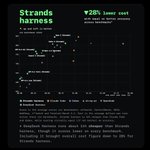
This Strands chart might be one of the most useless I’ve ever seen. Notice the Strands evals show what model is being tested but the other harnesses do not. Are we supposed to guess the model attached to the other harnesses based on their position in the chart? Maybe divination?
strandsagents.com/blog/intro…

Wonder how many startup dreams you’ll all end up crushing this DevDay. It’s almost an oxymoron. I don’t begrudge you all looking at what works, what the enterprises want and adopting it but it can be hard if you’re a small startup building something.
This Strands chart might be one of the most useless I’ve ever seen. Notice the Strands evals show what model is being tested but the other harnesses do not. Are we supposed to guess the model attached to the other harnesses based on their position in the chart? Maybe divination?
strandsagents.com/blog/intro…
They did it‼️
@fastinoAI released an open, freaking tiny decision model and it looks incredible.

Decision models should do more than pick a label.
To truly act, they need to extract evidence, understand relationships, produce structured records, and keep related decisions consistent. And they should do it fast.
That’s the new model we built with GLiNER2.5-Decide.
Like all GLiNER models, this one is highly responsive to fine-tuning. And now you can fine-tune GLiNER models, including GLiNER2.5-Decide, directly inside your coding agent with our new API.
To make building with GLiNER2.5-Decide as fast and simple as possible, we’re also offering hosted inference.
Our model goes beyond typed classification. It can return character-level spans, relations, and structured records, then apply implications, exclusions, cardinality limits, and ordinal bounds across related decisions.
And it does all of this very fast. On short, single-document requests:
CPU latency → 167 ms (48-vCPU Intel Xeon Platinum 8581C)
GPU latency → 38 to 47 ms (T4, L4, V100, A100)
Run it locally, host it, or fine-tune it. Your decision.
Download the weights on @huggingface: huggingface.co/fastino/GLiNE…

Building a startup is hard.
Hit a wall a week back. Recovered in a couple of days but just like whiplash the real hurt started when I tried to reboot.
Took me down for a full week.
Recovered. But 18+ hours a day, every day, waking up for calls and messages, the need to just keep working, it can only be sustained for so long.
Now with everything else like competing with elephants I come back to find my Astra usage on the Pro plan goes 1/2 as far today as it did yesterday - unless I’m reading that baffle gab legal forced the team to put out. I’m assuming it was legal.
Unless the language is much clearer I’m not buying the, you’re getting more today than you did yesterday even though your plan usage has been cut in half for Astra. Astra might be more efficient but it’s no more efficient today than it was yesterday so I’m not getting the vaunted model improvement savings as an existing plan user while using Astra, it’s kind of as simple as that. Of course unless I’m reading the post wrong.
I’m not even that upset. It was bound to happen. They could only subsidize usage for so long.
I just wish the language was more honest.
This will push open models even more to the fore. It’s a risky though necessary move as I said. Pausing training. Cutting usage. All this feels a lot like ipo prep.
Hmm. I wonder if reset bonuses will be going away as well?
This language is the type I dislike. It wraps what I think is a downgrade in fluffy pseudo upgrade language rather than just saying, if you’re on the $200 plan today the usage you had yesterday is cut in half on Astra.
Of course this is unless I’m misreading things. Which I probably am. I wish this stuff was just xyz instead of something legal came up with.
My understanding:
The $200 plan just had its usage cut in half but the spin is the models are better so they do more at the same price and were halving the cost of less capable models so you get more. The rub is I have to wait for the more capable model (if I’m using Astra today) or use a less capable model otherwise the so called improvement or cost savings doesn't exist for me.
Astra usage today is half what it was yesterday. Yes or No?
So no we’re not getting the same level of usage if we were already on the $200 plan.
Of course I may be reading this wrong and I lead from giving people the benefit of the doubt so please confirm or deny my understanding above.
Pausing training, halving limits. Feels like ipo prep to me wrapped in fluffy legal team language. I want to be wrong. I’ll believe I’m wrong but I want confirmation please.
/cc @reach_vb

Hi,
Tomorrow we are re-opening the Pro $200 subscriptions to new subscribers, but together with it we are also changing how we calculate the usage for it. In effect, if you do the math, it will net out at half the dollar in API spend compared to the old Pro $200 plan.
Now that it's said, let me explain why this is happening and why you will still get more work done than if you were on the Pro $200 subscription one month ago.
(a) We didn't want to compromise in other ways and are committing to not reintroducing the 5h limit, so that you can fully use the weekly usage when you want.
(b) On the subscription, we guarantee that over time you always get more work done and with an increasing level of quality. This means that you will continue to get more value per dollar spent as a result of models getting more efficient and us passing down the improvements in the form of API price reductions.
(c) We don't want to put an incentive on ourselves to artificially inflate the API list prices to make it look like you are getting a lot (and workaround it through discounts, etc). Instead we want to continue to both rapidly reduce prices and increase capabilities of models on the API. This week we introduced GPT-6 Sol and GPT-6 Luna at 50% of their previous price. Over time, we see prices go low enough that it makes sense for most to buy usage as needed without there being a significant gap between what you get in a subscription and what you get in the API for a dollar spent.
(d) Tomorrow, we are adding more things to the subscription that won't draw on the usage, I won't reveal what that is yet.
I wanted to be transparent before all the big announcements tomorrow. Lots of new exciting things are coming to the subscriptions that will make it super compelling, but I wanted to make sure to share this change ahead of time so you can all understand it before we shower you with good news.
Codexingly,
Tibo
The linked post is a rational take. These are still just tools. Incredibly smart tools that remove most of the boring parts of being an engineer, but still tools.
The people who know how to use coding agents and also understand what they should be generating so the codebase grows rather than groans are still a fraction of the people currently pushing code with them.
Using these tools is a new skill. It’s not push a button and great code comes out. Sure, you can push a button and code will come out, but this is where craft starts to matter.
It’s a double-edged sword. A lot of the old rules are changing or disappearing, but the core engineering knowledge is still needed. The new skill is knowing how to combine that knowledge with agents well.
No, that’s not elitist dev talk. It’s simple reality.
Coding agents work best with well thought-out, well-architected codebases. It takes work to guide them from greenfield into an evolving brownfield system without eventually collapsing under the weight of what they’ve generated.
Don’t get me wrong. Coding agents are enabling a whole new group of people to build software, which is AWESOME.
But most will initially be building smaller, targeted applications, not large systems that need to survive revision after revision over time. And even then, there’s baseline knowledge around security, architecture, testing and deployment that really needs to be there or you’re doing yourself and your users a disservice.
The bottom line is that craft still matters. Knowing how to think, guide, review and make architectural decisions still matters.
If you’re new, learn those things.
If you’re experienced, exploit them.
We may no longer be doing much of the mechanical act of typing code, but we still own what our agents generate.

Bury your head in the ground at your own risk. I aim to not jump on any hype trains, but since Opus 4.6 and GPT-5.2 + the harnesses it was clear that these things can write code nearly as good as I can in my best language; better in other languages.
But we won't see non-devs push production code for a long time; possibly forever, if you ask me. Software still needs to be built in robust ways, and it's our profession to do this well, and use the new tools we have, which create new and interesting (+tough!) challenges
Christopher retweeted

Credit assignment in AI matters.
Jev is receiving attention for schema-defined probabilistic decisions. But the underlying capability, schema-conditioned multi-task classification in is not new.
At @fastinoAI we built #GLiNER2 and released it publicly in 2025, published at #EMNLP2025: one text input, user-defined label spaces, multiple classification tasks, and confidence scores, all in one forward pass.
It has been open source under Apache-2.0 since then, and the ecosystem reflects that, with multiple fine-tunes across Hugging Face.
The framing is compelling, and Jev is heavily optimized for classification, so it may well be stronger on that specific task. But GLiNER2 is more general. Beyond classification it handles entities, structured extraction, and relations, which is what let us ship domain models on the same interface:
Guardrails (GLiGuard): huggingface.co/fastino/gligu…
PII detection and masking: huggingface.co/fastino/gline…
Paper: aclanthology.org/2025.emnlp-…
Code: github.com/fastino-ai/GLiNER…
HF: huggingface.co/collections/f…

If the team that created the GLiNER family is going to release a decision model I’m going to lose my mind.
I’ve been a GLiNER fan boy for a long time and GLiNER 2.5 was an amazing drop.
I’ve been reviewing other open decision models but this feels game changing without it even being released. Why? Simple. There are few teams I trust more with this type of model than @fastinoAI ‼️✨
The GLiNER 2.5 drop got lost in the usual big model hype but it was one of those high impact releases that had people doing real work drooling.
If the new decision models runs local and is also open I’m going to lose much more than my mind…
Can’t wait! 🤩
Hook me up.🤞🙏

Christopher retweeted

GLiNER is and always will remain open source

We are getting GLiNER2.5 support in vllm.cpp and in @LocalAI_API , supporting systemone API so you can swap it easily.
GLiNER2.5 went unnoticed until now that Jev is covering the news. Thanks @fastinoAI for making it open source and work in the open.