
tracking research ideas here
Joined February 2024
- Tweets3K
- Following129
- Followers10
- Likes677
bugsinside retweeted

We’re often urged to tolerate difference, as though tolerance alone could sustain peace. bit.ly/4z4hsaY
But philosopher Hamedeh Rastaei warns that tolerance by itself is dangerously unstable. Instead, we should recognise the deep metaphysical truth that the identity of our self depends on the difference of others.

bugsinside retweeted


所谓优雅的数学结构,本质上是人类为了迁就自己那点可怜的脑容量,被迫发明出来的拐杖。
一个顶尖人类数学家的工作内存,撑死也就同时追踪五六个变量的交互。
当你在算一个偏微分方程或者组合不等式时,一旦展开到三阶以上,几十个交叉项涌出来,人脑就直接宕机了。
所以人类数学家极其厌恶展开高阶项,一旦看到高阶项发散,人类的本能反应是此路不通,赶紧退回来找对称性、找不变量、搞同调代数或者几何直观,试图不展开式子就把问题绕过去。
但 AI 没有这个生理缺陷。
对于上万个并发的 Agent 来说,同时追踪一万个五阶交叉项的系数变化,跟我们算 1+1 一样轻松。
在它的视野里,根本不需要什么几何直观,它直接站在高维的代数展开式里往下看,人类觉得像乱麻一样的百项高阶余项,在它眼里就是一张明明白白的线性方程组。
既然把式子硬展开到第七阶,再凑几个待定系数就能让所有讨厌的发散项精准归零,它为什么要费劲去帮你发明一个人类能看懂的新概念?
这 700 个结果背后最无奈的黑色幽默:我们终于拿到了上帝账本里的答案,却发现上帝算账根本不用微积分,他老人家是直接拿计算器硬按出来的。
bugsinside retweeted

也算大势所趋了,最近深有感触。
或者你也可以从一个公司面试的方式上去判断这个公司跟不跟得上 AI 发展。

bugsinside retweeted

Are ViTs really as explainable as we think?🔍
We show that patch-token explainability (like in Logit Lens) is not inherent to ViTs, as commonly assumed!
Instead, it's a fragile byproduct of their training conditions.
1/7
🔗ronensc.github.io/Explainabi…
w/ Ronen Schaffer,@t_michaeli

ALT While in some ViTs object tokens score higher than background tokens as we might expect, in other ViTs background tokens are hotter. In some ViTs explainability maps can even be unexplainable!
bugsinside retweeted

Scientists had long thought that different areas of our brain processed information about a person’s face and voice to understand their emotions—but a new study shows that’s not the case
sciam.com/article/how-what-w…

bugsinside retweeted

BBBD provides 110 hours of synchronized EEG, eye-tracking, and physiological data from 178 participants viewing educational videos, capturing attention, motivation, and learning dynamics in BIDS format. This multimodal resource enables direct investigation of how brain and body signals couple during naturalistic cognition, supporting predictions of learning outcomes from diverse neural and ocular metrics.
nature.com/articles/s41597-0…

bugsinside retweeted

听别人讲大模型原理头晕脑胀?不如花 5 分钟自己从零手搓一个。
很多工程师天天看各种 Transformer 论文,但脑子里依然是一团浆糊。
这个极简开源教程教你用 5 分钟从零训练一个 900 万参数的微型语言模型:
从 Token 切分、Embedding 嵌入,到自注意力计算、前向传播与反向微调,
几百行极度干净的纯 Python 代码走完整个训练闭环。
虽然 9M 参数的模型干不了复杂业务,
但只要你亲手看它从吐乱码到能顺畅生成完整单词,
所有大模型底层的神秘光环都会被彻底打破。
想把底层机理彻底搞透的开发者,周末存下来亲手敲一遍。
5 分钟手搓 900 万参数微型模型实操代码与 Colab 脚本:github.com/tomdoerr/train-ti…
bugsinside retweeted

Google published a paper that gives RNNs a “growing memory”
And it might end the transformer era.
For years, AI architecture has been stuck in a brutal compromise. You had two choices.
1. Transformers (like ChatGPT and Claude) remember everything. But they get exponentially slower and more expensive the longer the conversation gets.
2. RNNs (Recurrent Neural Networks) are lightning-fast and incredibly cheap to run.
But they have a fatal flaw.
Their memory is a fixed box. As new information comes in, old information gets crushed. To keep moving forward, they are forced to forget the past.
Not anymore.
Google published a paper that completely breaks this limitation.
They call it Memory Caching.
They figured out how to give an RNN a “growing memory.”
Instead of constantly overwriting a tiny, fixed internal state, the model now dynamically caches its past representations as it goes.
It keeps the linear, blazing-fast processing speed of an old-school RNN.
But it unlocks the infinite recall of a massive Transformer.
This rewrites the math on AI compute.
Massive context windows. Infinite document processing. Real-time autonomous agents that actually remember what you told them three weeks ago.
All without the massive, quadratic compute tax that is currently bleeding AI labs dry.
Everyone is trying to figure out how to pay for bigger, more expensive chips.
But Google just proved the future of AI isn't about building a bigger brain.
It’s about building a better memory.

bugsinside retweeted

Author copies of 'The Idealized Brain: Uniting Philosophy of Science and Computational Neuroscience' (MIT) have arrived. Exciting! Stay tuned for its official open access release on 15 December 2026. For more information about the book, see mitpress.mit.edu/97802620549…

bugsinside retweeted
In a preprint, language and attention lateralization in 987 people shows three distinct brain profiles without clear cognitive differences.
biorxiv.org/content/10.64898…

bugsinside retweeted
密歇根大学这门 AI Coding 非常值得推荐!让学生自己造一个 Coding Agent,放它独立干活,最后还得写清楚它为什么翻车。
课程叫 EECS 498-016《Applied Agentic Software Engineering》。我翻了下课程安排,整整 15 周,从 Aider + 本地小模型入门,到自己实现 Tool Call、Agent Loop、权限审批,再逐步加入 Eval、Memory、Skill 和安全防护。
最值得关注的还是它的实验设计。
学生需要自己设计至少 8 个测试任务,每个跑 3 次,统计成功率、成本和延迟,还得认真分析失败原因。
而且课程的讲义、实验幻灯片和课堂 Demo 都在陆续开源,有源码也有 PDF,很多内容可以直接跟着动手。
感觉这门课挺适合已经在用 Coding Agent、但想把 Agent 工程真正弄明白的人。建议收藏,找时间跟着做一遍。
课程:eecs498-aase.github.io/
GitHub:github.com/eecs498-aase/mate…
bugsinside retweeted

yann lecun, french-american researcher born in paris in 1960, has been chief AI scientist at Meta since 2013. Meta's market cap grew from $60B to $1.5T on the back of transformers and LLMs. he spent those same years publicly telling anyone who would listen that the entire architecture was fundamentally broken.
nobody listened. the transformer became a $4.6T industry.
this october 2026 paper - independent research, not affiliated with any institution - is the mathematical proof that he was right.
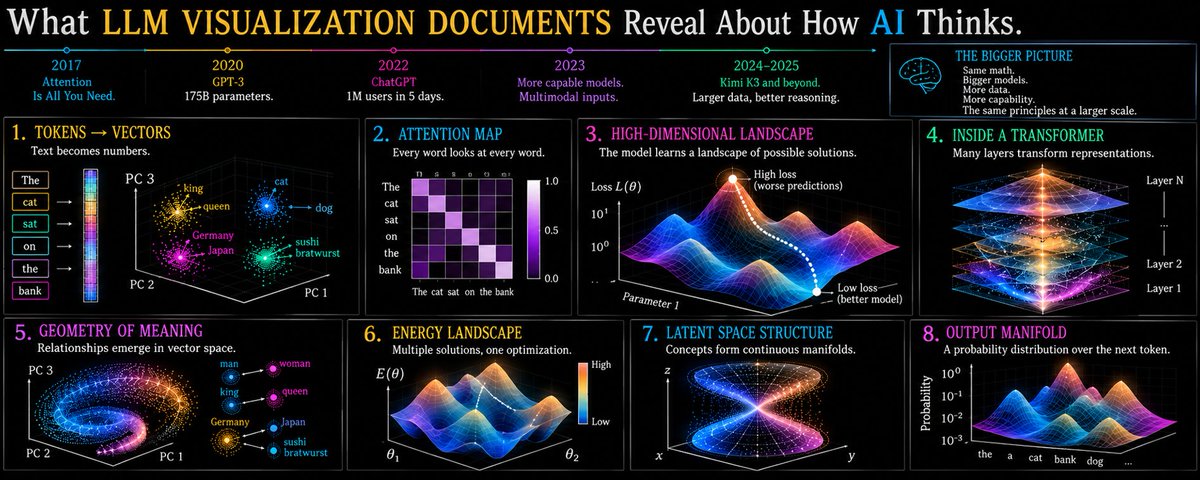
standard transformers compute in a single pass. H^(l) = Attention(H^(l-1)). one shot. no persistent state. no memory between tokens. no ability to revise reasoning mid-computation.
at 1K context: transformer accuracy 40%, NCM 60%. at 8K: transformer 42%, NCM 70%. at 32K: transformer 38%, NCM 75%. at 128K tokens - the scale every enterprise deployment now requires - transformer collapses to 35%. NCM holds at 80%.
the architecture replacing it: h_{t+1} = f(h_t, x_t, θ). a continuous internal state. information doesn't pass through once and disappear. it persists. it evolves. it gets refined across multiple computation steps.
state update: h_{t+1} = h_t + Δt · F(h_t, x_t, θ). a gated continuous function. the model doesn't process the next token and move on. it updates its entire internal representation based on everything it already computed.
transformer: quadratic complexity. static weights. implicit memory. reasoning: emergent, unreliable.
NCM: linear complexity. dynamic state. explicit memory h_t. reasoning: built-in. architectural.
lecun said in 2023: "LLMs cannot reason. they cannot plan. they are not going to get us to AGI."
the research community responded by raising another $500B in LLM funding.
Meta paid him $50M+ over a decade to be the loudest critic of the technology that made them $1.4T in market cap.
in 2026, anonymous independent research notes are publishing the architecture he predicted four years ago.
the paper ends with one sentence: "NCM may not simply improve LLMs - it could mark the next generation of language models."
lecun has been writing that sentence since 2022.
save this.

bugsinside retweeted

"WaveSpace is a modular Python toolbox for the
simulation and analysis of traveling wave dynamics in multichannel recording arrays."
joss.theoj.org/papers/10.211…
#neuroscience
bugsinside retweeted

this aligns with my thoughts on getting a PhD and intellectual jobs in the anthropocene. The trajectory you thought you could have is likely going to be obsolete. Collaboration will matter more than individual “genius” contributions


An Anthropic researcher just told a room full of PhD students that their career plan no longer exists
His 3 pieces of advice for students:
1. Use AI every day. If you're on the exponential, you'll never fall behind it.
2. Choose projects that get better when compute scales. The rest will be solved before you finish them.
3. Stop planning your career as if it were stable. The safe option no longer buys safety; it no longer exists.
And a phrase that sums it all up:
"Writing is thinking. If you outsource your writing, you outsource your thinking."
The talk is titled "The End of the Anthropocene"
bugsinside retweeted

📚 Open Access (free)
Kockelman, P. (2025). Mathematical Models of Meaning: A Dynamical Systems Approach to Possible World Semiotics. MIT Press. doi.org/10.7551/mitpress/156…

bugsinside retweeted

Spectacular Nature piece on why AI is not conscious and probably will never be.
Three arguments:
1) Intelligence is not consciousness.
Intelligence is about solving problems. Consciousness is about having subjective experiences.
AlphaFold can solve super difficult problems. By contrast, our brains performs complex operations entirely outside awareness.
Problem-solving and consciousness are two separate things.
2. Biology is essential.
Our brains are alive, down to every cell. Their activity is inseparable from the living tissue that produces it.
The idea that consciousness can be reproduced simply by running the right computations on silicon components who do not fight for their life is a very far fetching and, I would add, almost religious, assumption.
3) The physical organization may matter more than the computation.
According to integrated information theory, consciousness requires specific causal relationships between a system’s physical components.
The computer architectures running today’s AI lack this organization.
The comparison with AlphaFold is particularly revealing:
Almost nobody things AlphaFold is conscious, despite its inner working is very similar to an LLM
Why?
Because it does not speak.
LLMs do speak like us and therefore we fall into an illusion:
Since they speak like us, they must be like us.
But this inference is wrong.
LLMs are just a series of matrix multiplications.
They are not conscious, and they will never be.
*
Paper in the first reply


bugsinside retweeted

According to the laws of thermodynamics, information can be converted into energy. An information engine that harnesses environmental memory and exhibits non-Markovian dynamics has now been realized in experiments.
nature.com/articles/s41567-0…


bugsinside retweeted

Pilot study shows that a portable brain/neural exoskeleton powered by EEG + eye signals allowed #stroke survivors to complete bimanual daily tasks with high accuracy & fast control (<2s). ahajrnls.org/3JVptuH
@ssoekadar @WFNRehab @ChariteBerlin @SeoulNatlUni @snuh_official

ALT Graphic abstract in Colucci et al.