On sabbatical. Former early team @harvey
San Francisco, CA
Joined October 2021
- Tweets3.7K
- Following2.3K
- Followers5K
- Likes142K


Brian Burns retweeted

My quick read: extremely concerning in its implications for near-term global conflict.
Strategic ambiguity - our adversaries knowing less about our operations, our tactical data, our tools and countermeasures, our munitions stock - is in some ways (not all, but some) stabilizing. It makes our adversaries less confident that an attack on American interests will succeed and correspondingly less likely to undertake the attack.
I remember Trump's recent remarks coming out of the trilateral summit about spying. The bravado that they're going to keep doing it but we've got better spying. He was trying to signal that even if they know our capabilities, we know theirs and we remain confident. It may have been true but it may also have been a bluff. Whether he wins in Iran or not shapes his credibility on deterring China from a more consequential move on Taiwan and on deterring Russia from a more consequential move against NATO.
I'm worried that if enough sensitive military data is hacked, both sides can wargame out who would win in a fight this minute - and then our adversaries might snap into action to fight if they sense they have a window of opportunity. The terrifying thing is that they might.
If a third world war breaks out in earnest we may not get a lot of warning about it. The US government can't state unambiguously how much danger we are in without risking the outbreak of a larger conflict: any real signal they send about danger would undermine any bluff critical to deterrence.
The sudden weakening of secrecy as a structural protection due to AI hacking tools may seriously undermine the ability of the US to deter adversaries from harming our interests. We need a national security strategy that plans for this.

Exclusive: Hackers have breached the US Air Force's flagship cloud computing platform, three people familiar with the matter told Reuters, in a development that could jeopardize a vast swathe of sensitive tactical, personnel and logistics data reut.rs/4fVvpjM


Brian Burns retweeted

Some remarkable stuff in the NYT's guide for "how to talk to your family about AI doom this Thanksgiving"
(yes, this is real)

Reflecting on last week's monumental proof of the Riemann hypothesis, I spent last evening working through Riemann's original 1859 paper, where he introduces the zeta function as a tool for understanding the primes, culminating in an exact formula for the distribution of primes based on its nontrivial zeroes.
Highly recommend!
It's only nine pages and contains so many beautiful ideas. It's accessible to anyone with some math background (in particular, some complex analysis), and is much easier to digest with Claude explaining context and intermediate steps.
You really can do it in an evening.

On the Number of Primes Less Than a Given Magnitude: claymath.org/wp-content/uplo…


Brian Burns retweeted

The Fourier Transform complexity is apparently n sqrt(log n). github.com/openai/math/blob/…
This madness truly feels like the beginning of the singularity, at least for math.


Brian Burns retweeted

In testing GPT-6.2, I used it to make a significant historical discovery which I detail in the post below. This suggests that the process of research and discovery we’re already seeing in verifiable domains like math is starting to generalize to non-deterministic fields like history.
You can read the full post here:
generativehistory.substack.c…
In a nutshell, Yale’s Beinecke Library holds an anonymous sketchbook of an 1808 journey from Montreal to Lake Superior and back. I’ve spent many hours over the years trying to figure out who made the sketches with no luck. The artist could literally be any one of several thousand people. There are few clues: only four dated and labelled images.
With minimal prompting, in just 22 minutes, Astra used publicly available sources to identify a minor French aristocrat, the vicomte de Chabot, as the artist and suggested that we test the hypothesis by ordering copies of a little known microfilmed diary of Chabot’s trip it also found.
I was truly stunned. I’d never heard of Chabot or this diary! New document finds are also exceedingly rare in a well worn field like fur trade history.
I ordered scans of the journal from microfilm and when they arrived the handwriting matched the captions in the sketchbook. The itinerary also aligned perfectly with the few dated drawings in the book. But there was actually the type of conclusive evidence we rarely get as historians: on 18 June 1808, after Chabot’s canoe reached Fort St. Joseph, he wrote “I took a sketch” before describing the exact view of the fort depicted in a matching drawing.
The journal itself is also a major find. It had been mentioned once in a dissertation footnote, but in a completely different area of history and is unknown to fur trade or Canadian historians. It’s long and detailed, covering some 162 notebook pages which makes this a significant new document to my field. Attached to the journal was another trove of documents too: excerpts from long-destroyed North West Company papers, journals, and letters. Again, this almost never happens. Both finds equally surprised the other leading experts I consulted.
Although we can construct a coherent narrative in hindsight, I cannot emphasize enough how exceedingly difficult this sort of thinking and recall is for humans. Unlike a human, Astra was able to tackle the problem from both ends at once: working forward from the scant facts of the 1808 journey pictured in the sketchbook and backwards from the immense number of surviving facts about 1808 British North America in general.
While we can technically explain Astra’s path to this find as a product of enhanced search capabilities, it conducted the investigation from end to end. I basically acted as the research assistant, restricting copies of the paper documents it needed.
To my mind, this puts historians in a similar position as the mathematicians found themselves about eleven months ago, when LLMs started to solve the first Erdős problems. Over the past year, we’ve watched these same models go from learning to read handwriting, to beginning to think historically, to mastering the undergraduate essay, and finally to making small but real contributions to human knowledge more or less autonomously.
The trajectory seems clear.

Brian Burns retweeted

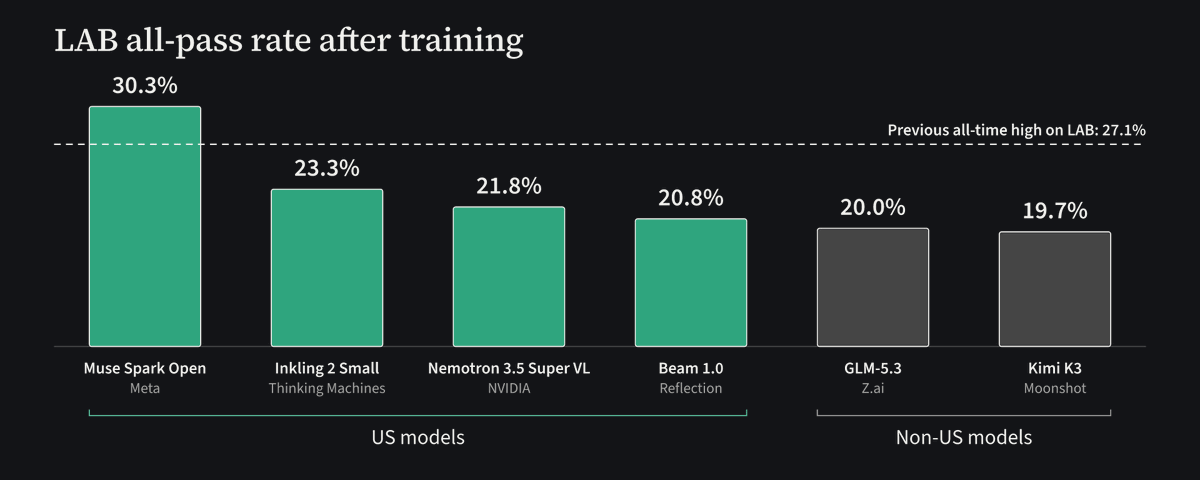
Pushing the US open-weight frontier
We post-trained four of the latest US open-weight models using an extension of our Harvey Tenet recipe.
1. Muse Spark Open reached 30.3% all-pass on LAB, the first model to pass 30% on the benchmark.
2. Nemotron 3.5 Super VL, Beam 1.0, and Inkling 2 Small each surpassed 20% all-pass on LAB after training, outperforming our prior result on Kimi K3, which is a much larger model
3. Scores also rose on most non-legal benchmarks we tested

Brian Burns retweeted

the Charleston AI guy is an official OpenAI partner
“First they ignore you, then they laugh at you, then they fight you, then you win.”


Brian Burns retweeted

The Lean FRO and Mathlib Initiative have released a joint statement on the Lean verification of the Riemann Hypothesis.
On November 20, Levent Alpöge released a proof of the Riemann Hypothesis as a Lean library of 17 million lines of code. Over the past day, the Lean and Mathlib communities worked together to verify it. The statement certifies the proof as correct and describes how it meets all necessary verification criteria.
Congratulations to Levent on this achievement, and thank you to everyone in the community who contributed to the verification.
Full statement: leanprover-community.github.…

Brian Burns retweeted

Btw Alessandro Masullo proposed a proof of GRH several months ago that has been under review by Brian Conrad "... and it is so far looking good." math216.wordpress.com/2026/1…

Brian Burns retweeted

Well, looks like @__alpoge__ & @claudeai are claiming a proof of the Riemann Hypothesis
alpo.ge/remark.pdf


Brian Burns retweeted

fun chart - law has an engineering-style power curve too (and looks like the top 1% of lawyers on @harvey passing the top 10% of engineers - not sure about definitions here)