





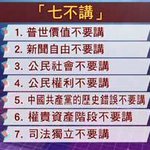

bjpz77 retweeted

陆奇的奇绩创坛,500 万元投出了一场美国制裁。
10 月 19 日,美国国务院宣布制裁 5 家中国实体,其中 4 家属于奇绩创坛,包括投资管理公司、一期基金、二期基金和一家关联企业,以及这次事件的导火索,上海至算。
事情要从上海至算的创始人,一个前 Google 工程师说起。
丁林伟在 Google 工作期间,偷偷把 2000 多页涉及 AI 超算基础设施的商业机密上传到了个人云盘。2023 年,他一边还在 Google 上班,一边筹备自己的 AI 创业公司「上海至算」。
他申请奇绩创坛创业营时,卖点就是自己熟悉 Google 的内部技术和系统,能在中国复制一套 Google 的 AI 超算基础设施。
奇绩最终录取了他,提供 500 万元种子资金,换取 7% 股份,还让他在路演日向其他投资人展示项目。
我翻了美国法院的裁定,发现一个非常荒诞的细节。
为了向奇绩展示自己的产品,丁林伟直接录制了一段使用 Google GPU 系统运行测试的视频,把它当成自己技术的概念验证。
法官在裁定中甚至直言,他当时根本没有真正的产品,只是在假装自己有。
今年 1 月,美国陪审团认定丁林伟犯有 7 项商业秘密盗窃罪。8 月,法官撤销了另外 7 项经济间谍罪的定罪,但商业秘密盗窃罪的定罪仍然成立。
如今,美国依据《保护美国知识产权法》,认定奇绩创坛向涉及商业秘密盗窃的项目提供了重大资金支持,将其 4 家关联实体连同上海至算一起列入制裁名单。
美国财政部同时给出退出窗口,受美国管辖的相关交易,可以在 2027 年 1 月 19 日前完成必要的收尾,但支付给受制裁实体的款项必须进入美国境内的冻结账户。
我觉得这件事值得整个中国创投圈关注。
过去,一个从 Google、OpenAI、Meta 出来创业的工程师,如果告诉投资人自己掌握大厂内部技术,可以在国内复制一遍,往往是非常吸引人的融资故事。
但这次,美国直接把制裁延伸到了提供种子资金的孵化器,连带其管理的基金和关联实体。


bjpz77 retweeted

二十出头的李思运是在4月中一个平常的夜晚知道这件事的。她躺在床上,随手刷着朋友圈,一条消息滑到眼前:北京师范大学学生媒体《京师学人》的公众号注销了。她退出,再点入,还是那行字:“该账号已自主注销,停止使用。”刷新,关掉,重开,什么都没变。
京师学人,不是早就没了吗?同时间另一个屏幕前,被信息刷屏的吴筱的第一反应是困惑。十年前她加入京师学人,曾在办公室熬夜写稿,和部员们聊选题、吃火锅,再后来成了主编。
《京师学人》是北京师范大学的一家学生媒体,创刊于2006年,旨在“立足校园,放眼社会”。
“我们已建起过墓碑,现在墓碑却又被砸了。”吴筱形容。
谁做出了注销的决定?为什么要注销一个早已死去的账号?发表过的稿子最后都去了哪里?为什么偏偏是现在?没有人给出答案。最后一位担任社交媒体管理员的学生,两年前毕业时就被解除了权限。
趁着微信平台的30天“注销冻结期”,成员们试过各种办法,试图说服校方撤回这次“自主注销”。但在与行政系统一番周旋之后,“京师学人”公众号没能回来。
✎ 低音发布深度报道,透过两代成员的经历,记录一个学生媒体如何从“立足校园,放眼社会”,走到失去办公室、发稿空间,最后连过去的文字也一并消失。
“已经死掉的东西,还可以再死一次?”
☞ 点击首页链接阅读全文《京师学人:一个学生媒体的噩梦循环》。diyin.org/article/2026/09/ji…
#中国 #中国新闻自由 #学生媒体 #京师学人


bjpz77 retweeted

The most intriguing part of the investigation readout on former Social Security Fund vice chairman Wang Wenling is the charge of privately bringing in and reading books with "serious political issues", rumored to be @DAcemogluMIT's "The Narrow Corridor".

bjpz77 retweeted

NEW: Four founders of leading Chinese AI company Z.AI worked on research in a joint project with an institute British intelligence accused of having “very strong ties” to China’s main spy agency
bloomberg.com/news/articles/… with @eastland_maggie
bjpz77 retweeted
NYT: "Surging exports and the industrial production needed to sustain them kept China’s economy growing over the past three months, even as consumer spending stagnated and investment plunged. The result is an economy increasingly dependent on selling goods abroad, even as domestic demand deteriorates."
NYT's Keith Bradsher gets this right. Many other analysts have been presenting this year's economic data as describing a two-track economy, with a sluggish domestic economy being balanced by a brilliant export economy.
But that is a very poor description of what is actually happening. Yes, net exports are surging, but this isn't a sign of a viable export sector. If the export sector were very profitable, it might make sense to describe it this way, but exports aren't especially profitable except in relation to domestic sales, where except in a few sectors businesses are struggling to make any profit at all, and once direct and indirect subsidies are backed out, much of China's exports are net value destroyers for the economy, with the losses capitalized on balance sheets in the form of surging debt.
When an economy produces far more than it can absorb through domestic consumption or investment, it must either export the balance or close down domestic production. Given how high real unemployment is, especially among the young, Beijing has no choice but to force the former, even if this comes at an economic cost.
The surge in China's net exports, in other words, is not a sigh of a strong and profitable export sector. If it takes rising debt, continued subsidies, and growing exports in order to prevent a contraction in domestic production, the surge in net exports is simply another way of describing weak domestic demand.
Surging exports are usually a good sign for an economy. Surging net exports usually are not.
nytimes.com/2026/10/18/busin…

bjpz77 retweeted

2022年,冯哲芸未能续签记者签证,无法再以记者身份返回中国,至今未获正式解释。想要了解中国、讲述中国人故事的记者,却不断遭遇各种限制。她也认为,比起党的声音,让一个多元的人口自主发声、讲自己的故事,“很自然会创造一种外界对中国人的好感”。youtu.be/W1q_V5TyDaw @EmilyZFeng @LiYuan6

bjpz77 retweeted

今年年初美国合法移民数量削减一半,美国国务院今年2月仅发放了2.6万份移民签证,来自穆斯林占多数国家的移民数量骤降90%以上。学生和工作签证等非移民签证数量也大幅下滑,较一年前下降30%。cn.nytimes.com/usa/20261019/…

bjpz77 retweeted

My coworker's mother passed away last November.
She left her modest $190,000 house to him clear and free, no mortgage, completely paid off after thirty years of factory work.
He moved into the home in January to finally settle the estate.
Two weeks ago, a letter arrived from the state Medicaid estate recovery office.
Because his mother spent four months in a rehabilitation facility before she passed, the state quietly slapped a retroactive $114,000 lien against the property title.
He called the state health department, frantic, asking how a hospital stay could bankrupt an inherited home that had no mortgage balance.
The caseworker sighed and told him:
"Federal law requires state programs to claw back healthcare costs from deceased estates. The house cannot be sold or transferred until the balance is cleared in full."
He offered to pay a monthly settlement.
They said no. The full $114,000 is due in 60 days, or they foreclose on the property at a public auction.
A lifetime of working-class savings, wiped out overnight by a retroactive healthcare lien.
You don't own generational wealth.
You're just holding a property title until the state finds a legal mechanism to repossess it the moment you die.
bjpz77 retweeted

体制内落马干部的采访,桃色那段看看就算了,安排干部这段,我觉得值得多看两遍。
按其口述描述,想塞自己人,会专门挑上级也要塞人的时候,把名单放到一起讨论。谁反对,就把整批任命都停下来,再让人把消息递出去,让上面知道是谁挡了路。
下次开会,大家也就懂事了。
最损的是,明明把自己人安排了,还显得自己尊重程序。会上认真提意见的人,倒成了不懂事、不会做人的家伙,平白得罪一圈人。
看懂这一段,就知道有些单位为什么越来越没人说真话了。你以为开会是让你发表意见,领导这是在等着看谁敢不举手呢。
至于那些没关系、没背景,还埋头苦干等着被提拔的人,最吃亏的地方就在于此,他真以为大家比的是工作。


bjpz77 retweeted

Among scholars of comparative economics, there is a widespread view that the Soviet – and later Russian – economy failed to take off because its leadership opted for shock therapy rather than for the gradualist reforms, Chinese style. Like many perspectives offered at 30,000 feet from the ground, this view is ahistorical. Mikhail Gorbachev tried the gradualist approach and launched land-leasing reforms closely modeled after the Chinese rural reforms, but unlike the Chinese farmers, who jumped on the offer, the Soviet farmers refused to sign up for a leasing deal with the state. In the documentary Inside Gorbachev’s USSR, an official recalled a Soviet farmer explaining why he did not want to lease the land, “You are paying me a salary, right? If I lease from you and there is no rain, I still have to work, but who will pay me? I have a loss, and I have nothing to eat.”12
In the hyperindustrialized economy, this Soviet farmer rested on the safety net of a basic salary in a way that completely eluded the Chinese farmers. The upside of the residual value is much larger to someone who faces risks than someone who does not, a notion that every venture capitalist knows well, and this is why venture capitalists structure compensations to the entrepreneurs they backed loaded with stock options rather than with high salary.
The baseline effect is again at work. The knowledge of residual claims depended on the existence of capitalistic residues and, in the late 1970s, rural China still retained a few rudimentary capitalistic traits, a fundamentally different situation from urban China and the industrialized Soviet Union at the time of perestroika. In these two latter settings, there were no longer any residues of residual values and residues of risks. The fruits were hanging low only because the trees were not tall in the first place. The “modesty” judgment of the dual-track reform ignores the crucial rural context of China’s experiment.

A true of story of how China took off--now almost completely forgotten and ignored yashenghuang.substack.com/p/…
bjpz77 retweeted

Look at the ANIMALS in Turkey.
Radical Jihadist Pigs in Turkey.
Disgusting, today in Turkey
Israeli woman who is running medical tourism trips from Israel to Turkey and had been targeted for days by radical Islamist groups. Her name was being shared everywhere, and she had been followed for days. Today she was cornered in a shopping mall, physically assaulted, and abused.
bjpz77 retweeted

“你没有选择出生的权利,但你有选择如何思考的权利”
10月15日,文章《中国》在抖音走红,文章呼吁“保持独立思考与批判精神,拒绝盲从、道德绑架和宏大叙事对个体价值的消解”,获得22.6万次点赞、6万次收藏和6.1万次转发。
文章提到:即使热爱自己的国家和文化,也要应保留对其进行审视和批判的权利。
认清现实、不盲目自责,也要警惕盲从与不合理要求(警惕无意义的吃苦、警惕“大家都这样”的逻辑、警惕“觉得不好就去建设”的道德绑架)。
文章还呼吁拒绝宏大叙事吞没个体,要培养独立判断的能力,区分事实和观点,避免只寻找支持自己立场的信息。
评论区:
“感觉现在开智的人越来越多了”
“再多一些鲁迅吧”
“独立思考 明辨是非”


bjpz77 retweeted

社保这件事,正在变成一件像1959-1961年的强制征收和大饥荒一样极度危险的事情。因为,经济数据的修饰和造假,一件在过去十年间逐渐被人所习惯的事情,重量开始和1959年前的粮食高产卫星与浮夸风之后一样,落到普通人头上了。
如果你们曾经看到那段历史的时候认为夸张而不理解,现在应该就理解了,这个体制的机制从来没变过。具体来说就是社保缴费基数的逐年上涨,是按照统计数据里的人均收入来算的,而这些数据已经多年严重失真。失业和无兜底零工被包装成“灵活就业”和“新就业形态”,于是现在这些人也被算入应交社保的人口。
你说这些很荒诞的东西不会成真?不,在体制的叙事里,它们是真的,正如当年体制认为亩产万斤,它就是会按照万斤的标准来征粮。因为体制里面没有人承担得起不相信叙事的后果。
这些不真实的经济数据被制造出来的时候,人们没有想过后果是什么;但是在当前财政面临硬约束的时候,这个体制下的摊派任务正是以这些数据为基础的,后果就这样落到了所有人头上。
而体制内部唱了这么多年的稳中向好,不会任何人有能力去指出这个稳中向好是假的。除非像当年一样,已经发生了像饿死几千万人类似严重的不可逆转的后果,才会开始找台阶下。
后果很可能是几乎杀死改革开放以来的民营市场经济生态,让社会经济的中下层陷入严重的互不信任,破坏力远超社保那点钱的百倍以上。但是破坏开始造成的时候,体制不会停下,它会一直推进到体制自己也无法承受为止。
“1959-1961年的饥荒有四条机制:
第一条是,中央的数字和现实脱了钩。大跃进里各地的产量被层层虚报;按照体制给出的数字,高层只能认为粮食多到吃不完。
第二条是,征购按虚报的数字下达,产量越低,征走的比例越高;因为任务是按报上去的数字定的,而报上去的数字不能改。
第三条是,说实话的人被惩罚,于是各级干部宁可饿死人,也要完成任务。
第四条是,没有人能够退出,户籍把人锁在原地,公社垄断了全部的粮食,人离开自己的村子就没有饭吃,逃荒的农民还会被民兵赶回村子。
四条合在一起,生产和经济活动的激励彻底崩溃。”
这四条机制里,前三条在今天的中国全部都成立。第四条不一样了,也许今天不会大规模地饿死人,但是会破坏掉所有人对任何经济规则的全部信任。


bjpz77 retweeted

🚨Do not travel to China
The US has updated its travel advisory for China with a high risk warning for unlawful detention. Which should have been done a long time ago
The Chinese government can arbitrarily ban anyone from leaving the country. Two Americans Min Zin and seismologist Youlin Chen have recently been detained.

bjpz77 retweeted

China has added more than $43 trillion in debt since Xi Jinping took power. That’s not a typo.
The Wall Street Journal’s latest reporting lays out the math: China’s total debt to GDP blew past 300% in 2025, up 60 points since 2019, now higher than the United States. Most of that growth didn’t come from Beijing’s own books, the central government’s debt stays relatively modest at around 30% of GDP. It came from local governments, through murky financing vehicles cities and provinces used to hit growth targets, many of them pouring money into real estate that then collapsed.
A broader IMF measure that counts both official local debt and those shadow vehicles puts China’s real government debt load at 127% of GDP, up from 98% just five years ago.
Here’s where the money went: factories and apartments nobody needed enough of. That mismatch triggered price wars, squeezed profits and wages, and now feeds directly into deflation and weak demand at home.
And it doesn’t stay home. Chinese companies carrying all that debt keep producing more cars, solar panels, and electronics than China itself can absorb. The surplus gets exported, undercutting prices everywhere else and fueling the trade fights now playing out with country after country.
Economists call this the real signature of the Xi era: investment-driven growth long after the investments stopped paying off. The capital controls and state-run banks mean China probably avoids a sudden collapse. What it doesn’t avoid is a slow bleed, years of suppressed returns and weaker growth, while everyone downstream absorbs the overflow.

bjpz77 retweeted

🚨 The Select Committee on China has released 700+ pages of previously non-public, unclassified investigative records concerning research security cases investigated by the NSF Office of Inspector General (chinaselectcommittee.house.g…). The records document cases involving undisclosed foreign appointments, compensation from 🇨🇳 institutions, participation in 🇨🇳 talent recruitment programs, conflicts of commitment, and repeated failures to disclose information required by federal research funding agencies.
⬇️⬇️⬇️
Chunmei Wang, Texas Tech University
Xiang-Qiang Chu, Wayne State University
An Chen, Iowa State University
Franklin Tao, University of Kansas Center for Research Inc
Hu “Tiger” Tao, University of Texas-Austin
Chenzhong Li, Florida International University
Shaorong Liu, University of Oklahoma
Hu Bin, University of Tennessee Knoxville
James Ricles, Lehigh University
Sebastian Bednarek, University of Wisconsin-Madison
Mingqing Xiao, Southern Illinois University-Carbondale
Weiwei Deng, University of Central Florida / Virginia Polytechnic Institute and State University (Virginia Tech)
Alex Liu, Michigan State University
Tao Li, University of Florida
Le Song, Georgia Tech Research Corporation
Tim Li, University of Hawaii / Hawaii Earth Science Consulting
Various Principal Investigators / Co-PIs, Stanford University
👉🏻 an Oct 2022 NSF investigation identified at least 26 Stanford University research awards involving researchers who participated in foreign-funded projects that had not been disclosed to the agency. Those awards had more than $12.8M in associated claimed costs, according to the investigative records. Investigators recommended suspending 14 awards because of disclosure deficiencies. The documents do not establish that NSF ultimately suspended all 14 awards or that the entire $12.8M was improperly spent. The investigation also identified Stanford professor Richard Zare as holding a Chinese Thousand Talents Program appointment requiring 3 months of work annually at a foreign university. Stanford had known about Zare’s appointment since May 2019 but had not formally notified NSF. Investigators recommended suspending his research award, which had received ~$464,000.
Wenlu Zhu, Wenlu Zhu, Chunsheng Wang,
and Ming C. Lin, University of Maryland College Park
Luiqing Yang, University of Minnesota, Twin Cities
Enrique Lavernia, University of California-Irvine
👉🏻 a 2020 NSF investigation involving Enrique Lavernia, a Cuba-born materials scientist who served as executive vice chancellor and provost of the University of California-Irvine until Mar of that year. Investigators documented his undisclosed affiliations with Wuhan University of Technology and other Chinese institutions, including participation in Beijing’s Thousand Talents recruitment program. Wuhan University of Technology publicly identified Lavernia as a strategic scientist and reported that he received the Chinese Government Friendship Award in Sep 2017. A Chinese Academy of Engineering document credited Lavernia’s work with helping China develop advanced materials and manufacturing technologies for defense weapons and equipment. The records also contain an unsigned Chinese employment contract offering $50,000 per month, research-team funding, laboratory support, and other benefits. Lavernia repeatedly omitted Chinese affiliations and compensation from federal research disclosures and a Department of Energy Top Secret security-clearance reinvestigation. The NSF investigation identified ~$5.2M in federal research awards associated with him since fiscal year 2012. NSF imposed a government-wide suspension in July 2020, temporarily barring him from receiving federal grants and contracts. Lavernia joined Texas A&M University in 2023. In Mar 2026, the university named him a university distinguished professor, its highest faculty distinction. University materials identify NSF and Energy Department support for his research.
chinaselectcommittee.house.g…


bjpz77 retweeted

我们翻译并发布了新疆特克斯县加尔阔拉村的两份村级报告(时间为2018年9月),分别是早派工报告和晚研判报告:shahit.biz/caseview.php?no=1…
这两份报告证实了阿布都于西格·沙德克(shahit.biz/cmn/101401/)当时被关押在集中营的事实。


bjpz77 retweeted
中科院研究:江浙沪人群血清中多种有害化学物质暴露水平位居全国前列
近日,中国科学院大连化学物理研究所、华中科技大学等机构在国际期刊《Nature Communications》发表研究,分析了中国15个省份5696名参与者的血清样本,发现不同地区人群体内的环境化学物质暴露水平存在明显差异。
研究显示,上海、江苏、浙江等东部沿海地区人群的化学物质总体暴露水平较高。其中,江浙沪人群的全氟和多氟烷基物质(PFAS)、砷、汞等暴露水平处于较高位置。
研究还发现,部分有机氯农药暴露与高血压、糖尿病、肥胖等慢性疾病风险存在关联,PFAS暴露则与高脂血症风险相关。
值得注意的是,研究揭示的是人群暴露水平及疾病风险之间的统计关联,并不意味着江浙沪所有居民的血液均存在超标污染,也不能据此认定相关化学物质直接导致疾病。


