
Crypto. Philosophy.
Joined November 2021
- Tweets1.6K
- Following3.2K
- Followers113
- Likes141





overman retweeted

The megatrends I’m spending the most time on:
1: AI + biotech economics
AI-designed drugs are reaching human trials. The bigger opportunity is whether better discovery translates into fewer expensive failures and more approved medicines per dollar of R&D.
2: The AI infrastructure buildout
Growing AI usage requires more computing capacity, networking, cooling and power. I’m interested in the companies solving the physical constraints on that expansion.
3: Domestic energy production, especially nuclear
Energy security is bringing renewed attention to domestic nuclear capacity. Reactor restarts, upgrades and fuel supply chains are worth watching alongside the development of new reactors.
4: Tokenization and onchain finance
Tokenized securities are moving into real transactions, including recent trades using DTC-tokenized assets. The opportunity is making assets easier to transfer, settle and use as collateral, with stablecoins developing alongside them as payment infrastructure. DTCC · BIS
5: Grid modernization and energy storage
Generating electricity is only part of the challenge; delivering it when and where it’s needed requires investment. Transmission, transformers, batteries and grid software all deserve attention as electricity demand grows.
6: AI agents and the economics of services
Businesses are starting to delegate complete tasks to AI. If that becomes reliable across more workflows, small teams could deliver services at a scale that previously required much larger organizations. Anthropic
7: Robotics and physical automation
Factories now operate roughly five million industrial robots worldwide. Better machine intelligence could make a wider range of physical tasks economical to automate.
8: Defense modernization
NATO allies have committed more than $40 billion to counter-drone capabilities over five years. I’m watching the growing importance of drones, sensors and the systems needed to detect and defeat them. NATO
8: Critical minerals and secure supply chains
Electrification increases demand for copper and other strategic minerals, while concentrated production creates supply risks. Mining, refining and recycling are becoming central to industrial security.
9: Cybersecurity and digital identity
AI is helping attackers operate faster and at greater scale while introducing new systems that need protection. Verifying identities, controlling access and securing AI agents should become increasingly valuable. Microsoft
10: Collectibles and Unique assets
In a world where production cost trends to zero, the wealthy will allocate to items with provenance and irreproducibility (classic cards, gemstones, gold, etc)
11: GLP-1s and metabolic medicine
These medicines are expanding beyond weight management into indications including cardiovascular risk reduction and liver disease. I’m watching how broader clinical uses reshape demand, manufacturing capacity and access to treatment.
12: Water infrastructure and reuse
Growing water insecurity is strengthening the case for treatment, recycling and industrial reuse. Reliable water supply could become an increasingly important constraint on where cities and industries can grow.
Plan it to make videos on each one
overman retweeted

Villa Dune: Desert-inspired forms brought to life through warm textures, organic curves, and soft natural light. Pure tranquility in stone and water. 🐪🏜️
Architect: D2
Location: Dubai, UAE
#desert #architecture


overman retweeted

5 predictions for the next decade
The future is probabilistic so none of this is meant to be declarative -- just one way it could play out. That said, it is "easier" to forecast 10-year megatrends than to trade 10-minute candles.
1. Blow off top. US mkts have a blow off top never to be visited again for many years. See this chart of the decade by DoubleLine. Every region gets its “this time is different” decade -- Japan (industrial perfection, 1980s), Europe (euro integration, 2000s), EM (Asian Century, 2010s). Each peaked, then mean-reverted.
The U.S. narrative now is American Exceptionalism (AI is deflationary, innovation, monopoly over capital markets). Same chart, new story.
2. TRILLIONS. Leverage, passive flows, and financial engineering unwind together creating a generational opportunity. Investors with cash on the sidelines get to buy stuff for prices that will be written about in history books. Governments and central banks print again -- but this time with inflation already embedded. 2008 was $700B, 2020 was $6T and whatever this next one will be some multiple of that. Monetary and fiscal policy blur into one, and we officially enter yield-curve control: higher inflation tolerated, yields capped, savers rekt.
3. Walls go up when the tide goes out. Capital repatriation, eroding rule of law, new tax regimes (global taxes, unrealized gains, exit taxes etc.) and residency weaponized. Governments turn inward and make it harder to move money and people. Mobility remains the ultimate privilege.
4. Value > Growth. Demographics, energy, and fiscal policy driven growth converge in Asia, the Middle East, and Latin America. Nations that export code, energy, or manufacturing talent win. Western capital will follow -- reluctantly at first, then permanently. Tech will still have winners but it won't be the secular bull market it has been for the last 15y and the zirp madness is firmly behind us. Value and commodity supercycle.
5. Active > Passive. The passive era ends when liquidity is no longer free. With dispersion back, fundamentals and judgment start to matter again -- volatility is information. Price moves reveal real risk, solvency, and opportunity -- like it does in crypto. Index funds are optimized for inertia, not insight -- so the next bull market belongs to active founders and allocators who can move fast, hedge risk, and find edge in chaos. Price is truth.
BONUS 6. Instant contracts replaces trust. Trust creates tolerable latency -- you wait because you believe the system will deliver. But in a low-confidence world, latency becomes a risk. The USD may stay strong in crisis, but weaker in trust. The new axis is instant settlement, not brand or reputation. Those who can settle obligations in real time --individuals, companies, and countries will dominate.
eg., a company pays a supplier in USDT instantly wins against a company that has a 30 day window and pays via JPMorgan.
- a lot can happen in 30 days
- JPM relies on regulation and reputation to make you trust the payment will arrive -- but wires can be delayed, reviewed, or frozen.
USDT has none of that, yet it settles instantly, globally, 24/7.
Feel free to push back/add other megatrends you are seeing.


overman retweeted

The market is always looking ahead. So are we. Here are the 50 stocks with the highest projected revenue growth for 2027 📈🚀
1. $IREN | IREN - 243.1%
2. $NBIS | Nebius - 190.8%
3. $CRWV | CoreWeave - 96.5%
4. $LITE | Lumtentum - 90.1%
5. $SPCX | SpaceX - 83.0%
6. $AMD | AMD - 70.3%
7. $AVGO | Broadcom - 63.3%
8. $BE | Bloom Energy - 62.0%
9. $MU | Micron - 59.8%
10. $FTAI | FTAI Aviation - 58.2%
11. $DOCN | DigitalOcean - 52.7%
12. $SKHY | SK hynix - 49.8%
13. $FPS | Forgent Power - 48.6%
14. $CRDO | Credo Technology - 48.1%
15. $ORCL | Oracle - 45.8%
16. $PLTR | Palantir - 45.5%
17. $MRVL | Marvell - 45.1%
18. $ALAB | Astera Labs - 44.2%
19. $LSCC | Lattice Semiconductor - 44.1%
20. $NVDA | Nvidia - 40.1%
21. $VACN | VAT Group - 39.4%
22. $RKLB | Rocket Lab - 38.9%
23. $COHR | Coherent - 36.5%
24. $ARM | Arm - 35.3%
25. $RHM | Rheinmetall - 34.7%
26. $KOG | Kongsberg Gruppen - 34.7%
27. $GH | Guardant Health - 34.6%
28. $BESI | BE Semiconductor - 33.1%
29. $TSM | TSMC - 32.4%
30. $STX | Seagate - 32.2%
31. $WDC | Western Digital - 32.2%
32. $III | 3i Group - 31.6%
33. $SSNLF | Samsung - 30.5
34. $RDDT | Reddit - 30.0%
35. $VRT | Vertiv - 29.4%
36. $AMAT | Applied Materials - 28.9%
37. $APP | AppLovin - 28.7%
38. $CG | The Carlyle Group - 28.7%
39. $AXON | Axon - 28.2%
40. $EQT | EQT AB - 27.6%
41. $NET | Cloudflare - 27.6%
42. $MELI | MercadoLibre - 27.5%
43. $MTSI | MACOM Technology - 26.8%
44. $CIEN | Ciena - 26.6%
45. $ASM | ASM International - 26.0%
46. $SNOW | Snowflake - 25.7%
47. $AFRM | Affirm - 25.7%
48. $ASML | ASML - 25.6%
49. $ANET | Arista Networks - 25.4%
50. $HOOD | RobinHood - 25.4%
Source: @KoyfinCharts
𝗖𝗿𝗶𝘁𝗲𝗿𝗶𝗮
- Revenue TTM >$500M
- Gross Profit Margin >30%
- Revenue est. 2027 >25%
- No biotech, mining companies
- Marketcap >$10B
What are your favourite growth stocks for 2027? 🤔🚀


overman retweeted

Most investors today are hunting for alpha with an ADHD attention span: <30 min of headspace. The bar is comically low. Spend even a few actual hours on a single trade identifying real information asymmetry and you’ve probably got a legitimate shot at becoming a top 1% investor.
overman retweeted

Why USDT and USDC are Harder to Kill than Crypto Twitter Thinks: My last Thoughts on Open USD
The launch of OUSD has taken Twitter by storm. Many people are now convinced @circle is doomed because a consortium of 150 companies spanning payments, fintech, banks, crypto infrastructure, and consumer technology is somehow going to crush the competition and launch a stablecoin that rivals USDC, and potentially even USDT.
I already wrote a tweet on why people are vastly overestimating this initiative and why consortiums are poor organizational structures to conquer anything, let alone a market with an established duopoly. In this short piece, I want to focus on one thing only: the true network effects of stablecoins. Instead of rehashing every argument, I want to walk through a tangible example that everyone is ignoring, because I believe both USDT and USDC have liquidity moats that are vastly misunderstood and underappreciated.
Stablecoin network effects are not created by a long list of logos. They are created by liquidity, habit, collateral acceptance, integrations, brand recognition, market depth, settlement flows, and the fear of breaking what already works.
This is why I think @tether and @circle are companies that are vastly misunderstood.
First, the obvious: OUSD will be GENIUS compliant, which means it cannot share yield directly with users. This isn’t news, yet people are screaming at Circle to pay stablecoin holders, as if OUSD were going to be able to do that. The reality is the opposite: Circle is probably the issuer that passes on the most yield to platforms, and by extension to users, of anyone in the market.
This matters because a lot of people are talking as if OUSD will create a fundamentally different yield product for end users. That is not the model. The model is not “pay stablecoin holders.” The model is “share the reserve economics with the platforms and businesses that distribute and use the stablecoin.
This is an important distinction.
The strongest argument I’ve seen for OUSD is that consortium members will be highly incentivized to entrench it in their businesses because they get a revenue share from the structure. Without knowing the details, let’s assume the economics resemble previous consortiums we’ve seen: Open Standard, the operating company, keeps a 25 bps management fee while each participant keeps 100% of the NIM on any OUSD sitting on their platform, network, or protocol.
On paper, that’s a deal anyone signs immediately. But it completely discounts the fact that these companies accrue value in other ways, and in many cases their core businesses depend on the existing liquidity and network effects of USDT, USDC, other stablecoins or simply other FIAT currencies.
The NIM from stablecoin reserves is attractive only if pursuing it does not jeopardize a much larger revenue stream.
That is the key point.
The best case study in the industry, and probably the strongest counterexample to OUSD, is Binance.
Binance as the best Case Study
@binance is the largest exchange in the industry by several miles. It initially had its own branded stablecoin, BUSD, which peaked at roughly $23B in supply before NYDFS ordered Paxos, the issuer, to shut the product down in February 2023.
Look at the three biggest Asian exchanges and you get three clean case studies. Today @binance holds about $45B of USDT, @Bybit_Official about $4B, and @okx about $9B. Binance has been, and remains, Tether’s fortress and crown jewel. USDT is the most liquid counterpair on the biggest exchange in the world. Today, if you want to buy BTC, ETH, SOL, or open a perp position in size, USDT is still the dominant quote currency across much of the offshore exchange complex. Binance helped make that true. USDT is embedded into the deepest order books, the most liquid pairs, the most active derivatives markets, and the workflows of the most important market makers and traders.
That is a real network effect.
Now many of you must be thinking: why is CZ so naive? Why hasn’t he called Paolo and Giancarlo and demanded at least a portion of the USDT yield, if not most of it? Binance knows it has extreme leverage here.
There is an extremely simple reason this has never happened: Binance’s crown jewel, from a revenue and enterprise value perspective, is its trading business. And that trading business is cemented by USDT liquidity.
Running the math
So let’s run the rough numbers and see why it is entirely rational for CZ not to chase the NIM, or try to replace USDT with a more “aligned” stablecoin. The back-of-the-envelope math below is based on on-chain data and assumptions; none of it is confirmed information.
Building it bottom-up:
Derivatives (the core engine). Binance runs roughly 40% of global crypto derivatives volume. Call it $40-50B per day on average through the cycle, so $10-15T annually. Blended taker/maker take rate after VIP discounts and BNB rebates is maybe 5 bps. That’s roughly $5B from perps and futures alone.
Spot. Maybe $8-10B per day on average, around $3T annually, at a blended 15 bps (much lower than Coinbase’s retail take rate, because Binance’s mix skews heavily VIP and they run zero-fee promos). Call it another $5B.
Everything else. Earn and lending spread, margin interest, Launchpool and listing economics, Binance Pay, staking commissions, plus the float: they sit on roughly $46B in customer stablecoins, and while they don’t sweep it like a broker-dealer, the corporate treasury and interest-bearing products around it are meaningful at these rates. Add BNB ecosystem economics and you’re conservatively looking at another $5-7B.
And remember, these are bear market numbers. Very conservatively, Binance is a business generating close to $17-20B in bear markets and probably closer to $25B in bull markets. A business of that scale and quality is plausibly worth north of $200B.
So why isn’t CZ in a rush to replace USDT or demand better economics from the Tether team?
Because the whole reason Binance is what it is today, the reason 300M+ customers keep returning to the platform, is that it is the most liquid venue on earth. Let’s price the trade Binance would actually be making.
Binance has $45B of USDT on its platform. Say it struck a deal with OUSD handing Binance 90% of the yield. At an average T-bill yield of 3.8%, that’s about $1.55B a year. Very appealing, until you frame it properly: risking a $25B revenue engine for $1.5B of upside is something only a madman would do.
The glue holding Binance’s trading castle together is precisely USDT. There is no incentive in the world that would make CZ rethink which stablecoin to entrench.
And we don’t need to speculate, because it has already been tried. Over a year ago, Circle reportedly paid Binance a one-time $60M plus ongoing monthly incentives tied to USDC balances held on the platform. Despite all of that, USDC supply on Binance has been essentially flat at $5B.
People are vastly underestimating the network effects these stablecoins generate for the businesses that host them. In most cases, the upside is simply not worth jeopardizing your core revenue engine.
For an exchange, the stablecoin is not just cash. It is the quote asset, the collateral asset, the risk-management asset, the working-capital asset, and the unit of account for millions of traders. Switching that substrate is not free.
Not All Consortium Members Have the Same Incentives
The final point is that the OUSD consortium includes very different types of businesses. They do not all monetize stablecoins in the same way.
Broadly, there are two models.
The first model is AUM monetization. These are companies and protocols that benefit from idle balances, deposits, or float. For them, reserve economics are directly relevant. A lending protocol, wallet, neobank, or exchange with large customer balances may care a lot about the NIM attached to stablecoin supply.
The second model is turnover monetization. These are payments networks, processors, remittance companies, and commerce platforms that monetize transaction flow rather than idle balances. For them, the stablecoin is more of a rail than a balance-sheet asset. They may care more about reliability, cost, compliance, speed, reach, and customer experience than about reserve yield.
An @aave and a @WesternUnion do not bring the same thing to OUSD.
A DeFi protocol can help create supply by making OUSD useful as collateral or as a yield-bearing venue for liquidity. A payments company may instead move OUSD through its system and burn it quickly at the edge. That can be valuable for volume, but it is very different from creating persistent supply.
This is why the consortium structure is less powerful than it appears. The members may all like the idea of shared economics, but their incentives are not identical. Some will create supply. Some will create turnover. Some will integrate deeply. Some will experiment. Some may do very little once the press cycle is over.
In equilibrium, it is hard to believe all members will be equally motivated to push OUSD. Some will do the hard work of adoption. Others will coast.
That is the classic consortium problem.
Conclusion
OUSD is not irrelevant. It is one of the more interesting stablecoin experiments we have seen, and the economic model is clearly designed to attack the reserve-income advantage of the incumbents.
But the market is overestimating how quickly shared economics can overcome embedded liquidity.
Stablecoins are not won by press releases. They are won through deep, repeated, high-trust usage across the venues where money actually moves.
That is why USDT remains so powerful. That is why USDC has proven resilient and is growing so fast. And that is why OUSD, despite the impressive consortium behind it, faces a much harder path than the market currently assumes.
The core question is not whether OUSD can offer better economics to partners.
The core question is whether those economics are valuable enough for partners to risk disrupting businesses that are already built around other currencies or stablecoins.
In many cases, the answer will be no.

overman retweeted

THIS IS HOW FABLE 5 MOVES WHEN YOUR VAULT IS BUILT RIGHT
direct path. zero wandering. hits the target on the first try.
without structure it's the opposite. 7 files opened. 2 minutes wasted. brief from 3 months ago still missing.
one index file per major folder. gives the agent a direct line to what it needs.
same task dropped from 2 minutes to 10 seconds. same model. nothing else changed.
build the path or watch it search in the dark.
full breakdown in the article below ↓

overman retweeted

GOOGLE CEO SUNDAR PICHAI:
"IF YOU DON'T LEARN HOW TO ORCHESTRATE AGENTS NOW, YOU'LL SPEND 2027 CATCHING UP TO PEOPLE WHO STARTED TODAY."
30 minutes on why the best engineers stopped writing code line by line and started orchestrating agents instead.
Most people think building an agent requires an engineering degree.
It doesn't.
It requires one guide and one afternoon. Watch the interview.
Then save the exact setup below. One guide. One afternoon.
That's all it takes.
The gap between you and the engineers winning in 2027 closes this weekend.

overman retweeted
I genuinely don't understand why everyone isn't using this yet.
Andrej Karpathy, OpenAI co-founder, posted a simple idea that went massively viral:
Stop using AI to write code.
Use it to build a second brain.
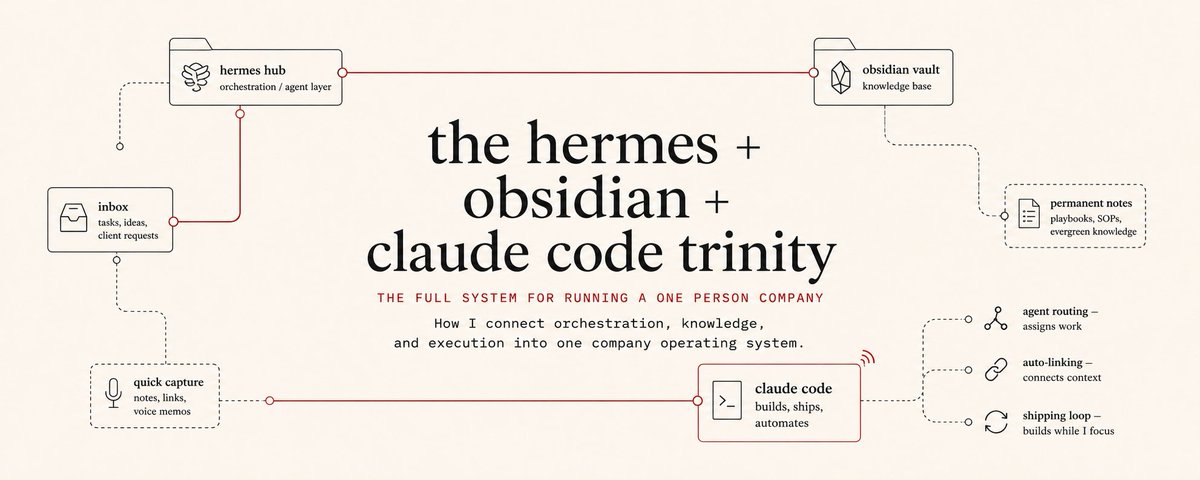
You point Claude Code at a folder. Drop in any source: an article, a transcript, a PDF.
Claude reads it, links it, files it into a living wiki of everything you know.
It compounds like interest. The more you feed it, the smarter it gets.
Here's the whole thing:
1) Install Obsidian
2) Create a vault
3) Open it in Claude Code
4) Paste Karpathy's wiki idea and tell Claude to build it
5) Claude makes three folders:
- raw (for sources)
- wiki (for its pages)
- CLAUDE. md (that runs it)
6) Drop any source into raw and say: "ingest this"
7) Ask questions across everything, forever
Five minutes to set up and you never start from a blank chat again.
Full step by step guide below.


overman retweeted
this is f*cking dangerous
build hedge fund using "loop engineering" that prints alpha 24/7 (Full Guide)
if I had this a year ago, I would've built my hedge fund in a week instead of a year
bookmark before someone takes it down


overman retweeted

Made an updated version this weekend
Here's how you do it (raw notes)
> Grab @karpathy's latest gist (in the first comment)
> Download @steipete summarize CLI
> Download yt-dlp
> Download obsidian
> Download @tobi qmd
--> Setup a node or Golang CLI called "brain"
--> Have it index all your youtube data, AI agent data (jsonl files)
--> Get your X data by requesting an archive in your settings
--> Setup vaults for each domain/topic area
--> Ask questions with your agent and qmd


overman retweeted

We’re still in the early innings of the AI boom. Don’t let the price swings scare you! Every drop can be a buy signal.
Here’s a breakdown of the sectors and stocks that should be on every investors watchlist. *Are the companies I own.
Cybersecurity
$CRWD: AI driven security stopping modern cyber breaches*
$NET: The connectivity cloud powering the agentic internet*
$DDOG: Unified observability securing the complex agentic stack
Datacenters
$NBIS: Scaling high-performance GPU clouds for AI innovators
$IREN: Vertically integrated renewable powered AI clouds*
$CIFR: Hyperscale power hosting for elite AI workloads
Energy Grid
$FLNC: Stabilizing AI power grids with intelligent storage*
$EOSE: Zinc batteries securing long duration data storage
$AMPX: Powering autonomous robots with ultra-dense silicon batteries*
Nuclear Energy
$OKLO: Advanced nuclear microreactors powering AI data centers
$SMR: Certified modular nuclear reactors powering hyperscale clusters
$NEE: Clean energy giant restarting nuclear for hyperscalers
Solar Energy
$FSLR: Dominant domestic solar modules
$TE: Reshoring solar supply chains for AI independence
Space
$PL: Daily global imagery training the planetary mind*
$RKLB: Scaling orbital infrastructure for the AI constellation*
$ASTS: Global cellular broadband powering ubiquitous mobile AI
Semiconductor manufacturers
$ASML: Building the machines that print AI silicon*
$ASM: Atomic precision layering powering advanced AI silicon*
SK Hynix: Dominant high bandwidth memory powering AI superclusters
Operating Systems
$PLTR: Operationalizing AI through a secure enterprise ontology*
$SNOW: Unified data cloud powering agentic AI applications
$AI: Accelerating enterprise value with turnkey AI applications
Humanoid robotics
$TSLA: Scaling humanoid robots through real world AI
$TER: Precision robotics automating the global AI workforce
$SYM: AI driven warehouses powering the agentic economy
overman retweeted

Here it is! My 10.000+ words Constellation Software Deep Dive.
$CSU is on one of it's biggest drawdowns ever. Before today, it never experienced a drawdown over 20%, but now it's down over 50% from it's all-time high.
Whether you like CSU or not. I think it's a perfect show-case of how you can built a company around core values, vision and a strong focus on execution.
It was built by one of the most interesting CEO's of all-time: Mark Leonard.
Just learning about how he built this compounding machine around his core values and beliefs is truly inspiring.
Free to read, so check it out!
Any like, share, comment or follow truly helps me out.
These deep dives take a lot of work, so all help is truly appreciated!
🔗Link in my bio and the comment section below!

overman retweeted

Anthropic claims Claude Opus 4.6 published today is a marked improvement for investment analysis;
I put it to the test.
I ran it through my automated stock pitch pipeline: 6 AI analysts, 5 rounds of debate, 1 research director.
It cost ~$50 (20x my usual).
Is it worth it? Here's what I found: 🧵


overman retweeted

I ranked my companies by how hard they are to dent with their monopolistic status. 👇
1. $ASML: The monopoly in EUV lithography. These machines cost $380+ million and have 100,000+ components. To disrupt them, you must spend decades and tens of billions of dollars just to reach the starting line. “You could put 10,000 intelligent people in the same room, give them all the drawings of our machine, and the machine would not work. Some things are simply not in the drawings” (Jos Benschop, ASML Senior VP of Technology, 2022). And if a competitor does arise, fabs would have to rip out an entire ecosystem, recalibrate lines for 12 to 18 months, and retrain staff, costing hundreds of millions in lost production.
2. $SPGI / $MCO: They rate $74 trillion of global debt. Their moat is legally mandated trust. To disrupt them, you need to rewrite the investment by-laws of every major pension fund, sovereign wealth fund, and insurance company on earth, which explicitly prohibit buying bonds without a "Big Three" rating. You are fighting a century of woven-in regulatory text, not a competitor. These companies have been around since 1868 and 1909.
3. $V / $MA: There are 4 billion+ Visa cards and 3 billion+ Mastercards in circulation. To disrupt this duopoly, you face a $26 trillion chicken and egg problem. You need to issue billions of cards to consumers who will not take them because no merchants accept them, while simultaneously signing up millions of merchants who will not take them because nobody has the cards. Even Apple Pay had to build on top of them.
4. $FICO: Used in 90% of all US lending decisions and 98% of US securitization. No risk officer is going to swap out the gold standard to save $2 on a credit score when they are underwriting a $500,000 asset. Banks are not going to switch to a less reliable competitor just to save a few bucks when the cost of being wrong is catastrophic. Even the credit bureaus cannot make a dent in FICO revenue with their VantageScores.
5. $AMZN: The everything store. They operate over 500 million square feet of fulfillment space and delivered 5 billion+ packages in the US last year, more than UPS. To challenge them, you must be willing to spend hundreds of billions in capital expenditures over a decade to build a physical delivery network that spans the continent, all while losing money on every package to match their unit economics. Not to mention they have the largest cloud network in the world.
6. $TDG: The moat is regulatory capture on around 380,000 unique parts. A competitor would need to reverse-engineer thousands of niche components without blueprints, then pay tens of thousands of dollars per part for FAA certification testing. You would spend billions upfront to enter a market where the prize is selling 50 bolts a year. The unit economics make competition mathematically impossible.
7. $BN: Brookfield owns the backbone of the global economy, with assets tied to long-term perpetual capital. They own the physical infrastructure that is impossible to replicate: toll roads, pipelines, hydroelectric dams, and nuclear power plants. You cannot disrupt this with code. You need massive amounts of capital to buy assets that simply are not for sale. Outstanding track record.
8. $GOOG: They own the entire stack of the internet. They have the default search engine, the world's largest video platform (YouTube), the third largest cloud provider, the largest advertising business, Android, and their own custom silicon (TPUs). All cylinders are firing. To beat them, you have to break the ecosystem that keeps billions of users locked in.
9. $UBER: 76% market share in the US rideshare market and about 25% of the global food delivery market. The moat is a massive liquidity network. More drivers mean lower wait times, which brings more riders, which attracts more drivers. To disrupt them, you would need to deploy millions of cars around the world simultaneously to match their density. If you cannot match their wait times and utilization, the network effect collapses.
As you can see, the biggest risks are multiple compression and regulatory scrutiny, so make sure you buy them at a fair price and do nothing.


overman retweeted

Here are 15 of my favorite stocks set to benefit greatly from the AI boom:
1. $NBIS: Powering next-generation AI through GPUaaS and Nebius AI studio, recently securing a $17 billion deal with Microsoft.
2. $AVGO: Powering the AI revolution with advanced networking, custom silicon, and hyperscale data infrastructure leadership.
3. $CIFR: Transforming into an AI data-center giant with a 2.5 GW pipeline.
4. $ASML: The indispensable enabler of every AI chip, without ASML, AI halts.
5. $TSM: Core of global AI manufacturing; every AI company relies on TSMC’s fabs.
6. $GOOGL: AI-first powerhouse scaling Gemini, cloud, and infrastructure dominance worldwide.
7. $ORCL: Rapidly expanding AI-driven cloud platforms that grew its backlog more than 3x QoQ.
8. $BITF: Building a 1.3 GW U.S. AI infrastructure pipeline, next-gen data-center leader.
9. $VRT: Riding AI’s data-center boom with critical cooling and power infrastructure growth.
10. $EOSE: Supplying advanced energy storage for expanding AI and HPC data-center networks.
11. $ALAB: Cutting-edge semiconductor innovator unlocking key performance gains for AI systems.
12. $MU: Memory leader poised to capture explosive AI training and inference demand.
13. $AMD: Nvidia competitor that just signed a 6 GW deal with OpenAI.
14. $WYFI: Emerging AI infrastructure disruptor building datacenters twice as fast and 40% cheaper compared to industry average.
15. $AMZN: AI-driven cloud titan leveraging AWS scale to power global intelligent transformation
