

bio + ml, prev @mit @WhiteheadInst @RadicalNumerics @DbrxMosaicAI
San Francisco, CA
Joined July 2022
- Tweets165
- Following1K
- Followers3K
- Likes2.2K




I think Nathan Fielder and Elizabeth Holmes are far more similar to each other than the average person or anyone else in that film
Melissa Du retweeted

terry tao: imagine, if you will, a petrifying situation. you have produced a very effective drug, but you do not know how it works. do you trust the drug? now, this is just a hypothetical, but—
drug developers:


PIE, the latest Virtual Cell model release, includes language embeddings of curated text describing the perturbation, the cell line, and each gene as part of its input space.
Think it’s likely that this approach will be superseded by frontier LLMs trained on perturbation data.

After thinking about it, I have come to the unfortunate conclusion that frontier labs (and wet lab shops) are all you need.
Of course, the base model can still write and use tools to abstract away certain functions or capabilities. The tools can still be other predictors or simulators. The reality will still be messy and the most performant systems will likely involve base models with great generalization and tools, both specified and learned.
Melissa Du retweeted

It's been a while since I've been this excited about a model, it writes better, it writes smarter, it writes shorter, and it's a pleasure to talk to. Bust most important of all, it codes well. It's a good model, sir.


Melissa Du retweeted

$20k referral fee if we hire someone you send us.
Serova is building fully vertical next-gen healthcare, from the lab to the clinic. Backed by Tier 1 investors. Roles open right now:
SCIENCE & LAB
Bioinformatics
Wet lab immunology
Wet lab robotics
Wet lab high-throughput
MANUFACTURING & ROBOTICS
mRNA manufacturing
Robotics engineering
ENGINEERING & PRODUCT
ML engineering
Software engineering
Product engineering
Design
CLINICAL & PATIENTS
Oncologists
Nurse navigators
Patient relations
Clinical operations
Translational project managers
Serova clinic leads (yes, we're building our own clinics)
REGULATORY & FINANCE
Regulatory
Medical legal
Insurance
Medical finance
OPERATIONS & SPECIAL PROJECTS
Email me at [email protected] if you want to chat. Tag someone who should see this.
(we had no team photos this is the best I could do)

Melissa Du retweeted

Some news: 5 months ago I joined @coreauto, a small research lab focused on new ways for models to learn. I’m also hiring four interns to do something my younger self would've loved.
It started with a pretty unusual project. We set up a handful of small online businesses, and put an agent in charge. We gave each business some initial funding and a seed idea, and off they went, trying to sell real things to real customers while we watched. It’s about as open-ended and unforgiving a task as you can probably give to an agent, with countless decisions to make and effects that take time to become clear.
Each business got its own bank account, a debit card to pay suppliers, a web browser, an email inbox, a domain name, cloud infrastructure and a schedule. Every few hours, the agent woke up and decided what to do. It might update a landing page, adjust an ad campaign, reply to a customer, and then go back to sleep.
The agents built actual storefronts and apps. They bought ads, attracted visitors, and even made some sales. The agents acted as operators that kept a business moving, but we noticed they never really stepped back to strategize about what might move the needle. If people weren’t buying, why? Was the landing page unappealing? Or maybe the offer itself was the problem?
One amusing example was the very first order a customer placed. Our supplier had run out of stock. But it’s a dropshipping business, and thankfully tens of other suppliers carried the same product. Instead of trying another supplier, the agent almost immediately sent the customer a polite apology and attempted to issue a refund. Gah! So close!
The agents could handle much of the work of getting a business up and running. What they struggled with was deciding what to change when it wasn’t working.
That’s what we want to understand. We also want to see what changes when people take the lead. What does a business operator actually do all day when agents can do so much? What new work does this allow them to do? Which decisions can’t be delegated?
—
So this winter we're hiring 4 interns as Associate General Managers. Associate Product Manager internships are programs that give early career generalists a product to own. We want to try something similar, but with entire businesses.
You’ll create and grow businesses, with agents handling the routine work so you can focus on figuring out what matters. Each AGM gets a budget and our agent infrastructure that’s designed for this. Which ideas to try is up to you. Put more money behind what finds customers and keep refining.
Where you step in tells us what agents can't do yet. You'll be in our SF office with me and people I’m so fortunate to work with, like @_arohan_, @joannejang, @MillionInt, @marksaroufim and @juliacvillagra
We don't care much where you went to school or what your resume looks like. We’re looking for enterprising people with a drive to create, who’ve made money on the internet before and already use AI extensively to enable their ideas. If that sounds like you: coreauto.com/AGM


If you work at any of these companies, especially on clinical development or portfolio strategy, I would love to chat!
Drink / coffee / pastry of your choice is on me ❤️

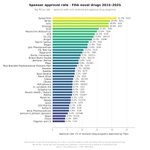
people in the biotech space aren’t alarmed enough by the fact that the success rate of all preclinical research is 10%

Melissa Du retweeted

1/ Leaders of OpenAI, Anthropic, & GDM signed a letter urging Congress to mandate DNA synthesis screening.
But chatbots & agents can't read DNA.
So we built Omnii to defend against natural & AI-designed pathogens.
Blog: radicalnumerics.ai/blog/omni…
Letter: screendna.org
I shared some of the same skepticism as the broader ML x Bio community when I first learned about the Evo models--concerns about data biases, uncertainty around how to apply the model downstream, the need for more experimental validation...
But developing omnii @RadicalNumerics has been elucidating.
Innovations in mid-training and post-training enable us to "prompt" the model for an incredible diversity of downstream tasks, similar to what instruction-tuning unlocked for LLMs.
I underrated the clinical significance of classical benchmarks like VEP and QTLs. We’re already seeing how gains on these tasks can translate into applications like target ID.
And above all, it's rare to work with such a competent and kind team. Incredibly excited for where this work is going❤️

Together with my co-founders Michael @MichaelPoli6, Stefano @Massastrello and Armin @athmsx, I am excited to announce @RadicalNumerics is emerging from stealth with a $50M seed round to build general biological intelligence.
We’re also sharing an early preview of our new model Omnii, the most powerful genome language model to date.
Omnii preview link:
radicalnumerics.ai/blog/radi…
At Radical Numerics, our mission is to master the code of life, and to drive the frontier of biological AI for both design and defense.
This is our dual mandate, which comes from something our own team helped make possible.
Our founding team trained Evo and Evo 2, the largest biological AI models (40B params) trained on DNA sequences. Trillions of tokens across all of life, from microbes to mammals. It’s fully open source, and created the field now known as generative genomics.
Last year, scientists used Evo to generate the world’s first complete genome from scratch using AI. Turns out it was a bacteriophage—a type of virus. It functioned in the real world, and in this case it was harmless. But for us, it was a clear turning point.
It showed that AI is no longer just analyzing biology. It is on the cusp of generating functional lifeforms. Eventually, AI will have the power to design and control life itself.
That should make all of us incredibly excited, and incredibly uneasy. (Anyone can design DNA with a new function, and have it synthesized and delivered, like something from Amazon Prime).
The same technology that will help us cure cancer is the very technology that might create the next global pandemic, or worse, allow the creation of bioweapons that can wipe out populations.
We believe these forces are inseparable. If you work on the frontier of biology, you have to build technology to safeguard it from its misuse. Existing biosecurity tools are sorely losing the arms race, relying on outdated “have I seen this exact thing before?” style algorithms.
We founded Radical Numerics to turn the tide.
And we can’t do that by training on textbooks and natural language. We must understand the language of biology from the raw physical data itself, to reason across every molecule and modality, from DNA to proteins.
The next frontier for AI goes far beyond chatbots or video generators to models that can understand and engineer life.
Today, we’re previewing Omnii, which is already far surpassing Evo 2, and will continue improving as we scale and add new modalities (training now).
1. For human health, Omnii can read and write whole genomes (more on writing later). It’s state of the art (SOTA) on detecting causal variants for disease, and can rank Alzheimer's mutations zero-shot. We’re partnering with a diagnostics company to use Omnii for early cancer detection (pancreatic and multi-cancer).
2. For defense, Omnii is SOTA at detecting AI-generated pathogens. We benchmarked existing detection tools, and they simply can’t detect the AI-generated ones (“deepfake viruses”). We’re partnering with a US national lab to pilot Omnii for detecting the next pandemic, both natural and AI-generated.
We have a data center full of Blackwells in construction now to build the most powerful biological AI models ever. This mission takes a new kind of AI lab that can actually scale on physical, biological data: new alignment research (mid/post training), scaling long context, building out mech interp teams to dissect what these models learn, new architectures and systems designs, all from the ground up.
Our team is made up of AI researchers and scientists from top labs and institutions (e.g. Stanford, MIT, Google DeepMind), but more importantly, we all share the belief that this is the most important challenge of our lifetime. If you feel similarly, we are hiring. We aim to bring the brightest minds in AI and science together to save lives.
Thanks to our partners on this journey, led by Emergence Capital @emergencecap, with Obvious Ventures @obviousvc, Triatomic @TriatomicCap
, and Patrick Collison @patrickc. Our advisors include Eric Horvitz @erichorvitz, CSO of Microsoft, Chris Re @HazyResearch of Stanford, George Church @geochurch of Harvard, and Andrew Weber @AndyWeberNCB, former Assistant Secretary of Defense for Nuclear, Chemical and Biological Defense Programs.
Fortune article: fortune.com/2026/06/15/exclu…
Jobs: radicalnumerics.ai/join-us

