

making things happen with electron microscopes🔬 she/her 🐘: https://xitter.cf/t.co/R0PzrAIen6 🦋: https://xitter.cf/t.co/q3MDRCDW1D
back focal plane (oregon)
Joined March 2022
- Tweets806
- Following1.9K
- Followers1.8K
- Likes15.9K







I love these things, these are just a few of my collection


Before "there's an app for that", we used these slide chart calculators...
youtube.com/watch?v=bKEQFHVM…


that’s some very nice deflection 🫶

Via #OPG_OpticaQ: Astigmatism-free 3D optical tweezer control for rapid atom rearrangement bit.ly/4zgaDDV #Distortion #QuantumMetrology @UCBerkeley


Isabel retweeted

Surface level bits of an Ion Implant ROM.
These are an absolute pain to decode optically, requiring delayering and a timed Dash etch (HF, Acetic, & HNO3) under halogen light. This procedure makes ones brown a little bit faster than it does zeroes.


Isabel retweeted

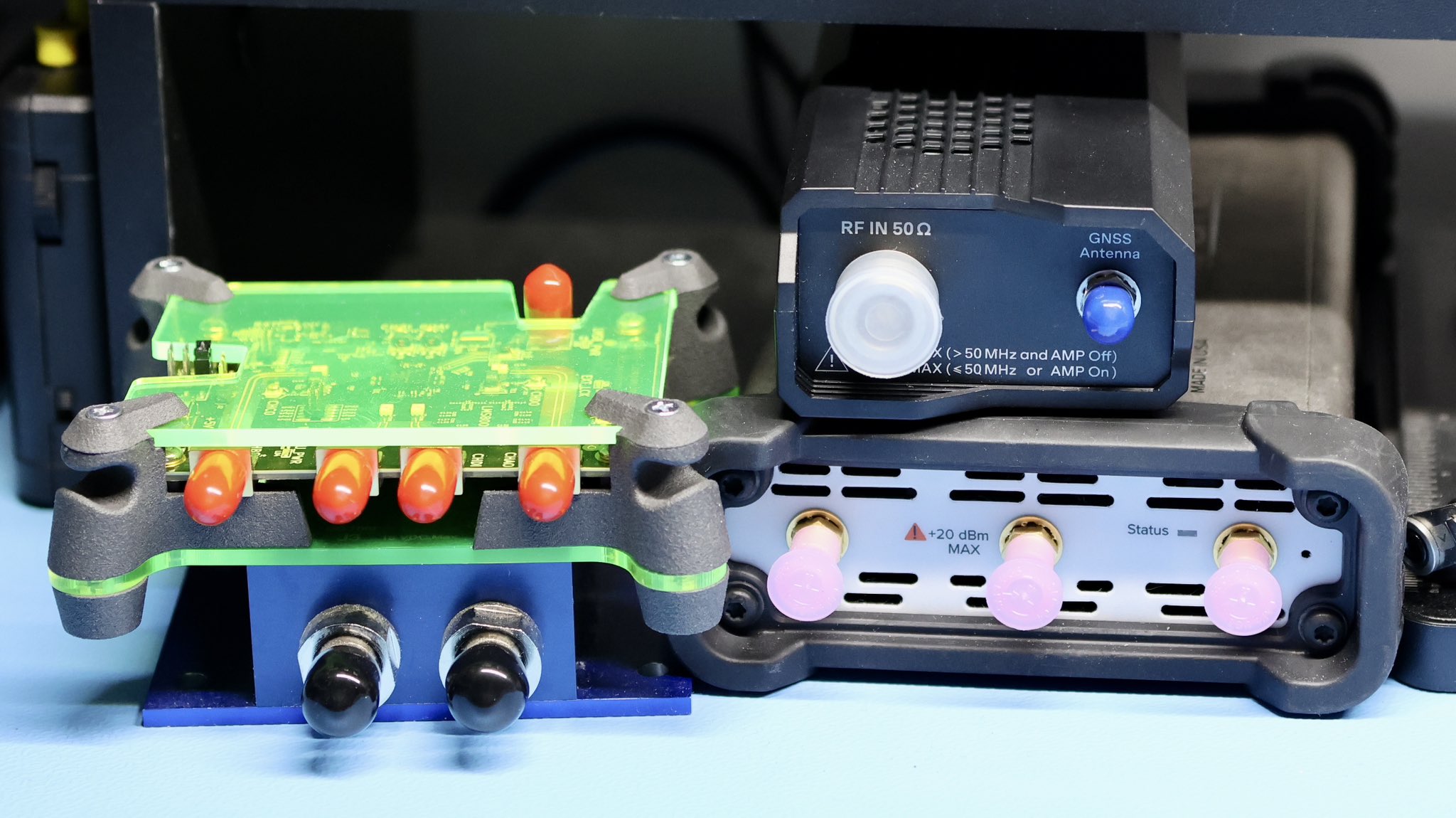
The CR-8 @crowd_supply page is live! Make sure to subscribe so you don't miss the campaign launch!
crowdsupply.com/dragon-labs/…


Isabel retweeted

Kirin 9030 has bad dishing at M2. Only layer I see with this from @SemiAnalysis_ breakdown. The CDU also looks somehow off for this layer.




Isabel retweeted

In 1911, Heike Kamerlingh Onnes, by virtue of being the first person to liquify helium, serendipitously discovered that the resistance of mercury dropped to zero below 4.2K–the first superconductor. For the next decades, some of the luminaries of 20th century physics tackled the superconductivity problem, without achieving the holy grail of a microscopic theory about why it happens. It was not until two smoking gun experiments in the 1950s pointed in the correct direction: isotope effect experiments in mercury showed that the atomic lattice, not just electrons, were implicated, and low-temperature specific heat experiments gave evidence for a small energy gap associated with the superconducting state. These key experiments were among thousands of valid works about superconductivity, and certainly no one knew what would be the smoking gun experiment in 1911 or even in 1941 (the author of the isotope effect paper even stated that their motivation was that they had different isotopes of mercury laying around).
With all the key observations in place, Bardeen, Cooper, and Shrieffer were able to formulate the BCS theory explaining what is now called the ‘conventional’ type of superconductivity.
This history illustrates the important role of serendipity and path-dependence in superconductivity research (as well as other areas dealing with complex many-body systems). If Onnes chose to measure aluminum instead of mercury, he would not have discovered superconductivity when he did; if someone had tried to FAFO superconductivity in different isotopes of a metal earlier, the mechanism of superconductivity could have been established much sooner.
Similarly if superconductivity was discovered in Ba1-xKxBiO3 (BKBO, Tc up to 34K) *before* it was discovered in La2-xBaxCuO4 (LBCO, Tc up to 35K, first cuprate discovered), humanity could have gone another generation without discovering cuprate superconductivity in excess of liquid nitrogen temperatures.