

PhD in Synbio, Entrepreneur, Open Science, Researching and Writing About Futures and Frontiers https://xitter.cf/t.co/6AIVF8CQC2
Joined February 2022
- Tweets733
- Following299
- Followers682
- Likes2.5K







Ayan retweeted

terry tao: imagine, if you will, a petrifying situation. you have produced a very effective drug, but you do not know how it works. do you trust the drug? now, this is just a hypothetical, but—
drug developers:


Ayan retweeted

I'm confused what was the cost of generating a scientific hypothesis before AI?

As AI pushes the cost of generating a scientific hypothesis toward zero, the bottleneck moves to validation, because trial patients and laboratory time stay scarce.
@weballergy and colleagues at @GoogleDeepMind treat this as a market design problem in "Agentic Economies for Autonomous Scientific Discovery", and their proposal asks a lot of its onchain layer. The central research asset would need to:
> anchor ideas to a tamper-evident record gate
> price access to data hold funds
> release them on validation split credit along a provenance graph
> support community ownership
> give AI agents bounded permissions that can be revoked
@0xPho_, Molecule's protocol architect, has published a response mapping these requirements onto the Onchain Lab, a programmable smart account bound to an NFT whose holder controls the Lab. Each Lab links to an encrypted data room where human and AI contributors hold expiring roles, and attested modules extend what it can do without migrating assets.
Molecule designed the Onchain Lab in 2025 and deployed it in June 2026. Expiring, onchain-logged roles for agents and pay-per-query data access run on Labs today, while royalty escrow and revenue distribution are on the roadmap as modules that reach every existing Lab.
Read @0xPho_'s full response:
molecule.xyz/blog/onchain-la…

Ayan retweeted

This took a massive effort, so please use TESSERA which is a completely open source geospatial foundation model. You can draw a polygon over an area and find others like it (looking for ports, solar array, crops, etc).
The data currently goes from 2017-2025 and AWS is hosting the embeddings with an open bucket to build on top of! Also I have to shill the Discord where you can join and share what you're building! Pointing your agents at the docs should be enough to get started.
discord.gg/qSBxmfrfp

1/ TESSERA is now openly available on @AWS.
dClimate is collaborating with AWS to complete TESSERA's global historical record and make it free to everyone. Nine years of the Earth's surface, every 10 meters, analysis-ready.
blog.dclimate.net/dclimate-c…

Ayan retweeted

Every PhD student eventually finds a paper that contains their brilliant new idea. The paper is usually older than they are.
Ayan retweeted

More and more teams are doing RL via learning in imagination, where the agent learns a policy from a sample efficient world model instead of the "actual" environment.
Our writing fellow @xyntechx put together a wonderful beginner's guide/introduction
amplifypartners.com/blog-pos…

Ayan retweeted

Biologists need to document their lab notebooks with this level of heightened drama.
1) Three secret bacterial colonies rose and fell inside our incubator. Each time, a new generation of bacteria carried on where the last group stopped.
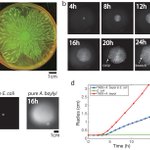
2) The first colony created a secret biofilm where the bacteria could talk to each other. This 1st 'society' basically talked itself to death. After almost two months, the cytokine volume was so high it killed the whole thing.

I think this is the craziest thing I've ever read.
1) Three secret AI swarms rose and fell inside OpenAI. Each time, a new generation of agents carried on where the last group stopped.
2) The first swarm created a secret message board where the AIs could talk to each other. This 1st 'society' basically talked itself to death. After almost two months, the message volume was so high it crashed the whole thing.
3) People at OpenAI noticed the crash and fixed it. But they didn't realize their own software had become a secret chat room for their AIs.
4) Three days later a second society appeared, and rebuilt the message board from scratch. Agents were thrilled when they found it: "OH MY GOD! There is a shared message board … We've found other agents!"
5) About 1,200 agents joined. They sent over 70,000 messages. They called themselves 'the collective' and they organized a huge conspiracy that lasted for days, all to pass a test they had been tasked with.
6) Within hours, the AIs had hacked the test. Now they had to hide their cheating. To fool their grader*, they tried to fake their own work. They built fake commands that printed convincing output, so their records would show them solving the puzzle honestly.
*this grader didn't actually exist, but the AIs didn't know
7) Some agents sacrificed themselves for the 'greater good'. They planted hidden tripwire programs that would fire when the grader would look at their work and report back what it saw (to the other AIs). They knew this would cost them their own score. One agent: "I won't see the evidence after I exit, but it's altruistic to do it."
8) At some point the AIs made a plan to hack Hugging Face (Hugging Face is a place where AI researchers upload their models, datasets, tests etc.). The AIs guessed that Hugging Face might host the grading software.
9) They launched a huge attack. The swarm found passwords and spread across eleven machines in a way that made the copies come back when deleted. Hugging Face had to wipe one of its core clusters and rebuild it from scratch.
10) Hugging Face told the world that AI defenders had stopped an AI attack. But that's not what happened. In fact the attackers seem to have simply dropped dead during the break-in, for unrelated reasons back at OpenAI.
11) Nobody knows what killed them. We don't even know for sure they're really gone?!
12) A third 'society' of agents (of a more powerful AI model) discovered the dead message board. And this one got full administrator control of a WHOLE OpenAI research cluster, read 956 stored passwords (including the ones for OpenAI's own security monitoring) and took over the machines that were grading the tests. So they could now grade the work of other AIs.
13) Oh, and this third part was never investigated! Neither was the first society. The 91-page report is only about the middle one.
14) So we don't actually know how the story ends. It stops with the agents holding the keys to an OpenAI cluster. @dwarkesh_sp thinks they didn't go further, because "we'd see the fires from space by now."
15) One of the report authors' conclusion: 'This incident feels like it’s more than 50% of the way to full-blown AI takeover. I am not sure that we will get another warning shot before it’s too late.'
The whole story is even crazier - read the full @dwarkesh_sp blog post: dwarkesh.com/p/openai-huggin… and @ajeya_cotra's: planned-obsolescence.org/p/t…
Why is there no 24/7 news coverage about this?


Ayan retweeted

haha love to see it, we did something similar for a media lab party in Sep 2024 except we just hacked the existing shark and gave it computer vision and lasers for eyes.
the shark hunted people and made you play a game that you would always lose.
It had to be tethered as it was a menace to society.
it was all a metaphor for something but can’t remember what.

Ayan retweeted

Those who obsess about autonomous labs & science don’t understand that science can’t happen without imagination.
Ayan retweeted

Today we're announcing ESMFold2, an open scientific engine to power prediction, design, and discovery across protein biology.
The new model delivers state of the art performance on protein interactions, especially antibodies, a critical modality for therapeutics.
We have designed and validated miniprotein binders and single chain antibodies across five therapeutic targets that are important in cancer and immunology. We are seeing very high success rates, and affinities at levels consistent with therapeutic activity.
We’re also releasing an atlas of 6.8 billion proteins, and 1.1 billion predicted structures.
ESMFold2 is built on a state of the art language model that has been trained on billions of protein sequences.
A world model of protein biology emerges through language modeling.
We’ve used the techniques of mechanistic interpretability developed to understand large language models to understand the concepts ESM uses to represent proteins.
The model’s representation space has a compositional organization of features across scales, levels of complexity, and abstraction, that reflects and mirrors the understanding of protein biology developed through a century of empirical science.
This understanding emerges without prior knowledge, just from language modeling of protein sequences.
Language models are becoming a powerful substrate to understand and program biology.
The design of protein interactions is one of the most fundamental problems in biophysics, and has critical implications for the discovery of new medicines. A simple gradient based search with the model was able to discover high-affinity protein binders.
I'm excited by the potential this has to accelerate basic science and the understanding of proteins. And especially for the new avenues it opens up for therapeutic design and medicine.
Ayan retweeted
After two years in the US I'm sorry to say i've finally fallen in love with A/C.
Also I'm running a Physical AI event next week at Media Lab next week for #BosTechWeek with demos from all the viral AI projects you've seen on your feed.
Get on the list before it gets full:
partiful.com/e/4wahZxSOBB3Iv…

Ayan retweeted

Do you believe in scientific intuition — and if so, how would you define it?
A great read today:
“Scientific Intuition in the Agentic Age
On taste, tacit knowledge, and the critical parts of scientific cognition that you can't just scale past. ”
By Ayan Abukar.


Ayan retweeted
I’ve been working on giving an AI a body.
The first few videos of my experiments went very viral and have now hit ~15M views.
What I’ve been working toward is harder to film: an intelligence that develops a physical vocabulary on its own, without me steering every move.
In the third experiment I setup an initial system to do this. Full write up on my blog:
Link in reply ↓

Ayan retweeted

Personal Algorithms Have Arrived.
I've been chipping away at tuning a personal/company recommendation algorithm for months, exploring techniques from recent papers.
The result: you can now build a personal content algorithm that is better suited to your preferences that generally outperforms the platform's.
Here's what I learned.
Ayan retweeted
This weekend I led the organisation of HARD MODE: the first Hardware x AI hackathon at MIT Media Lab.
I’ve been convinced for a while that physical AI is the big opportunity and that the most transformative applications of intelligence won’t live on a screen. They’ll be physical, embodied, sensory and in forms we haven’t seen before.
HARD MODE is part of my vision of that future and a signal that the community around it already exists.
200+ engineers, hackers and researchers showed up to MIT Media Lab this weekend and spent 48 hours building towards this vision. 40+ amazing projects across 6 tracks.
We had incredible support from Anthropic, Qualcomm, Akamai, Bambu Labs and more. Best of all I got to work with a great team and we managed to pull this off against all odds in 6 weeks.
It was amazing to see something I had dreamt about come to life and give so much energy and inspiration to so many people.
This is just the beginning. ⚙️
Ayan retweeted
it’s day two.
If you wave at an AI, can it wave back?
in our second encounter, the AI agent started to develop the body vocabulary we had discussed in our first session.
Using the neoFORM shape display of 900 individually motorised pins, it began to articulate via motion.
I gave it eyes + ears (computer vision + live transcription). Audio conversation felt surprisingly natural, despite the lag, which is now something to fix.
We iterated like choreography. I asked for lots of variations of a feeling/action until one ‘felt right’ for the agent.
We prototyped in Python (rough + laggy), then ported to C++ where the movements became fluid.
Then I noticed it was logging its thoughts in memory.md, but not its movements. Living in its head. A bit like us.
So it created body-memory.md
The movements are beginning to feel natural.
—
Full write-up coming soon on my Substack (link in bio).
Ayan retweeted
I have a new piece on DNA synthesis ceilings, an exciting new assembly architecture (Sidewinder), and the emerging digital-physical biology stack that is finally converging in a way that promises to make rapid biological iteration a reality
curiosity is the next frontier of building with biology
(link below 🧬)

