

Tokenizing the supply chain economy. Turning haulage trucks, cargo ships, and aircrafts into investable products.
blockchain
Joined March 2025
- Tweets486
- Following6
- Followers192
- Likes1.2K






Pinned Tweet
We’re excited to announce @audacityonchain has received support through the @arbitrum DAO Grant Program and the Crypto Cities initiative.
We’re bringing real-world transportation assets onchain and building it on Arbitrum’s secure scaling infrastructure.
Execution begins now.
Oct 29, 1929: Black Tuesday.
About 16M shares traded in one day, a record.
The Dow, a key US stock index, fell about 12%. Many lost savings without knowing what they owned.
In 1933, the US made firms share real financial information.
Tokenization follows that idea: ownership anyone can check.


Why are investors looking at RWAs in 2026?
Onchain RWAs grew from about $11.8B to $33.5B in a year.
➡️stobox.io/blog/rwa-market-si…
BlackRock, Franklin Templeton and Apollo all have live tokenized products.
Tokenized assets are backed by real things that earn real income, and investors anywhere can own a piece.


Audacity is on the front line of tokenization, where the moving economy meets the blockchain.

What if you could invest in a truck without actually buying the truck? 👀
@audacityonchain is turning real-world transport assets into investable products on-chain.
Starting with commercial haulage trucks backed by real logistics revenue.
audacitydao.com
In 1968, Wall Street closed on Wednesdays. Not for a holiday or a crash. For paperwork.
Trading volume had exploded, but every trade still meant moving physical stock certificates by hand. Back offices couldn't keep up, so the exchange shut down mid-week to catch up.
The fix was to record ownership in a central system instead of moving paper around.
Tokenization takes that idea a step further, recording ownership onchain so settlement doesn't depend on paperwork.
Every era's bottleneck looks permanent until someone rebuilds the plumbing.


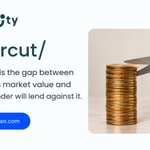
Ever heard of a "haircut" in finance? It has nothing to do with barbers.
A haircut is the gap between an asset's market value and what a lender will lend against it. If you own a $100 bond, a lender might only lend you $95.
That 5% is their cushion in case the asset loses value.
The riskier or harder to value the asset, the bigger the haircut.
Haircuts exist because lenders can't always see what an asset is worth.
Clearer onchain data on pricing and performance can help them judge risk with more confidence.


Start the week with one question: what do I actually hold?
A token that tracks an asset is not always the same as owning it. Check who created it, what rights come with it, and whether the asset owner supports it.
GM! 💙

Have you heard about Repo?
"A short-term loan where one party sells a security and agrees to buy it back later at a higher price."
Repo markets quietly keep global finance liquid. Banks, funds and dealers use them every day to borrow against safe assets.
Now imagine that collateral tokenized: moving faster, settling instantly, visible on a shared ledger.
Less idle. More working


Would it survive a bear market?
That's the only test any yield needs to pass.
If it depends on new deposits, it's a pyramid with better branding. If it depends on token incentives, it's a subsidy that ends when the budget does.
Real assets generate cash whether ETH is $4,000 or $400.
Tokenizing a real asset doesn't create yield. It gives onchain access to yield that already exists: a real customer paying for a real service, with the asset itself as the source of the cash flow. Real-world assets were already generating income before the token existed, and they'll keep generating it after.

Your stablecoins are asleep.
They sit in wallets, waiting for the next opportunity. Meanwhile, real economic activity needs capital to keep moving.
Tokenized real-world assets connect the two: idle onchain capital financing real economic activity, with income coming back onchain.
Wake your capital up.

Fractional ownership of trucks with @audacityonchain

In 1993, one ticker changed how the world invests.
The SPDR S&P 500 (SPY) launched as the first U.S. ETF, letting investors own a whole basket of stocks by buying a single share. No need to pick individual companies, no need for large capital, just one trade for diversified exposure.
Tokenization is aiming for a similar shift, just with a different set of assets. Trucks, credit, equipment, infrastructure, things that were never easy to access, let alone diversify into.
Wall Street packaged access once, through the ETF. Web3 is opening it wider, to assets that never had a packaging layer at all.

Who lends to real businesses today? Increasingly, it's not just banks.
Private credit, which means loans made to companies by investment firms instead of banks, has become one of Wall Street's fastest-growing asset classes. It's an estimated $2 trillion today and expected to roughly double to $4 trillion by 2030.
Traditionally, getting in meant big minimums, limited visibility, and slow reporting. Tokenized private credit changes that with smaller entry points, onchain records you can verify, and clearer distributions.
What stays the same is the source of income: real borrowers repaying real loans, backed by real assets.
