
General Partner (AI Apps & Fintech) @a16z, proud Canadian, mom of 2 boys, distance runner; Previous: product leader
San Francisco, CA
Joined February 2007
- Tweets912
- Following2.1K
- Followers29.1K
- Likes1.4K








angela strange retweeted

More background on how this happened and why Silicon Valley is so magical:
-I had the privilege of working with Jean-Denis (@jgreze) at Plaid for many years
-After running in the SF Marathon in 2024, I "ran" into him at In-N-Out in Daly City and we talked about what he was doing next...
-SMB tax...!
-Meanwhile, my partner Justine Moore (@venturetwins) was off trying every single consumer and enterprise productivity agent...and Town had pivoted
-She concluded Town was the best, which caused @bhorowitz to start using Town
-I then re-heard of Town and was like...the SMB Tax tool? :)
-I reached back out to Jean-Denis and told him about his mega fan and suggested having dinner with Ben and me
This also shows why venture is a team sport. This investment would have never happened without Justine, and probably without Ben as well! And maybe without the SF Marathon! And likely not without Plaid / @zachperret!

Jean-Denis Greze was CTO of Plaid. His next startup, an AI tax product for small businesses, brought in nearly $1M in revenue its first year, and he projected $2.5 to $3M the next. He shut it down anyway.
The reason: in the age of AI, it was never going to be venture scale. Incumbents could use the same technology to automate tax prep for their existing customers faster than a startup could win market share. Tax is also sold once a year, so he had about a one-month window to pivot before the door closed.
The pivot became Town, an AI assistant that works from your email and calendar. It found product-market fit fast enough that Ben Horowitz messaged a16z's Alex Rampell to say it "changed my life."
In this conversation, Alex and Jean-Denis cover:
- How to know when to kill a business that's working on paper
- Why Town competes with OpenAI and Anthropic, the companies it buys its tokens from
- Why the "forward deployed engineer" model gets worse as AI gets better
- How a $1/month AI routine can save a restaurant thousands
- What agents mean for Amazon, advertising and the future of shopping
0:57 How Ben Horowitz discovered Town
2:20 Why Town started with AI tax prep
3:55 Why tax couldn't be venture scale
6:30 Shutting down a working business
10:24 The customer ask that became Town
13:35 Why Town built for users before IT
16:18 AI's iPhone moment at work
21:28 Jevons paradox for executive assistants
23:13 Town as a "token allocation machine"
28:00 How Town tailors itself to each job
34:03 Competing with your token suppliers
42:24 Staying off the AI labs' radar
44:42 Why AI isn't spreading evenly yet
52:32 How agents break the ad model
55:35 The friction humans actually enjoy
57:05 Why supply aggregators lose to agents
YouTube: youtu.be/o_5f4N6Nq80
@jgreze @TownAI @arampell
angela strange retweeted

. @opencode, the popular open-source AI coding harness got hacked. Developers’ API keys to frontier labs - OpenAI and Anthropic - were exposed as they were apparently being stored in cleartext.
Here's a rundown of AI Token theft, one of the fastest growing fraud vectors and how AI companies can stay safe
Trust is very fragile: takes years to earn and one mistake, in one second and you lose it.
An AI company which takes trust seriously, always wins in the long run

We had a security breach last night related to a large scale distillation attack that impacted 1.4% of OpenCode Console users
We have notified them all this morning via email. If you did not get an email you were not impacted, it was a subset of users who had external providers linked
The incident is ongoing so we cannot share more details at this point but we are working with Anthropic, OpenAI, and Google to remediate


angela strange retweeted
The fastest growing fraud vector I’m seeing – token scams. So I asked our AI engineers at Sardine to explain how this scam works, from:
- Free trial abuse
- Account farms that sign up thousands of fake users
- Reselling stolen AI credits
- Distillation attacks
- Why ID checks and selfies don't stop it
- Why payment-stage fraud tools often miss token abuse
- The signals that still work when fraudsters rotate accounts
- How you stop token scams before they get started
The full breakdown is here: sardine.ai/blog/free-trial-a…
And over the next few days, I’ll go in depth on some of these topics. Truly one of the newest and fastest growing fraud vectors out there that has the potential to affect so many companies.

angela strange retweeted

@fal's H3 Max generates video faster than you can watch it. With director mode and voice prompting, you can direct a scene as it plays - moving the camera and guiding the action just by talking to the model.
The leap isn’t just speed. It’s creative control. That’s what takes AI from impressive demos to a serious technology for Hollywood and professional filmmakers.
Inspiring convo with @gorkem and @isidentical on what possibilities are unfolding in generative media.
.@fal's Gorkem Yurtseven and Batuhan Taskaya on making an open source video model 35x faster, and what Hollywood wanted after they built it:
Last month, MiniMax released H3, an open source video model. fal rebuilt it - they cut down the steps the model takes to make a video, rewrote the code under each stage, and got the GPUs to 70-80% of their theoretical ceiling instead of their usual 30-40%. No quality loss.
Video now generates faster than you can film it. The models have gotten so cheap and fast that end users aren't even asking for improvements in either category anymore. The gap has moved to quality, or how closely the model follows the prompt.
Hollywood wasn't a customer a year ago and is now fal's fastest growing segment. Studios love it for the little things - extending a shot, moving the camera, changing the lighting. Those edits land 80-90% of the time. fal is chasing 99.9%.
In this conversation with a16z's Jennifer Li:
00:00 Intro
01:45 The first open model worth rebuilding
03:45 The industry ran out of compute in April
06:25 35x faster without losing quality
11:05 5s of video generated in 1.5s
14:25 The weekend fal dropped everything
16:15 3 viral projects nobody planned
18:20 Teaching a video model to remember
20:25 An hour of video that's consistent
23:30 2x the usage of other models in 3 weeks
26:35 The case for giving video away for free
29:00 Blender sketch in, finished shot out
30:40 Chasing 99.9% reliability
34:15 Hollywood, fal's fastest-growing customer
36:50 Why studios wouldn't touch it until now
YouTube: youtu.be/SDbRJXQrYGY
@gorkem @isidentical @fal @JenniferHli
angela strange retweeted
Careers are long. And you never know how life re-intersects…
The karmic boomerang is real. For good (and for bad). Always why you should do the right thing!
angela strange retweeted

How to Rebuild a Company around AI
@Alehandromz (Alejandro Maza), Chief Product & AI Officer, Kavak, interviewed by @astrange (Angela Strange) and @gabe_NM (Gabriel Vasquez) (@a16z Podcast)
Summary: Kavak, the Latin American used-car marketplace, now runs 96% of customer interactions and 95% of transactions through AI agents, and spawns between 100,000 and 200,000 of them every day. Alejandro Maza rebuilt the APIs, the teams, the metrics and the customer journey around agents. Most companies hand employees a chat tool and keep the org chart. Maza then threw his whole architecture out and started over when a better model made it obsolete.
1. The Six Percent Trap. The technology for Ford's production line existed 40 years before Ford built it. Edison was selling electricity in New York by 1881 with a very efficient dynamo, and factory owners kept their four-story buildings, their shafts and their belts, and swapped the coal engine for an electric one. That bought them about 6% efficiency. The 3x came from demolishing the factory, moving out of the city and redesigning the floor around small distributed motors, and Maza says every CEO faces that same choice right now.
2. An Agent Per Customer. Kavak's design question was how it would build the company in 2035 with GPT-10 level intelligence. Every customer who arrives gets an agent spawned for them alone, with its own virtual machine, memory of every web visit and phone call going back years, and a long-term goal of maximizing that customer's lifetime value. Between 100,000 and 200,000 of these wake up each day, work for three minutes or eight hours or three days, set an alarm for the next task and go back to sleep. Most companies are still wiring up multi-agent expert systems, and Kavak bet on long-running agents with hard goals.
3. One Agent, 15 Experts. Selling a used car in Latin America means being excellent at 15 things at once: 20,000 SKUs, financing, insurance, coverage and quoting the trade-in. The old model routed a buyer through 15 human experts on 15 teams, so Kavak built an agent better than the expert at each piece and fused them into one. Kavak never built a customer service agent, only sellers, and pointed them at the hardest job in the company. Customer satisfaction tripled, and the agent first converted 50% better than the human team, then climbed to 2.1x.
4. Evals Are The Brakes. Kavak spends roughly the same engineer time, tokens and money on evals as on the agents themselves. Maza's rule of thumb is that you press the accelerator in proportion to your brakes, and the companies moving slowly on AI are the ones without them. What gets measured is the business result: did the customer convert, did the loan get approved, will they come back. He watches other companies count calls and minutes-per-call, which does not tell you whether the thing worked.
5. The Three Minute Loan. A car loan in Mexico typically takes two months or more to approve. Kavak approves in under three minutes, because it holds the data on both the customer and the car. Vertical integration also gives it a move a bank does not have: if the customer can no longer pay, they return the car and get a cheaper one with a smaller payment. Agents run the underwriting, the pricing and the servicing end to end, on customers with thin files or none, down to the interest rate, the risk tier and the maximum loan for that individual.
6. The AI CEO. Kavak carved out the city of Cuernavaca and put an agent in charge of it. The goal for the first month was to double profits, and six weeks in it has delivered 50% more. It works the way a very smart and very tireless person would, reading every number and every customer, building the forecast, then micromanaging the daily plan and messaging the physical staff, who send voice notes back on their progress. Customer satisfaction, inventory rotation and financing penetration all improved, in the one job everyone assumed would go last.
7. Ten Million Relationships. Kavak used to count cars bought, cars sold and brake pads ordered. It now counts 10 million customers in a database, most of them with an agent assigned and a mandate to grow that relationship over years. On a book of cars and large personal loans, activating 1% of that base is worth hundreds of millions of dollars. The economics work because a used car is a trust purchase, and trust comes from an agent that remembers a conversation from two years ago.
8. Token Tiers. Maza sorts AI spend into three tiers by whether he can see the return. Tier three, the most valuable, is tokens going into agents doing the actual work of the business, where the ROI of each token is measurable today. Tier two is indirect, like watching developers in the codebase and inferring the value before pushing it to production. Tier one is everyone on Claude Code or ChatGPT or Cowork with no idea what came of it, which is where most companies spending hundreds of millions currently sit.
9. Humans Behind The API. Most production agent systems escalate to a tier-2 human queue and forget about it, so the loop never closes and the agent never learns. At Kavak the agent calls an API asking for help, and a person is on the other side of that call. Draw it on an org chart and it is human teams reporting to an agent. When a mistake gets corrected, the other 200,000 agents have it by the next day.
10. The Jedi Academy. Kavak trains everyone from the CEO to the mechanics to build agents, in a six-week program Maza designed and teaches himself, and graduates ship agents to production. He rewrites the curriculum constantly because the material keeps changing, and there is nowhere to send people to learn it. The message to staff was direct: this is where Kavak is going, you can learn the skills to work in it, or you can leave. Some became AI engineers, and everyone learned to work alongside the technology.
11. Destroy What Works. By December Kavak had tens of thousands of agents in multi-agent graphs running the business profitably. Opus 4.5 shipped and Maza concluded the architecture had become the constraint, because the graph structure was capping a level of intelligence that no longer needed it. He threw out two years of work that was producing growth and profit, and rebuilt on a virtual machine with memory, evals, a CLI and access to every tool and API in the company. His advice to anyone starting now is to skip agentic workflows and graphs entirely.
12. Creative Destruction. Schumpeter's point was that new technology reaches the economy by destroying incumbents. Maza's read is that almost no public-company CEO will stand up and say they are demolishing 40 years of accumulated systems to rebuild as an AI-native company, so they will adopt superficially and take the 6%. That leaves the deep rebuild to companies that do not exist yet. His closing argument to founders is that the most powerful intelligence in the world now costs $20 a month, so draw the trend line out and build for where it lands.

angela strange retweeted

Unless you're an immigrant yourself, most don't fully realize is that these roots form secret (friendly) mafias in Silicon Valley. Putting those roots and branches to work for Canadian entrepreneurs is the best work I ever did.

Canada was early.
15 years ago I helped launch @theC100 🇨🇦 with @chrisalbinson @anthonylee after seeing what India & Israel had already built in the Valley: ambitious founders, and a diaspora ready to pay it forward.
@tobi @harleyf built a global company from Canada. @zatlyn @stewart built theirs from the US. Talent and customers on both sides of the border.
Your roots are increasingly an advantage.
angela strange retweeted

@astrange what you built with C100 was incredibly foundational for so many of us.
Thank you so much for doing that!
Deeply grateful.


angela strange retweeted

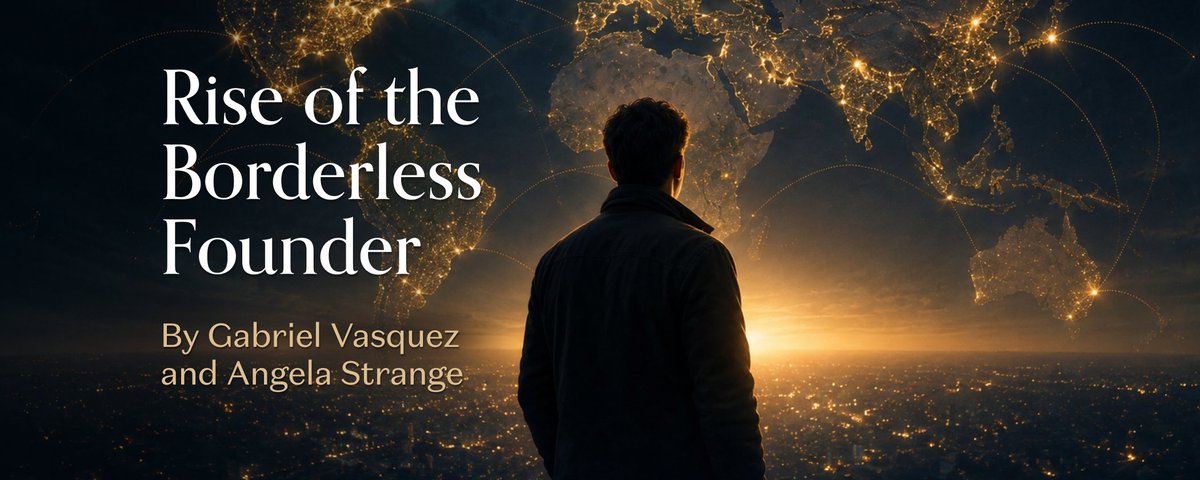
a16z GP Angela Strange on how Borderless Founders accelerate preferential attachment through talent and customer power laws:
"I would argue Borderless Founders have more levers at their disposal."
"So if you start with talent, this is the fiercest talent market I've seen in my career as an investor, and also as an operator."
"We have an AI insurance company in Brazil, and so you might think, 'Oh, the best talent is at the top most well-known universities there.' Actually, for AI talent, it's at a university that you haven't heard of."
"And so if you are a company that gets 10 incredibly smart people really early, the 11th that you might be trying to recruit from the US that has 100 other offers meets your team, is like, 'Holy shit, how do they get people that are that good there?' And that starts the talent flywheel."
"On the customer side, anytime you want to land a large customer, the first question they're going to ask is, 'Who else is using you that's in my industry at my size?'"
"Nobody wants to be the first bank or the first insurance company. But via Borderless Founder network, you can get a large bank and a large insurance company in another country much more quickly."
@astrange @VirtualElena


angela strange retweeted
1/
Two weeks ago, we turned off AI access for every new non-engineering hire at @valon.
That is a strange decision for a company at the frontier of AI adoption. It is also one of the biggest bets we can make on our people.
valon.ai/blog/we-turned-off-…

angela strange retweeted

🚀Thank you Cursor for the honor of a career to work together. You changed how software is written. While I'm sad to step off the board, SpaceX is a perfect fit. I can't wait to watch y'all continue to change the course of the industry (and humanity) as a frontier AI leader🚀

Cursor is now part of @SpaceX.
Today, we have officially closed our acquisition. We will join the @spacexai team to help make Grok the world's most useful AI and improve Grok Build, Grok Bot, Grok API, Cursor, and more.
SpaceX has built some of the most inspiring and impressive technology in the world, and we’re grateful for the opportunity to become part of such a special company. Onwards.
angela strange retweeted

Ale is the most sophisticated thinker on models/agents/loops in the enterprise that I know, and our conversations are some of the most stimulating I get to have.... he's living in the future, highly recommended listen/follow.
angela strange retweeted

something that i've noticed in the ~4 months i've lived in sf is there's a small cohort of founders / engineers / ai researchers who all behave as if they're living 3-5 years in the future. this manifests in a lot of bruce wayne-type behavior. i've seen workflows of engineers who lie supine on the couch as they wisprflow commands to their agent swarms without ever touching a keyboard. i've seen people build out entire second brains that they orchestrate with openclaw / hermes agents. i know guys who spend $1m +/year on tokens.
so i think this conversation with alejandro maza, kavak's chief product and ai officer, with @astrange and @GEVS94 is super interesting because it 1) shows us what an entire organization built around living in the future looks like 2) kavak isn't even based in sf (or the us) so it's very cool to see how an organization outside of the bay area approaches ai from first principles. some takeaways:
- alejandro's governing question is what kavak would look like in 2035 with much more capable, cheap intelligence. kavak moved from functional specialists and transactions toward a persistent *agent per customer*, with a long-term goal of maximizing that customer’s lifetime value.
-every major model release should trigger a fresh model–harness experiment. kavak had developed a multi-agent framework, but a new model release rendered the company's legacy orchestration outdated, so they discarded 2 years of working infra and rebuilt everything around a simpler agent harness. the lesson is to keep asking: what's the minimum scaffolding the newest model needs to express its intelligence safely and at scale?
-kavak built an ai ceo for one city, and says it increased profits by 1.5x in its first month. customer satisfaction, inventory rotation, financing penetration, and other KPIs also improved. maza attributes the result to fields medal-level intelligence applied relentlessly to every number and customer: forecasting performance, assigning daily work, and collecting progress reports.
-in light of above points, alejandro's deeper thesis is that the organization, not merely the model or individual worker, should self-improve as new intelligence becomes available.
AI agents at Kavak sell the cars, underwrite the loans, coach the mechanics, and in one Mexican city, run the entire operation.
The Latin American used-car marketplace bet on agents three years ago. Today ~95% of interactions and transactions run end-to-end on AI: NPS tripled, sales conversion doubled, warranties down 26%, car loans approved in less than three minutes.
CPO & AI Officer Alejandro Maza joins a16z's Angela Strange and Gabriel Vasquez on how they pulled it off, why adoption without redesign fails, and why they deleted two years of working architecture to start over.
00:00 Intro
01:03 ML before transformers
02:23 Kavak's agent-per-customer architecture
04:59 Three bets: redesign the company, build superhuman agents, change the metrics
10:49 Agents with 2.1x conversion
14:23 Car loans approved in minutes
16:13 1.5x profits in a real city in six weeks
20:13 "Jedi Academy": training mechanics to ship agents
28:44 Destroying two years of work
32:52 Ford's factory: why adoption isn't enough
34:45 Advice for founders
@alehandromz @astrange @GEVS94
angela strange retweeted

This is a great story and frankly inspiring and prescient
The surface area of things that the people really want is infinite, just large and requires tenacity in sampling it
You can create your own luck if you keep stories like this close to your heart
.@bhorowitz on how a game studio turned it's last $6 million into Slack:
"Stewart calls me. He says, 'Ben, I've got $6 million left. I have no way to raise money because I've made really no progress. So I've got three choices. I can pray for rain and try and finish it, I can shut down the company and give you your $6 million back, or we built this tool that we use in our engineering team to communicate with each other, and I could just put that out as a product.'"
"I'm like, 'What? You just built some tool to talk to each other and you want to put that out as a product? And you're a consumer guy, and you want to become an enterprise software guy?'"
"$6 million is not gonna make any difference in my life. If you really think it's a good idea, go ahead."
Ben Horowitz Talks Honesty, Failure, and Secrets at UC Berkeley (2016)
angela strange retweeted

I've never shared this before, but now feels like the right time.
When we raised our $25 million Series A, we had two term sheets.
The @a16z terms were actually more expensive. We went with them anyway.
The reason was @joeschmidtiv.
@joeschmidtiv is not just a venture capitalist, but he's also a licensed insurance agent and cares deeply about the space. This decision became an inflection point in the growth story of @furtheraicom.
Joe was kind enough to sit down to talk about where insurance and AI are actually headed.
We covered:
→ Most dangerous thing in enterprise AI right now
→ AI psychosis
→ Where insurance + AI are actually headed
This is also my first episode as a "podcaster". If you like this style, please help amplify.
What we cover:
() How insurance went from tech laggard to AI-first
() Oil Wells vs. Pipelines: two AI adoption strategies
() 25 of the 100 largest insurers visited a16z this year
() The growth opportunity everyone is missing
() Avoiding Death on the Yellow Brick Road
() Why AI is great at code but terrible at underwriting
() The build vs. buy debate in insurance
() The last mile is everything
() Our famous Bay Area donut story
() Where insurance is going in the next 5 years
() How CTOs should actually think about AI adoption
Thank you to Joe for being a part of this!
angela strange retweeted

So excited for our chat w Santi!
The story of how @SantiaSua is building Addi is a masterclass in scaling an AI first company. 1 in 4 Colombians now uses Addi to shop, pay, and soon to bank. Addi has 200+ agents in production - they counterintuitively started in legal! - for full automated legal, onboarding & CS.
For anyone thinking about hiring & scaling a global workforce & building agent, checkout the full conversation with me & @GEVS94 @Addi_Col