

PhD candidate @Parietal_INRIA, interested in stats/ML for medicine and neuroscience. MSc graduate @ENSAEparis @ENS_ParisSaclay (MVA)
Paris
Joined August 2022
- Tweets18
- Following83
- Followers55
- Likes49




Pinned Tweet
🚀Happy to share our paper at @NeurIPSConf with @BertrandThirion @ogrisel @pneuvial: arxiv.org/abs/2310.10373
It introduces KOPI, a novel method for statistically controlled variable selection based on Knockoffs. Come check out our poster #1004 at #NeurIPS2023!
🧵1/6

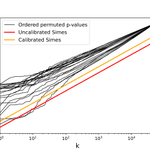
📊We’ve put KOPI to the test against other state-of-the-art Knockoffs-based method on simulated data. KOPI controls the FDP in all settings and offers superior or equal power compared to other methods.

🧠We’ve also employed KOPI on fMRI and genomics data. The aim of fMRI data analysis is to recover relevant brain regions for a given cognitive task as shown below. These results are reproducible using github.com/alexblnn/KOPI.

Alexandre Blain retweeted

#IA 🤖 ⏐En direct du centre @CEAParisSaclay, à NeuroSpin, où nous accueillons les équipes de @FranceInter pour une journée spéciale dédiée à l’IA et à la #santé !
🧐 l’IA va t-elle prendre soin de nous ?
👋 @Philippe_Ciuciu, @BertrandThirion, @BrunoDuvic, @VCIrene, F. Terrier
Alexandre Blain retweeted

Our paper on using Optimal Transport to compare human cortical surfaces was accepted at #NeurIPS22 🥳
We implement a new OT solver (FUGW) to compare human brains although their anatomy and functional activity patterns differ a lot.
arxiv.org/abs/2206.09398
github.com/alexisthual/fugw
How many active voxels are there in this cluster ? This question can be addressed using Notip: Non-parametric True Discovery Proportion control for brain imaging published in @NeuroImage_EiC
Pre-print: arxiv.org/pdf/2204.10572.pdf

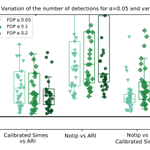
These gains are observed on 36 fMRI datasets from Neurovault that differ across several dimensions (number of subjects, nature of contrasts,
fMRI study, quantity of signal…) and for targeted FDPs:

All results are fully reproducible using github.com/alexblnn/Notip, which relies on @nilearn and sanssouci.python. Computing lower bounds takes ~1 minute per fMRI dataset. This work was done at/with @Parietal_INRIA @BertrandThirion @pneuvial @InstitutDATAIA @Inria_Saclay
