
I help enterprise sales and executive teams in vertical AI and vertical SaaS expedite GTM and revenue generation.
London, England
Joined February 2009
- Tweets23.2K
- Following4.8K
- Followers4.2K
- Likes1.7K





Pinned Tweet
Remember: Anyone can critique. Not everyone can CREATE.
Combine both and you have progress!
AI decreases the cost of producing information.
But it doesn't decrease the cost of producing trust.
If AI lets any team create 10x more content, 10x more content is not an advantage. Faster output does not translate to value.
The value shifts to having something distinctive to say.
Own and define your strategic narrative.
AI is making marketing output cheaper and faster than ever, but the AI slop debate is a distraction.
A better question: is your company capturing how it wins, so that intelligence compounds rather than walking out with every leadership change?
New piece: forwarddeployedmarketing.sub…
🤖 Made with AI

Aimee Carmichael retweeted

As someone who has personally spent $500k / mo+ on Google Ads for years, I can tell you with certainty:
This revenue growth in Search is artificial & extremely unhealthy for Google’s business long term
Search volumes are declining as legacy search is being increasingly cannibalized by non-monetized LLM queries
Google’s response?
Manufacture revenue growth via short-sighted, highly extractive, customer-hostile tactics. I.e. charge advertisers more for lower quality clicks, including clicks they do not want and explicitly did not approve Google to charge them for
A few examples to illustrate:
For all of its history until recently, Google operated on a 2nd price auction model
I.e. if you bid $5 CPC and the next highest bidder bids $1 CPC, Google charged you $1.01 for the click (one penny more than the 2nd highest bidder) rather than the $5 you bid
This was a genius move by Google early on as it incentivizes advertisers to input their true maximum willingness to pay rather than trying to play the game of bidding low and constantly adjusting to try to stay just ahead of the next highest bidder while still not paying too much
However recently, Google silently deprecated the 2nd price auction and began charging advertisers as much as their bid and budget caps allow, regardless of what anyone else is bidding
It’s a short-sighted cash grab at the expense of the long term health of the advertiser ecosystem
Making thing worse, Google also recently nerfed keyword targeting precision
Google previously had precise keyword targeting settings that allowed advertisers pick individual search phrases to bid on, defined down to the character w/ exact match or phrase match targeting
This was one of the core features that made search advertising magic, enabling advertisers to run extremely precise campaigns based on exactly what their target customer typed
But now, even if you bid on a specific term or phrase using the strictest exact
-match targeting settings, Google will show your ad across 1000’s of unrelated keywords, labeling them as as “exact match (close variant)”
The definition of “close variant” means whatever they want it to and changes constantly. The result is advertisers get billed for clicks that are totally irrelevant to their business and that their targeting settings explicitly forbid Google from targeting. Google does it anyway and there’s no ability to turn this off
So now exact match is broad match, and broad match is just meaningless spam
This is all very bad for advertisers, but for Google, it allows them to show your ad and bill you for clicks across 1000x more searches that were previously going unmonetized (mainly because they’re garbage queries no one wants)
This is how you grow revenue atop declining search volumes
Lastly, and perhaps most egregiously, Google quietly stopped respecting budget caps by a factor of 2x. For example campaigns we’ve been running for years with $1000 daily budget caps suddenly began spending $2000+ per day
And the extra spend is entirely on the garbage keywords Google arbitrarily throws in as “exact match (close variants)” which have no value to our business, but can’t be turned off
Google offers no refunds nor any recourse for overspend or spend on keywords you explicitly did not target
These are not the actions of a healthy business. These are the actions of company whose core business is in decline but desperately needs to pump quarterly earnings so Wall Street will continue to fund insane capex while hopefully looking through their rapidly deteriorating negative free cash flow
Google operated a benevolent monopoly for the better part of 25 yrs
Meaning the value Google captured from Search was but a small fraction of the value it created, and that spread produced a potential energy that justified expectations of high earnings growth far, far into the future
This is now no longer the case
At the alter of AI capex, Google is sacrificing the golden goose

Q2 was an amazing quarter, with our AI investments redefining what’s possible across every part of our business.
Alphabet revenue grew 24% YoY and Google Cloud accelerated to 82% growth. We saw exciting momentum across the board from Search to YouTube to the Gemini app (which reached 950M monthly active users). Our model APIs are processing 22B tokens/min (up from 16B+ last quarter) driven by our workhorse Flash models. We’re also seeing great adoption of Gemini Enterprise, used by 90% of the Fortune 100, as well as strong demand for our security solutions.
Outstanding results and momentum, and such an exciting moment—thanks to all of our partners and employees around the world! 🙌 About to hop on the call!

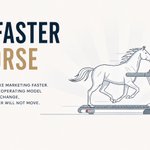
Is your marketing org simply creating a faster horse? or really creating compounding intelligence?
forwarddeployedmarketing.sub…


Most AI adoption in marketing is a faster horse. The work should not simply get faster.
The operating model must change.
forwarddeployedmarketing.sub…
🤖 Made with AI

Aimee Carmichael retweeted

loops can help you build more effective, more autonomous agents
this post dives into a few loops:
1. the agent loop
2. the verification loop
3. the event driven loop
4. the hill climbing loop
and how you can compose them with langchain primitives!


Aimee Carmichael retweeted

I built and scaled a vertical software company over 10+ years. One tactic quietly drove millions in bookings: roadshows.
I've ran roadshows annually for years, and they've become a staple in my planning. Every time, they've delivered.
In certain vertical markets, like HVAC, legal tech, or construction, relationships are everything. Prospects aren't scrolling LinkedIn for generic demos. They want trust, proof, and personalization. Roadshows deliver that at scale.
The data backs it: Face-to-face meetings convert 40% higher than virtual ones (per Harvard Business Review studies on B2B sales). In specialized industries, where switching costs are high, that personal touch builds moats faster than any webinar. Here is my exact process to make this a success…
1: Nail the Purpose
A roadshow without purpose is just a vacation with expense reports. "Hey, I'm in town, coffee?" That's weak. Prospects smell desperation.
Strong purposes tie directly to value creation. One examples I've used successfully over and over again:
You're rolling out something game-changing, like AI-powered workflow tools for a niche. The roadshow isn't sales, it's validation. You're saying, "We're investing millions; help us build it right."
Purpose drives everything. It shapes your targets, messaging, and follow up. Without it, attainment rates tank below 20%. With it? I've hit 80%+.
2: Who Leads the Roadshow?
This isn't delegate and forget territory. The leader sets the tone.
CEO or C-Suite: Ideal for high stakes plays. Execs open doors AEs can't. I've seen CEOs book 90% of meetings vs. 50% for reps. Why? Authority signals commitment.
3: Target the Right Mix of Accounts
Not all prospects are equal. Focus where the domino effect kicks in.
80% Prospects, 20% Existing Customers: New logos drive growth, but renewals build momentum. Customers provide testimonials on the spot, "This saved us 30% on ops" which prospects eat up.
For launches, skew heavier on net-new. Adjacent expansions? Balance with upsell opportunities.
4: Pick Marquee Accounts, Quality Over Quantity,
Roadshows aren't spray-and-pray. Target 20-30 top tier accounts per leg.
Criteria:
→ Marquee Status: Household names in your vertical. Think top HVAC chains for field service software or mid-market law firms for legal tech.
→ Strategic Fit: Accounts that, if won, create FOMO. Launch with them, and others follow. I've closed a $600KM deal with a marquee prospect, then watched three copycats pile in within months.
→ Geographic Clustering: Group by city/region to minimize travel drag. East Coast run: NYC, Boston, DC. West: SF, LA, Seattle.
5: Outreach, Warm Intros Only, No Colds
Cold emails? Forget it. Response rates are sub 5%. Roadshows live or die on introductions. Tools like ZoomInfo or LinkedIn Sales Nav help, but warm networks are king.
Leverage Networks: Mutual connections via investors, alumni, or vertical events. "John from [Investor] suggested I reach out."
Timing: 4-6 weeks out. Share purpose early to build intrigue.
6: The Hook, What's In It for Them?
Warm intros get the meeting; value seals it. Don't lead with your pitch. Lead with theirs.
Prospects love being "advisors." It flips the dynamic, you're learning from them.
Step 7: The Grind, How Much Work Is It Really?
Be real: It's intense. 1-3 months means 50+ meetings, logistics hell, jet lag.
Breakdown:
Planning Phase (4-6 Weeks): Map routes, book intros, prep materials. Involve exec team—marketing for collateral, sales for pipelines, product for demos, success for retention plays.
Execution: 3-5 meetings/day. Keep agendas tight: 30-min intro, 45-min deep dive, 15-min Q&A.
Follow-Up: Immediate. CRM notes, personalized recaps within 24 hours. Nurture non-closes with content drips.
I've lived out of suitcases, but ROI? Millions in ARR. One roadshow alone added $5M+ in pipeline velocity and brought in nearly $2M in ARR.
I’ve preached this to founder friends for years and ALWAYS get good feedback from them. It’s NOT necessarily fun, but it works…
Vertical software thrives on depth. Roadshows deepen that edge. Go Design Yours and Own the Results
Don't overthink. Start small: One city, 10 accounts, ironclad purpose. Incorporate it yearly. Get exec buy-in. Execute flawlessly. I've seen roadshows turn good years into blowouts. Yours can too.
Try it. DM me results. I'll share more on what’s worked/what hasn’t.
Aimee Carmichael retweeted

Satya wrote this article himself, in contrast to a lot of the AI-generated responses
Dario’s essays, roon’s tweets, Noam Brown’s posts, all slop-free too
A counterintuitive measure of AI fluency is knowing how not to overrely on it


Aimee Carmichael retweeted

Move from Markdown to HTML and give AI a richer canvas to communicate output humans will actually read. Think plans, specs even throwaway editors. Like this idea which keeps more humans in the loop.


Aimee Carmichael retweeted

Mythos / Fable is unbelievable.
Was on a customer call today and had Claude transcribing in the background.
As they were telling me about the features they wish their current software had, Claude was building the features in real time.
By the end of the call I was able to show a fully working product, with the exact workflow they mentioned 15 minutes earlier.
Autonomous looped building triggered from a customer call. 🤯
Aimee Carmichael retweeted

Fable 5 is state-of-the-art on nearly all tested benchmarks, with exceptional performance in software engineering, knowledge work, scientific research, and vision.
The longer and more complex the task, the larger Fable 5’s lead over our other models.

ALT Benchmark table titled Mythos 5 & Fable 5, comparing Claude Mythos 5 and Fable 5 against Claude Mythos Preview, Claude Opus 4.8, GPT 5.5, and Gemini 3.1 Pro.
The most dangerous AI metric is usage.
It looks like proof.
It feels like progress.
It tells you almost nothing about whether value was created.
For most of the software era, adoption was a reasonable proxy for value.
AI breaks the alignment.
A bigger AI bill tells you almost nothing about whether enterprise value increased. Expanded this idea here:
forwarddeployedmarketing.sub…
A lot of software is really just workflow wrapped in a UI. As agents, APIs and MCP become the primary interface, the value shifts from the screen to the underlying data, context and execution layer.


Every portfolio company is funding AI in marketing.
Few can point to a meaningful change in commercial performance.
Better AI on top of missing commercial intelligence is still missing commercial intelligence.
That's the problem.
forwarddeployedmarketing.sub…

Aimee Carmichael retweeted

Take whatever number of people you thought might be in jobs related to AI deployment in the enterprise and multiply it by 10. Then probably 10 again.
A major topic that keeps coming up in talking to CIOs across enterprises of all sizes and industries is the implementation gap for getting agents to work at scale and organizations on mission critical work.
As the task goes from implementing a chat system that’s basically an LLM plus search, to connecting to real production systems that both can deliver meaningfully better productivity gains but also introduces meaningfully more risk, a whole new set of work has to be done.
You have to ensure the right level of protection of data, updates to access control controls, migration of legacy systems to common modern platforms, create observability across what agents are doing, implement new workflows, figure out the human in the loop moments, drive the change management of the new workflows, and more.
Then, all of a sudden the model capabilities get updated and you have to do a set of the above steps over again. Half of what you’ve done is obsolete, and the other half needs to be upgraded to take advantage of new capabilities. Or, token budgets run hot and you have to peel off some of the workloads to lower cost models that will be more cost effective. But then you have to go through those same steps.
Enterprise are trying to figure out what is the right set of roles to go and implement the systems in their organization to ensure that the workflows are actually being executed properly, ensure it’s not just slop being produced, and to make sure their organization remains safe and secure.
Many companies are starting by repositioning existing IT talent in these functions, but there’s also a growing need for the equivalent of internal FDEs to go take on these tasks in an enterprise. The looks incrementally closer to software engineering than it does traditional IT implementation.
Next, almost all AI vendors (labs and the software players) will have some form of next-gen FDE or Applied AI architecture functions to help support these use-cases. The benefit here will be these companies have an incentive to make their capabilities work well so they can bring best practices from a range of customers they’re seeing and directly from the product innovation.
And finally, we’re seeing the rise of all new AI services firms or major parts of existing services firms move into AI implementation. Companies will often want to bring in ostensibly neutral players that can work across their tech stack but also have seen best practices across their vertical. There are going to be tons of new service providers that get launched to do this, and many will eventually go and disrupt (or get acquired) by the larger player.
Either way, all told, we’re in for years of AI diffusion, and along with it tons of new roles and areas of work to be done to deploy AI at scale.