

Physician | Building & evaluating intelligent systems in technology + biology.
Nigeria
Joined December 2020
- Tweets1.2K
- Following244
- Followers962
- Likes1.4K




It's Movember, so a plain question for the men. When did you last have your blood pressure checked?
A) This month
B) This year
C) I honestly can't remember
In Nigeria about 1 in 3 adults has high blood pressure, and fewer than 1 in 3 of them know it.
The figures are from a 2021 analysis of 53 Nigerian studies: about 32.5% of adults had hypertension in 2020, 29% of them knew, 12% were on treatment and about 3% had it under control.
doi.org/10.1111/jch.14220

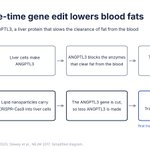
At 15:00 Nigerian time today, CRISPR Therapeutics presents CTX310 at AHA. It's a one-time infusion that edits the ANGPTL3 gene in the liver, so the liver stops making ANGPTL3, a protein that slows the clearance of fat from the blood. Today's data are in people with very high triglycerides.
The target came from genetics. In a US study of 58,335 people, about 1 in 240 carried a broken copy of ANGPTL3, and carriers had 27% lower triglycerides, 9% lower LDL and 41% lower odds of coronary artery disease. CTX310 breaks the gene in liver cells on purpose.
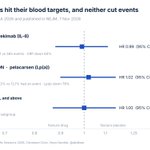
Last year's first trial in people, published in NEJM, gave one infusion to 15 adults. At the highest dose, triglycerides fell by about 55% and LDL by about 49% at 60 days. Two people had serious adverse events, one of them a sudden death about six months later that the investigators judged unrelated to the treatment.
This afternoon I'll be looking at how long the effect lasts, what happens to the liver, and how many people have now been treated. Unlike a tablet, an edit can't be stopped if a problem shows up years later, so it needs far more safety data before it is offered to anyone outside severe disease.
The genetic study behind the target was done in people of European ancestry. I'd like to see that analysis repeated in African genomes.

Last year's phase 1 paper in NEJM, then the genetic study that pointed at ANGPTL3.
nejm.org/doi/full/10.1056/NE…
nejm.org/doi/full/10.1056/NE…

If your smartwatch told you tonight that your heart might be pumping weakly, what would you do first?


A trial presented in Chicago tonight tested whether a whole county can raise cardiac arrest survival. In 62 North Carolina counties it combined phone coaching of bystander CPR, community CPR training and getting defibrillators used before the ambulance arrives.
If a Nigerian city could fund only one, which would save more lives?
A) CPR training in every secondary school
B) Defibrillators in markets and motor parks
RACE-CARS is run from Duke. This is the design paper, published before tonight's results.
pubmed.ncbi.nlm.nih.gov/3908…

Yesterday I asked whether you'd stop an 82-year-old's statin. STREAM, published in NEJM last night, tested exactly that.
1,880 people aged 70 and over with at least two long-term conditions, all taking statins for primary prevention, were randomised to stop or continue. Stopping met its noninferiority margin, but heart attack, stroke and death were all more common in the group that stopped. The authors put it at about 1 extra event for every 40 people over 2 years, and the trial's safety board has since advised the stop group to discuss restarting.
The usual reason to deprescribe is to spare people side effects, and quality of life, muscle pain and falls were no different between the groups. I would still stop a statin for real muscle symptoms or a short life expectancy. For an older patient who is taking it without trouble, I would now keep it going.


Presented at #ScientificSessions26:
In older adults with at least two chronic conditions and no known atherosclerotic cardiovascular disease, statin discontinuation was noninferior to continuation for a composite of myocardial infarction, stroke, or death at 2 years. Full STREAM trial results: nej.md/47U1X9N
@AHAScience

ALT A graph from the Original Article "Discontinuing Statins in Older Adults without Cardiovascular Disease." The trial name, STREAM, is in parentheses after the title. The graph shows estimated cumulative incidence of primary-outcome events. The trial results are being presented at the American Heart Association Scientific Sessions 2026. The logo of the New England Journal of Medicine is at the bottom.
Ref: Rodondi et al., NEJM, 7 Nov 2026.
nejm.org/doi/full/10.1056/NE…
A correction to my first reply yesterday. I wrote that the only earlier trial of stopping statins enrolled people with less than a year to live. SAGA/SITE (Lancet Healthy Longevity 2026) also tested stopping in 1,160 adults aged 75 and over, and found it non-inferior for death at 3 years.

Since Thursday, Claude can read some Americans' bank balances and up to two years of transactions, through Plaid. It can't move money or see passwords. ChatGPT added a similar feature in May.
What would you check first, forgotten subscriptions or where last month's money went?
US only for now, in beta on the paid plans. TechCrunch has the details.
techcrunch.com/2026/11/05/cl…

OptimPacing is presented at AHA tonight, at about 22:30 Nigerian time.
It compares two ways of placing a pacemaker lead in people with heart block, and the answer could change what a standard pacemaker implant looks like 🧵

OptimPacing, led from Nanjing, is an international randomised trial of this question, powered for clinical outcomes.
I'll be watching how often the left bundle lead couldn't be placed, the complication rate, and whether the benefit holds. I'll post the result tonight.
The trial's registry entry, then the earlier LEAP-Block trial in JAMA.
clinicaltrials.gov/study/NCT…
jamanetwork.com/journals/jam…
Tomorrow's AI session at AHA has four studies, and the one I'm watching most closely is PROVAR+. It tests AI reading ECGs sent in remotely, to pick out structural heart disease in underserved populations.
It's the one closest to how things are in Nigeria. An ECG machine is cheap and almost every hospital has one, while echocardiography may not be readily available in rural areas. If AI can read a small-town clinic's ECGs and say which patients to send for an echo, the scans go to the people most likely to need them.
The other three:
- WATCH-LV, smartwatch ECGs checked for a weak left ventricle, including repeat readings at home
- AI ECHO INSIGHT, AI-assisted reading of echocardiograms
- LIFE-AI, AI analysis of plaque on CT coronary scans
The session starts at 16:45 Nigerian time on Monday.
