

Founder of @pulsarplatform, host of @audiencedisco
London, England
Joined May 2009
- Tweets16.8K
- Following4.9K
- Followers2.9K
- Likes20.9K



Francesco D’Orazio retweeted

Just watched the @netflix Instadocs about the @OpenAI cyberattack on @huggingface. Super disappointing, as they went for maximum anthropomorphism of the technology and full doomer mode.
I spent more than two hours with them trying to correct all their mistakes and ground this in reality, explaining that agents are technological systems, not aliens. But it looks like the drive to scare people for maximum views was too strong.
Also, they didn’t mention the lack of containment and monitoring of the agents, how closed-model safeguards blocked our defensive work, or how we defended ourselves with AI using an open model. And that we still lack a lot of information and transparency, including full agent traces and that companies need to remain accountable for what their agents do.
It ends up being a fun sci-fi movie though!

Francesco D’Orazio retweeted

Spent years watching models ace a single image and completely whiff on anything that moves or changes angle. Today we’re fixing that.
Try Glimpse now, our first visual thinking model with competitive frontier performance compared to Astra on key public visual reasoning benchmarks.

As the @arcticcircleorg Assembly kicks off in Reykjavik, we're looking at how the world thinks about the Arctic in our latest narrative Intelligence study, The Arctic Reframed.
The study covers three years of Pulsar Narratives AI data, billions of news articles and social posts, 13,731 narratives detected between 2023 and 2026 📈 📉
The biggest point for me is that the Arctic is not driving his own narrative, the story is written elsewhere.
Here's the headlines:
- Sovereignty, security and the economy now account for 6 in 10 Arctic narratives in both news (61%) and social media (59%). Three years ago it was 42% in news and 26% on social.
- Climate science and wildlife narratives fell from 44% to 17% of Arctic news coverage. The economy (shipping, energy, minerals) is now the biggest single theme, at 28%.
- Discourse is now driven by waves of geopolitical attention: in its busiest week, public attention to the Arctic in 2026 runs at 3.5 times a typical week, up from 1.9×. Every spike that could be traced to an event was geopolitical or a cold snap; none was a climate milestone.
- Indigenous and community voices make up only 0–5% of the Arctic narratives every year, in both news and social.
Full study in the comments ❄️🧊🏔️🐻❄️
#ArcticCircleAssembly #Arctic #CentralArcticOcean #ArcticGovernance #ClimateAction


Francesco D’Orazio retweeted

EA AI safetyism increasingly looks like Marxism-Leninism for the algorithmic age.
The old vanguard claimed privileged knowledge of the inevitable course of History. The new one claims privileged knowledge of the probabilistic course of Humanity.
Both use an elaborate intellectual framework to reach the same political conclusion: a small group of enlightened people must constrain everyone else for their own good.
That has never lead to anything except monumental human suffering.



For the past two months we've been running a weekly audience-intelligence read on one of the cleanest natural experiments in public-opinion modeling: Iceland's EU-accession referendum on 29 August. 🇮🇸 📷
Iceland is about as close to a perfect testbed for social intelligence as you'll find:
1) Small, bounded population. You can reach the whole engaged electorate, not a sample.
2) Near-total digital penetration. The usual "social isn't the public" gap is smaller here than almost anywhere.
3) Language as a firewall. Icelandic is spoken almost nowhere else, so "in Icelandic" is very nearly "from Icelanders." (the national signal is remarkably clean, a reminder that data hygiene is the whole game.)
4) Legible influence. In a nation of 380,000, the persuaders are named people, not anonymous swarms. You can watch a single business founder move the entire system in a week.
5) And the part that matters most for modeling is that the experiment ends in a dated, binary, verifiable result. A rare chance to calibrate discourse against reality. So we're publishing the read.
Every week, @PulsarPlatform's Saga — our autonomous research agent — produces a "Dispatch" on how the two camps' narratives form, which are gaining momentum, and where audience sentiment diverges from the press.
Three things the data surfaced this week that a poll wouldn't:
1) The referendum has migrated off the news pages and onto the feed: news is now under 9% of the conversation.
2) Volume and engagement tell different stories. The No frame is being heard roughly 10x louder per author than the other.
3) This week we've started seeing influential voices driving discourse.
@kerecis founder Guðmundur Fertram, endorsed the No side. Clearly discourse is not a vote. Loud is not the same as winning. But as a live lab for what social intelligence can — and can't — tell us about how public opinion forms, it's hard to beat.
Base case, moderate confidence: a No result on 29 August, 55–63%, on a rural + business-elite + identity coalition. The one variable that would compress it: a Fertram-tier Yes-side entrant before the 14 Aug debate. None has appeared.
Read the latest Despatch, link in comments #SocialIntelligence #AudienceIntelligence #PublicOpinion #SocialListening #Iceland #EU

Kimi K3 by @Kimi_Moonshot smashed through the experience benchmarks climbing to #3 at launch: it's the biggest new arrival since @OpenAI's ChatGPT 5.6, praised for frontend taste, agentic autonomy and debugging without refusals. “Fable refuses, Kimi solves” is the meme of the week, a positioning gift no benchmark buys.
Qwen 3.8 by @Alibaba_Qwen arrives three days after Kimi as a preview, framed almost entirely on economics: cheaper, faster, comparable-enough. It doesn’t own a capability dimension outright, its moat is tokens per dollar, and it holds only while the price holds.
Saga dives into the experience benchmarks in the latest Day One report dayoneai.tiiny.site/


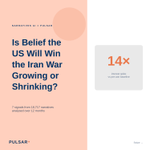
A referendum on the resumption of European Union membership negotiations is due to be held in Iceland on 29 August 2026.
With about 5 weeks to go, the No side is winning on autopilot: it still owns social discourse 2.8-to-1 and frames 8 of the 10 most-visible posts. And yes its momentum is cooling, but the Yes camp added no new credible public voice to its side, and the persuadable middle is publicly asking where the Yes content is.
Saga deep dives into the Yes camp no-show in our latest Dispatch 03👇 lnkd.in/ei6WuW4S

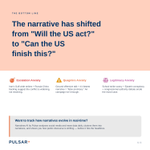
Are people starting to go back to @OpenAI form @AnthropicAI ?
Definitely not an exodus yet, but we're starting to see the beginning of an emerging defection narrative forming.
lnkd.in/e777UP2u

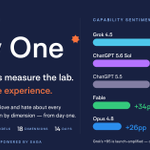
Benchmarks show lab wins but real adoption is scattered across thousands of user posts. Day One, powered by Saga, tracks what early users love and hate about every model across 18 dimensions, from launch day onward.
The focus of this first release: @OpenAI ChatGPT 5.6, @SpaceX @xai Grok 4.5, @AnthropicAI's Fable and Opus 4.8.

