

I'm librarian (Head, Data services) + blogger from Singapore Management University. Library science, Bibliometrics, academic discovery tech.
Singapore
Joined June 2008
- Tweets42.3K
- Following1.4K
- Followers7.4K
- Likes16K




Aaron Tay retweeted

Smaller subset of 200 queries (prior post was >1k) but jina-reranker-v3.5 doesn't do well here and more notably, voyage rerank-3 is a good baseline bc it's ~Luna quality (Luna (low) with blitzrank is wayyyy higher latency to be clear, this is a method for prepping a dataset not a reranker you'd use on prod). If anything Luna should have an advantage here bc it's likely distilled from/trained on much of the same data as Sol's preferences which is my ground truth here so in that sense your assumption should be that this eval makes Luna look better that it should.
So here again, Jev is outperforming Luna at lower cost and much much lower latency.


Aaron Tay retweeted

Everyone is benchmarking Jev against GPT-5.6.
That's the easy comparison. Jev isn't an LLM, of course it's faster.
So I benchmarked it against the boring open-weight encoders found on @huggingface that have done zero-shot classification for years.
Jev wins on accuracy. It loses at the one thing it's named for. 🧵
Singapore is well known for having very liberal laws for text mining/ai training. But if these recommendations go through its going to get even more so /1 sal.org.sg/wp-content/upload…
My limited chatgpt aided understanding is , the proposal will allow users to upload content into third party subscribed services like chatgpt and do analysis (including RAG) over it! I think the current law doesn't allow this unless its servers you control.

Looks like we may be having another retrieval breakthrough. Wonder how well it will do at title abstract screening for evidence synthesis

[Blogged] Prompt Engineering Is the Wrong Mental Model for AI Agents aarontay.substack.com/p/prom…

Aaron Tay retweeted
Quick rant bc this triggered me: this is unfortunately wildly misleading and incorrect.
In this eval, the candidates retrieved by each model are never evaluated to determine which returned the most relevant results...
Synthetic queries were generated with GPT 3.5 turbo, GPT-4-0613 (from 2023) was used to ensure that the chunks GPT 3.5 turbo used to generate those queries were actually factually accurate. And then it's assumed that there are no other chunks in the corpus that are better answers to the generated query. You can't even use this approach to produce good training data for an embedding model bc way too much of the time there's a better positive chunk in the corpus. You have to use better llms, a better synthetic query generation pipeline, and apply sensible filtering on those just to get usable training data, much less an eval...
These synthetic queries are also unusual in that there's clearly v high lexical overlap between the synthetic queries and the document chunks they were generated from (you can see this in how well bm25 does on the problematic eval).
And then none of the strongest "single vector" embedding models are included in the benchmark. Voyage-4-nano is good for its size but not being evaluated properly here.
When you fix this, every conclusion flips. The models at the bottom of this plot all start out performing the late interaction models and bm25.
I've never been able to actually recommend a late interaction model to anyone bc, without exception, they have underperformed the state of the art in dense embedding models every time I've benchmarked them.
I'm not talking about a plausible future state in retrieval. I'm not talking about what might someday happen if people train better late interaction models or a paper where they use the same training data, same compute and same param count. I'm talking about you building an app that needs good search where you're asking me to help you pick either a base to fine tune or the best off the shelf model for your task. There's almost a 0% chance you should consider using a late interaction model today. There are exactly 0 competitive open source late interaction models when you compare to the current state of the art "single vector" embedding models and it's not remotely close folks. Pls don't be confused by these terrible benchmarks.
It's not that I don't think late interaction models could someday be good if someone training one on a large, strong dataset. It's a cool idea. We need lots of different ideas to blossom but then we need to accurately assess which techniques are currently going to give builders the best results. But today, the available open source late interaction models are not good.


My attempt to summarise the ongoing shake up of the academic search arena with Web of Science Smart search, Scholar Labs and Consensus. In Katina magazine
katinamagazine.org/content/a…

This is nice and I remember Elicit had this early and also scite assistant. Makes it really to verify. But sadly not every academic Rag tool does this

The risk of an AI tool hallucinating a citation is small.
The cost of it happening in your literature review is not.
So researchers check. They should — reading the source is part of the job.
What's broken is everything around it: leaving the answer, tracking down the PDF, scanning for the passage that supposedly backs the claim.
On Tuesday, August 25th, we're launching Citation Grounding, our set of features that show you the evidence in every answer.
👉 Hover a citation in Consensus and you'll see the quote it came from.
💻 Click the quote and we'll open the paper to the exact place it lives, in its original context.
🔎 Open the Evidence tab and you'll see every quote pulled from that paper for your search.
Daniel 'Tuba' D'Souza, our Head of Growth, will cover how it works, why we built it, how our full-text partnerships make grounding possible, and live research workflows you can use the same day.
Save your seat and see it live → consensus.app/home/workshops…

[Read] Reproducibility in the Era of AI Agents sigir.org/wp-content/uploads… . This is by Jimmy Lin, a prominent academic in information retrieval field but you can understand his argument with minimal understanding of how IR eval works. (1)

Is the future of reproducibilty (and replicability and...) creating software artifacts that can be easily reproduced by agents? Also enjoy authors description of how he thinks about designing tools & skills. Still as author notes this proposal isnt new new.e.g. executable paper

Agentic reproducibility is the unlock, I claim. To what? 🙋♂️ Find out by reading my piece "Reproducibility in the Era of AI Agents" 🤖 in the June 2026 issue of SIGIR Forum. sigir.org/forum/issues/june-…
[Blogged] When LLMs Can Argue Both Sides Better Than You Can
Can Teaching Media Literacy Backfire in the Age of LLMs? Revisiting Boyd’s 2017 provocation -aarontay.substack.com/p/when…
🤖 Made with AI

Aaron Tay retweeted

My takeaway: multi-vector retrieval is becoming a serious production option, and in 2026, there's less and less excuse not to give it a go:)
Check the full lecture deck here meet.ameliechatelain.com/lec…
I hope you'll have as much fun reading as I had making it ☺️

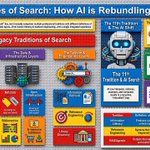
[Blogged] AI Search Is Rebundling Everything Libraries Know About Discovery
Ten established traditions, an emerging eleventh, and why libraries need to have a more holistic view of discovery aarontay.substack.com/p/elev…

In late 90s to early 2000s, advanced chess or Centeur chess was done, human+chess engines duked it out. By mid 2010s this died out cos engines did not benefit from human help. At least for now, we are not at that level. A good researcher makes ai output better often much better

Thought-provoking article that argues how AI in research doesn't remove the scholar's responsibilities (identifying good questions, interpreting results, being accountable for them) but changes the speed of execution.
In the AI era, the human struggle can no longer be the point of research - @timeshighered
timeshighereducation.com/dep…

In fact, when deep blue beat Kasparov most people believed the best humans were still better, the case now is even stronger that many humans are still better at research than ai. But how long this era will continue where ai benefits from humans with strong expertise is unknown..
[Blogged] What Changes When an LLM agent Searches Your Library Catalogue (Primo)? - Agentic search is great at helping novice users find right databases avoiding zero hit queries. Key is Agentic/iterative search not llm to boolean! aarontay.substack.com/p/what…
