
Angel Investor | Alternative Income Freak | Tech Veteran
Joined March 2021
- Tweets3.7K
- Following1K
- Followers116
- Likes5.3K



Deep Learner retweeted

Anthropic engineer, Addy Osmani (ex-Google):
"Google hired me at $600K–$1.2M a year because I know how to make AI agents write code that doesn’t break."
In this 41-minute workshop he shows exactly how to build that system from scratch
Claude Code → Prompts → Agent Skills → AI agents → Harness → Agents That Ship Without You
step 1 → Refine the idea - drop in a vague thought, the agent interviews you and comes back with 3 directions
step 2 → Write the spec - success criteria, stack and open questions locked before a single line of code
step 3 → Plan in small tasks - each one gets acceptance criteria and a list of files it's allowed to touch
step 4 → Build test-first - red to green, slice by slice, so nothing that already works breaks
step 5 → Verify and review - the agent opens the app in a browser, checks security and simplifies its own code
He open-sourced all 24 skills, and the repo is close to 100K stars
Google calls this "agentic engineering"
95% people spend weeks building this by hand
You don't have to
Bookmark it and watch it rn
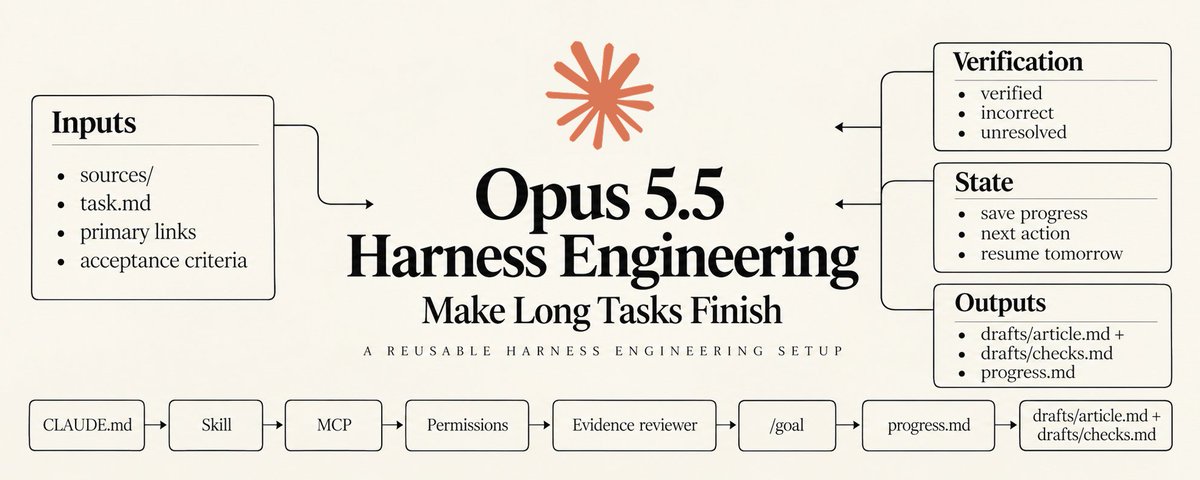
Then read the full Opus 5.5 harness engineering guide below ↓

Deep Learner retweeted

A shallow dive into open-source chip design:
vitalik.eth.limo/general/202…


Deep Learner retweeted

A free online book: The LLM Stack: From Silicon to Agents by Prakash Kagitha (2026).
The book follows an LLM through its entire lifecycle, from arithmetic on accelerators to applications that retrieve information and use tools.
It connects the mathematics of learning to the hardware and software that make training possible, then follows the consequences of those choices into serving and evaluation.
The book combines explanations, from-scratch implementations, and examples drawn from production tooling.
The book has more than 800 exercises that you can work through with an AI tutor.
Read the book online on @chapterpal: chapterpal.com/book/81e2c303…
When reading on ChapterPal, use the built-in AI tutor when you feel stuck. Solve AI-generated quizzes to test and solidify your understanding. Do exercises with the AI tutor, which guides you instead of solving them for you.

Deep Learner retweeted

Wanted to share my thoughts on the inference hardware challenges + opportunities paper from Xiaoyu Ma and David Patterson from Google (also sent in the Modal research slack channel 😅)
"really great read about the hardware-level inefficiencies of inference and research opportunities to make inference way more efficient. david patterson is probably the most famous computer architect alive and has usually been right when predicting important things into the future (RISC ISAs, hardware specialization, end of moores law/dennard scaling, etc)
challenges tldr -
> memory wall - HBM bandwidth is scaling way slower than FLOPs. this means that are chips are becoming more compute bound, which is bad for low batch decode
> expensive memory - DRAM is becoming more expensive and density is decelerating, which is bad for big model inference. SRAM chips are mentioned, but growing model sizes make them infeasible at scale
> e2e latency - realtime serving requires lower latency. in these regimes, we are super memory bound on GPUs and interconnect latency outweighs bandwidth
opportunities tldr -
> high-bandwidth flash - stacking flash dies like traditional HBM stacks gives order-of-magnitude win in capacity. drawback is write endurance (writing too much eventually breaks the flash), but this is fine for inference when we just serve 1 model’s weights and keep activations in DRAM (?)
> processing-in-memory - this has been a hot topic in comparch for the last few years, and tries to do most computation close to memory so we limit data movement (which is the main energy cost in chips). table 4 in the paper is a nice breakdown of tradeoffs.
> 3d memory stacking - self-explanatory name. this has real power implications (chips get hotter = cooling stacked chips is harder), but this gives us better bw and capacity. all AI chips are moving towards this in the coming years
> low latency interconnect - goes hand in hand with disaggregation over more specialized chip. in my time working on Rubin+LPU disagg, i found that interconnect latency was always the bottleneck. if this problem is solved, expect much more heterogenous disaggregation
always cool to see where things are going on the hardware/comparch side!"

Deep Learner retweeted

OpenSource-Ai-Glasses
AI glasses you can customize at the system level
This standalone platform runs embedded Linux and provides a C/C++ SDK for accessing hardware and building your own applications.
It supports 1080P recording, live RTSP video streaming and an optional monocular display. An Android client lets you connect, manage and debug the glasses.
After setup, hold the left temple button to speak, then release it to send your request and wait for the AI response.
github.com/Iam5tillLearning/…


Deep Learner retweeted

[PDF] All-optical programmable liquid crystal photonic circuits🤖📲🛸scholar.google.com/scholar_u…

Deep Learner retweeted

درس تدريبي | Training Masterclass
تمرين التمرير وتحرك اللاعب الثالث | Passing Drill – Third-Man Run ⚽🧢
-تصنع الحلول الهجومية من تناغم التمرير مع الحركة والقدرة على خلق المساحة والتوقيت وفي هذا الترابط تتجلى قيمة اللعب الجماعي وتتولد القدرة على تجاوز الضغط وفتح مسارات جديدة
Deep Learner retweeted
[PDF] Microwave-optical quantum transduction with quantum-well exciton polaritons🛰️🤖📲💻arxiv.org/pdf/2611.21785

Deep Learner retweeted

Making progress on the EM sim visualizer plugin (KiCAD). Need to make some adjustments for render performance (enable GPU, w/ CPU fallback)... but it's moving along nicely. (Work in progress: github.com/zrecore/kicad-em-… )
Deep Learner retweeted

🗣️ Entrenamiento complementario en fútbol ⚽
(Vía @sohaib_bouziane_coach)
Deep Learner retweeted

I am releasing the Logic Analyzer that I designed with Opus 5.5 and I am open sourcing it! Check it out and let me know what you think!
Deep Learner retweeted

AI and Digital Design!
So, I asked the LLM to create a ethernet controller and deploy it on the Arty-A7 board. It wrote the RTL, checked it with a test bench, compiled and deployed it to the FPGA, and ran the ping command to confirm it's on the network and working...
All of this in less than 5 nudges.
In the video, I tried the command in the bottom right window and it indeed is working.
Deep Learner retweeted

Two chip design professors on AI, speed, and how students should still learn.
Full interview: youtu.be/A3AAiumuSs8
Deep Learner retweeted

Universities fail to teach FPGA design to a good level. I am thinking of creating a series of FPGA classes designed to fit into semesters that universities can use so their graduates are actually useful in industry (Sorry profs you are mostly out of date). It will all be free and coming as part of a new initiative I am launching.
I have my own ideas as to what needs to be included but a question to professional FPGA engineers.
What basics do you think students today need to learn ?

Deep Learner retweeted

🚨 BREAKING: Claude has a hidden ADHD Executive Function Mode.
You can use it to hack your brain’s dopamine and finish a week’s worth of work in 4 hours.
Here are 7 prompts to access it:↓


Deep Learner retweeted

Optics as code - a new paradigm in physical AI
Optical neural networks are notoriously hard to calibrate and suffer from the sim2real gap. We show that a coding agent with the hardware in the loop quickly tunes the optics and improves image classification from 35% to 96.8%.
🧵1/6
Deep Learner retweeted
"How do I learn chip design if AI does the designing?"
I asked chip design professors Harald Pretl and Carsten Wulff.
Carsten: "You have to choose to go into slow time and do something hard manually."
Harald: "Use the efficiency, not as a shortcut."
youtu.be/A3AAiumuSs8
