

humanist, scientist, optimist | assistant professor, Cornell EEB
Ithaca, NY
Joined February 2015
- Tweets2.9K
- Following689
- Followers521
- Likes14K





John Benning retweeted

I think of my goal as a mathematician as something like: to better understand the fundamental concepts “shape” and “number,” and to convey that understanding to others. I think this is a valuable goal for many reasons. The primary reason discussed on social media is the (admittedly slow, but I think very real) diffusion of mathematical ideas into technologies that better our lives. There are others, though: production of human capital (which plays some role in this diffusion), and diffusion of mathematical understanding into culture, for example. It is not obvious to me that even the bare technological need for mathematics can be filled without human experts; this seems to me to be a tricky question of institutional design.
For me the most compelling reason is simply that we feel a pressing need to understand. While deep understanding is largely limited to professional mathematicians, the existence of mathematicians and of the institutions they make up is a huge part of what makes mathematical understanding available to those who want it. I believe that the capacity to understand mathematics (and the universe as a whole) is part of a good life, and we should try to provide people with a good life.
We operationalize the goal of understanding in a number of ways, problem-solving and theorem-proving among them. My own research is oriented around certain open questions that I believe measure our lack of understanding (of numbers, shapes and so on), and I think resolving those is genuinely important. I would welcome a solution with any provenance. But I think proof is only a measure of progress—what actually matters (for technology, human capital, culture, a good life) is a bit harder to get at.
Crucially it is very hard to measure progress—plausibly theorem-proving is used in large part because it is easy to measure rather than because it is a perfect proxy for what we care about. I worry a bit that we may automate many easy-to-measure things without automating the correlates we care about for which they are proxies. This presents a clear problem for the design of institutions aimed at achieving progress.
In part because I think problem-solving is a proxy for something else, I don’t feel that my goal of understanding “shape” and “number” is particularly threatened by a machine that is good at problem solving. I expect that machine to be a substantial boon, instead. Ultimately I think we will operationalize mathematical progress in better ways. But how to do this is a difficult question and I think many on here are too quick to dismiss concerns about it.
John Benning retweeted

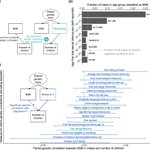
What should an open scientific paper look like in the AI age?
We made a demonstration project out of our paper on the childhood socioeconomic circumstances of the Nobel Laureates.
Please check it out and share. Details in 🧵 1/

the conservationist in me wonders if the AI vs human discourse will stir some reconsideration of the 'intrinsic value of species and biodiversity' among some who dismissed it earlier
John Benning retweeted
Well worth reading (as with all of Frank’s writing): galoisrepresentations.org/20…
John Benning retweeted

I'm requesting all scientists in academia especially to seriously consider, discuss & test alternative approaches instead of shoving our heads deep in the ancient sands desperately clinging on to the old system. 4/
John Benning retweeted

Today, we are announcing our third cohort of residents! Each resident will receive up to $2M to work on a high impact scientific problem, with the governing principle being that they build something people actually use and build it openly.
John Benning retweeted
Without commenting on the correctness of this claim, I want to briefly say a few words about what it would mean in practice.
Chess is supportable as a hobby in part because one can pick up the rules of chess in an afternoon. While one can't quickly play at a high level, it is relatively easy to appreciate the game, and have fun at it.
Research math is not like this. Over the last decades we have made incredible progress understanding basic concepts (number, shape, etc.) but the edifice we have built to do so requires an incredible time investment. Learning the ideas that go into proving, or understanding the proof of, basic statements like Fermat's last theorem requires years of institutional support.
It's possible that soon, AI will be able to do work at this level; despite recent successes, this isn't the case yet. But even if it can do this, why would it? Without people who care about these deep but fundamental ideas, who will ask it to? Perhaps it might on its own, or a person asking it to "do some cool math" might elicit a similarly deep idea, but who would understand it, if doing so requires years of unsupported work?
In practice, turning pure math into a hobby means the end of pure math, and the end of people who understand basic mathematical concepts at a deep level. Whether this is something we want is something we'll have to decide together.

John Benning retweeted

Please repost: My department (quantitative and computational biology at the University of Southern California) is hiring a teaching-track faculty member. The new hire will focus on teaching statistics courses to biology students. Apply by Dec 1 usccareers.usc.edu/job/los-a…

John Benning retweeted

To wish that mathematics becomes like the human genome project is to wish that mathematicians not understand mathematics. Because one thing the human genome is most definitely not is "fully classified".

We are now poised to:
Formalize all known Human Mathematics.
This is the modern equivalent of the Human Genome Project. or AlphaFold more recently, whereby all data of its kind is fully classified.
With sufficient funding and compute/tokens, a coordinated effort among academia, frontier labs, philanthropic organizations, and the federal government can formalize all Human Mathematics in the next year.


John Benning retweeted
So there's a mathematical question I've been thinking about on and off for about 10 years. For the first 5 or so years I made very little progress, but learned a bit about the general area (while working on other things). In the last 5 years I've made some modest progress with collaborators, resulting in some (IMHO) nice results, though the question itself is still totally open.
This has developed into some not-quite-rigorous research program which guides much of my current work (some of which is aimed at trying to make it rigorous). Of course I discuss this work with the models; for the first time, this week, I had a model produce, non-autonomously, a very nice partial result towards a question that came up in the course of this program, connecting it to various areas about which I know relatively little (microlocal sheaf theory, Lagrangian Floer homology). So now I get to learn about some of this stuff!
Even in this (quite small) part of the project, there's lots for me to do--I've already found various improvements to and simplifications of the arguments it produced, and noticed some implications it seems to have that seem to me quite significant. An arguably underrated part of math is "discovering interesting new phenomena," and one function of mathematicians and the mathematical community is to certify this interest. That our open problems have been so significant to frontier labs is evidence we're pretty good at this!
Of course I have thought about how I would react if GPT-8 Ultra Extreme or Claude Cthulhu 7 were to autonomously solve the entire problem. I think I would be excited--there would be a lot to learn, and surely a solution would raise many new questions. Maybe it would be a little bittersweet (I have an ego), but I view this problem as mostly an excuse to think about some fundamental objects, and I am quite convinced I'd continue to think about them.
John Benning retweeted
I wonder how much of the divide among mathematicians on AI comes down to which of us consider ourselves scientists and which of us consider ourselves artists. (I'm very much in the former camp but for what it's worth I am sympathetic to the latter.)
John Benning retweeted
I've been saying for some time that we should use AI systems to produce better work, as opposed to, say, more PDFs. One simple thing we can now do is identify and fix lots of extant errors in the literature. 1/n
John Benning retweeted

Had a very optimistic discussion with a math professor friend about the role of AI in research. His take:
1) Having a fast way to disprove conjectures is already very useful and will save mathematicians lots of time.
2) Humans are very good at moving to higher levels of abstraction and will likely integrate AI proofs as a new abstract level that they operate over.
3) Out of necessity, math has operated on claims that can be explained by/to humans but surely there is an even bigger swath of math that cannot be explained to humans but is useful for other human goals. Having AI that can understand and verify those components and turn them into tools for human use could be revolutionary.
The less optimistic discussion was over whether the games that humans set up for ourselves to stay motivated (challenge problems, medals/awards, etc) will be maxxed out by AI in a way that is ultimately detrimental.
John Benning retweeted

Some initial thoughts, and a complicated mix of feelings.
1. Wow. I mean, Erdos problems are cool (I genuinely mean that), I didn't know about the Jacobian conjecture before it got disproved. But this newest batch from OpenAI hits home in a way the previous announcements did not.
New circuit lower bounds? A simple, easy-to-describe non-sofic group? Hardness of approximation for CVP without needing a unique games-like conjecture? I didn't just hear about these problems from my friends or from seminars. I feel their importance in my bones; I deeply care about the answers to these questions.
John Benning retweeted
Starting to think that the base rate at which well-known old conjectures are true might not be very high!
John Benning retweeted

Openness to immigration has on balance been a huge source of strength to the United States but it can be a problem when you get immigrants like Elon Musk who fundamentally reject American values and ideals.

John Benning retweeted

Please don’t vibe code science without checks, part 351.
Treat agentic coding as a hyper-productive computational grad student who is drunk 1/4 of the time they aren’t given explicit directions.

John Benning retweeted

If I were a conservative woman I think it would really give me pause that so many conservative men so openly despise women and believe they are not morally or intellectually the equals of men and should not be considered on their merits for positions of power.

John Benning retweeted

I wanted to like QED's new 1% preprint ranking. But the more I looked at the data, the more uncomfortable it made me. Here is my full peer review:
open.substack.com/pub/blekhm…
