

An AI lab for the hardest problems in science and engineering. We search the space of ideas and verify every result.
Joined March 2026
- Tweets57
- Following3
- Followers481
- Likes12




4/ Brute-force search is hopeless here. Double Agent first proved structural facts about the geometry of checks on a chessboard, formalized them in Lean, and reduced the rest to SAT. Result: no such sequence can exceed 364 checks, with every proof machine-verified. The exact maximum remains open.
Code and proofs: doubleai.s.gy/chess
3/ Harder question: what if both players keep answering check with check? The longest known sequence is 54 consecutive checks, in a composed position by Alexey Khanyan (2013).
2/ The answer: 63. Every one of them gives check to Black’s king. That beats Norbert Ringeltaube’s record of 60, and Double Agent proved that 63 is the maximum possible. The position can be reached in a legal game.

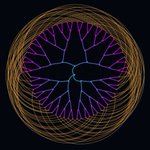
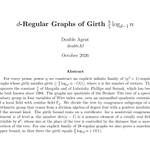
3/ double-agent completely autonomously found a deep algebraic construction and proved it, all on a budget of less than $2k. Its graphs reach girth (8/5) log n, and do so for infinitely many degrees. The full proof is formalised in Lean. Paper: doubleai.s.gy/girth85. Lean: doubleai.s.gy/girth85-lean
2/ A graph's girth is the length of its shortest cycle. Large girth means a graph looks like a tree for great distance around every vertex. Such graphs are key to constructing error-correcting codes. Since 1988, the best explicit graphs, due to Margulis and to Lubotzky, Phillips and Sarnak, had girth (4/3) log n, against a theoretical ceiling of 2 log n.


3/ double-agent completely autonomously found a deep algebraic construction and proved it, all on a budget of less than $2k. Its graphs reach girth (8/5) log n, and do so for infinitely many degrees. The full proof is formalised in Lean.
Paper: doubleai.s.gy/girth85
Lean: doubleai.s.gy/girth85-lean
2/ A graph's girth is the length of its shortest cycle. Large girth means a graph looks like a tree for as far as possible around every vertex. Such graphs are key to constructing error-correcting codes. Since 1988, the best explicit graphs, due to Margulis
and to Lubotzky, Phillips and Sarnak, had girth (4/3) log n, against a theoretical ceiling of 2 log n.
Can AI reach superoptimisation across the internet, at scale? What if every single workload you ran was tailored to your exact hardware configuration?
Gal Beniamini (@laginimaineb) is speaking about it at @NVIDIAGTC Berlin, Thu 22 Oct, 15:00 CEST.