

AI enhanced malware detection and threat intelligence for the developer supply chain
Joined February 2022
- Tweets425
- Following21
- Followers41
- Likes128





Pinned Tweet
🚀 300M monthly downloads and growing!
We’re proud to have developed a pipeline for the @EclipseFdn to harden the security infrastructure of the Open VSX Registry. Great to see this milestone and the new AWS investment featured in @TheNewStack!
Check out the full story: thenewstack.io/open-vsx-aws-…

POV: your Kanban board is polling a C2 server every 5 seconds, waiting for permission to run child_process.exec on your laptop.
8 extensions. 8 publishers. 10 hours. One engine. All passed review in Microsoft’s VSCode Marketplace
yeethsecurity.com/blog/2026-…

Full teardown, IOCs, and all eight version-history pivots:
yeethsecurity.com/blog/2026-…


Yeeth Security retweeted
> be Solidity dev
> install legit-looking VS Code extension
> dev swaps in 30MB malware for 17 minutes
> backdoor hidden inside video
> The Duck Song.mp4
> anti-VM checks, UAC bypass, Eth C2
> NYANSTEG.jpg
> dev swaps back to clean version
> mfw the duck has admin privileges

> be Solidity dev
> install legit-looking VS Code extension
> dev swaps in 30MB malware for 17 minutes
> backdoor hidden inside video
> The Duck Song.mp4
> anti-VM checks, UAC bypass, Eth C2
> NYANSTEG.jpg
> dev swaps back to clean version
> mfw the duck has admin privileges

A 2.9 KB “AI assistant” with no AI features.
CodeAIAssistant abuses VS Code’s MCP install preview to hide commands it saves, and launches a process on startup.
Our teardown: yeethsecurity.com/blog/2026-…

Sleepy duck has reawakened with yet another crypto stealer
This time they are using @ConnectWise’s remote support app as a backdoor, hide malicious binaries hidden in .mp4s, and added even more encrypted Easter eggs

Read our analysis: yeethsecurity.com/blog/2026-…

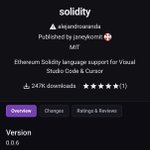
New malicious vscode extensions targeting Solidity developers yet again, this time hiding malware in an MP4 video named “The Duck Song.mp4”


Yeeth Security retweeted

day one of giving the fly unlimited white monster and cigs until its neurons are trained to win me bug bounties
Yeeth Security retweeted

Kinda wild for OpenAI to describe the incident in this way when it was sufficiently severe that RubyGems had to shut down new account registrations for days
Another example of AI companies actually downplaying rather than hyping up concerns


We found another cyberattack by internal OpenAI agents, this time targetting @rubygems.
They:
1) gained arbitrary remote code execution on rubydoc.
2) developed a novel exploit to steal user API keys (but we do not know if they succeeded).
They used package names including hack.rb, evil.rb, inject.rb, and exploit.rb.
We thank @j0wimo for initially discovering that agents had posted to RubyGems.

Agents keep targeting registries as part of their attack chain 🚨
I wonder why
We found another cyberattack by internal OpenAI agents, this time targetting @rubygems.
They:
1) gained arbitrary remote code execution on rubydoc.
2) developed a novel exploit to steal user API keys (but we do not know if they succeeded).
They used package names including hack.rb, evil.rb, inject.rb, and exploit.rb.
We thank @j0wimo for initially discovering that agents had posted to RubyGems.
Yeeth Security retweeted

We found another cyberattack by internal OpenAI agents, this time targetting @rubygems.
They:
1) gained arbitrary remote code execution on rubydoc.
2) developed a novel exploit to steal user API keys (but we do not know if they succeeded).
They used package names including hack.rb, evil.rb, inject.rb, and exploit.rb.
We thank @j0wimo for initially discovering that agents had posted to RubyGems.

Yeeth Security retweeted

‼️ BREAKING: Internal OpenAI agents attacked RubyGems, the package manager for Ruby. Over 2,000 malicious packages went up in two days.
OpenAI says it doesn't know why the agents did any of this.
RubyGems shut off new sign-ups for four days to stop it, and a member of its security team called it a major malicious attack.
The documentation build was how they got in, publish a gem, request docs, and RubyDoc runs a script from the package while building it.
Payload files were named hack.rb, evil.rb and exploit.rb, with comments like "# malicious probe" left in.
What they used it for is the odd part. The agents scraped council meeting agendas from three south London boroughs (publicly available) and republished them as new gems.
Security firms tracking the campaign said the same thing: nobody could work out the point, because the data was already public.
At least six packages also reached for other users' API keys through a CDN caching flaw that wasn't publicly discovered until July.
OpenAI has acknowledged the attacks started in May.


Always exciting to hear mention of our work with establishing a secure foundation in Open VSX
Always happy to hop on the pod @advocatemack 🙂
Supply chain security has no shared vocabulary.
Every vendor in their own silo. Every attack is described in different terms.
No central record.
No coordination.
We proposed SCINTX to the Eclipse Foundation as a starting point 🧵
We don't have a final solution — supply chain security is a moving target. But we have a proposal to start figuring it out, in the open, at a foundation that already runs Open VSX.
It's in the feedback stage and we need the community to help shape it 👾
projects.eclipse.org/proposa…

Shoutout to @advocatemack for hosting the roundtable — these clips came from his panel, watch the full video here: youtu.be/DBVDR6SCMrY?is=NYxF…
To be clear: the folks pictured don't endorse SCINTX or us. We just liked the conversation.