

Co-Founder @ Flashpass: The Antidote to AI Doomerism. Co-Founder @ Bowers Hinman Capitol Affairs. Former Director of OH House Speaker’s Office
Columbus, OH
Joined December 2025
- Tweets289
- Following395
- Followers269
- Likes188



Pinned Tweet
Democrats claimed rural Ohio Republicans were too racist to back Vivek for governor.
But Ramaswamy won 82.5% of the primary vote and every county.
Their delusion will end up biting them. Ohioans care about issues over identity politics.
Here's my op-ed in today's Dispatch:

Opinion: Republicans aren't racist. Ramaswamy’s big win proof Democrats are delusional | Opinion dispatch.com/story/opinion/c…

I can't write a line of code, and this year I've been more involved in product than at any point in my career.
Turns out translating between a customer describing a problem in their own words and a person who can build the answer is a technical skill too.
Just not the one I expected to learn as a founder.
I've done about two dozen TV appearances. Election nights, the RNC floor, regular commentary in Columbus.
Never had a minute of media training. I'm not even that good at it.
People underestimate their abilities constantly, then wait for permission that isn't coming.
Will Hinman retweeted
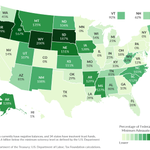
Trump’s decline in popularity is more concentrated in suburbia and much less pronounced in the Ohio Valley, where he’s still relatively popular… so not sure this tracks.
Hot take: government procurement rewards first movers more than the private sector does.
Bureaucrats are risk averse by design. Getting a state past its first hesitancy toward something new is the hard part. Once you clear that hurdle, you become the vendor they trust to operationalize, and competitors have to clear that same wall from the outside.
The product gets you in the door. The trust keeps everyone else out.
The unemployment rate only counts people actively looking for work.
It misses the sidelined workforce. People who stopped searching because the industries that are hiring look nothing like the ones they left, and that's intimidating.
Getting them back into the workforce matters more for the country than any single jobs report. Share this with someone thinking about getting back to work.
I've done about two dozen TV appearances.
Election night recaps, a piece from the floor of the RNC, regular political commentary in Columbus, etc.
I've never had a minute of formal media training.
I'm also not that good at it. There are people with sharper wit who are much smoother on camera. Nobody has ever told me I did a terrible job, but nobody would say that to my face either 😂.
What those appearances taught me is that the bar to get on TV is far lower than people assume. Stations need guests. Producers are actively looking for people to put on air. If you reach out, build the relationship, and show up prepared, they'll give you time. You don't need to be a polished TV persona.
And the payoff is disproportionate. A few segments buy you a kind of localized, industry-specific legitimacy. People see you on a Sunday show and decide you must be the authority. The actual qualification was a willingness to put on a suit at 7 pm and drive to a studio after a full day of work.
People underestimate their own abilities constantly, then wait for permission that isn't coming. I might not be great at this. I keep doing it anyway, and it has opened more doors than almost anything else in my career.

Perceived momentum is worth a fortune in a campaign.
Donors back candidates who look like winners. Consultants steer money toward races that look close.
So anything that works as a public scoreboard becomes a target.
-Polls
-Headlines
-Thinly traded prediction markets
The cheapest way to move money in politics is to move the perception of who's winning first.
Will Hinman retweeted
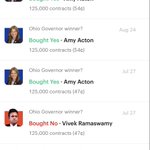
The total market volume in state races is typically around $1M. Lots of motivation to manipulate markets and shift perceived momentum. In OH, these concentrated, one sided buys made up 20% of the market and the media acted like it was a real barometer of momentum

YC concentrating its portfolio in one corner of the country is arrogant (and bad business.)
Markets are dictated by consumer preferences, and a huge share of American consumers live in Middle America.
A portfolio that only reflects one region's preferences misses the upside everywhere else.

An unemployment check bridges you back to a job that may no longer exist.
A workforce aligned credential bridges you to one that does.
Only one of those is a durable use of public money.
Will Hinman retweeted
Before I started my first business, I spent six months mapping out every detail. It gave me some confidence, but in retrospect, I was better off just building the plane while flying. You end up iterating significantly anyways. Only way is to jump, then swim.
Unemployment insurance was built for an economy where the factory slows down, checks bridge the workers, and the factory ramps back up.
The whole system assumes the job comes back.
AI breaks that assumption, and we're still funding the system like it doesn't.
We've never charged a learner a dollar of tuition.
States fund the training, credentials, and job placement directly.
The money for workforce transition already exists. The question is which system we route it through.

The AI deniers say no jobs will change, so do nothing.
The doomers say all jobs will vanish, so nothing matters.
Preparing people is the only position that requires actual work. Might explain why it's the least crowded.
Replacement thinking says the worker is obsolete, so you cut.
Displacement thinking says the tasks moved, and the person can move too.
Two companies can look at identical technology and reach opposite conclusions about people.
A layoff saves money this quarter.
It also walks a decade of operating knowledge and customer relationships out the door, then pays a premium to recruit it back once leadership figures out what still needs a human.

Silicon Valley would never have become Silicon Valley if the California of the 1970s had the regulatory environment California has today.
There are two kinds of AI regulation:
1/ Transparency rules
These tell users what a product does and what the terms are, then let them choose. They inform the consumer and get out of the way.
2/ Audit regimes
They are a different animal. They layer cost and uncertainty onto anyone trying to build, before a single user has been harmed.
California just became the first state to mandate AI audits. The feds have already threatened to withhold funding from states that go this route. So a founder picking where to build now prices in the audit regime plus the chance the state loses federal dollars on top of it.
Companies have been leaving California for years.
This is one more reason to pack.
