





Wasef Mattar retweeted

Finally, a forward looking indicator for the markets.
Taiwan and South Korea Chip Exports Lead US Earnings by 6 Months; No Downturn Signal Yet
The average of Taiwan and South Korea export growth, pushed forward six months, closely tracks MSCI US forward 12-month EPS growth.
Both countries are "significant producers of the chips that are the foundation of the AI investment boom" and are released monthly, with South Korea publishing a 10-day estimate around the 21st of each month.
Chip exports are "likely to detect the pullback with about a 3-6 month advance."
Crucially, as of the October 15, 2026 publication, "South Korea and Taiwan's exports currently give little sign that the investment cycle is imminently about to turn down."
When they do turn, that's also a cue for yields to decline since chip exports lead nominal GDP as well.

Wasef Mattar retweeted

This time isn't different.
The S&P 500's Shiller P/E just hit 40x. In 125 years it has been that stretched only once: the 2000 dot-com top near 44x. Expensive markets can get more expensive, but starting valuations this high have never produced strong 10-year returns. The AI trade does not repeal math. $SPX

Wasef Mattar retweeted

MS' Mike Wilson says a buying opportunity is coming but only after the S&P 500 "catches down" to the broader market weakness that has been happening for months under the surface.
“We advise investors to be ready for either a very rapid reconciliation or a slower bleed into November because in our view, that will be the time to add risk rather than shun it,” Wilson said in a client note.
Wilson continues to expect quality stocks (stronger profitability, balance sheets, earnings predictability) to lead as the market continues to move from an early-cycle recovery led by lower-quality stocks into “a more selective mid-cycle environment where earnings durability matters more.” The emergence of quality stocks as the market focus has been in motion since mid-August he says.
The gap in earnings revision breadth between high- and low-quality has expanded to 10% Wilson noted, the second-widest since 2010. Historically, when this gap has been in the top quintile, it’s led to an average 7.5% outperformance over the following year for higher-quality stocks over their lower-quality brethren.
Wilson also continues to think that that tightening financial conditions will obviate the need for the Federal Reserve to hike the federal-funds rate. Wilson says the tightening from rates, the dollar, and energy prices is the most since 2022. If, however, Warsh maintains his hawkish focus on inflation, rate-sensitive stocks may continue to underperform, Wilson said.


The S&P 500 is masking a hidden market pullback. Why Morgan Stanley says an index retreat would signal a buying opportunity. trib.al/uN8OrVz

Wasef Mattar retweeted

FEDWATCH, on helium scarcity:
“.. The result is fewer GPUs, longer delivery times, delayed data‑center buildouts, and higher compute costs—and with markets already bracing for an AI capex slowdown .., they’re now also pricing in a helium shortage that’s turning structural.”

Wasef Mattar retweeted

Midterms will mark the end of Trump era (beginning of it). Crisis of the West looming as it will be near impossible to restore global US leadership. Tail risks rising due to social fractures in the US, failure of EU migration project, and an effective defeat in Ukraine/Iran.
Wasef Mattar retweeted
GS DESK:
“.. Friday was the first real sign of panic in index protection, following weeks of significant damage in individual stocks .. total put volume was the fourth-highest back to 2015 .. a clear indication of just how much concern has built around broader index downside.”

Wasef Mattar retweeted
A big source of comfort for equity traders has been the solid credit market. But that's been eroding in the past few weeks as corporate bond yields creep higher, particularly among weak companies. Yields on the lowest-rated bonds are now the highest since 2022.

Wasef Mattar retweeted

Hedge fund manager Dan Niles says AI stocks "probably go down 30 to 50 percent" early next year - with OpenAI and Anthropic "half" of the hyperscaler backlog
"I hear things like, semiconductors might not be cyclical anymore
And so I start to laugh"
He still likes the technology - and told Master Investor what could break the AI trade:
> Most Overbought Since 2000 (12:38):
- Asked if semis are "the most overbought they've been since 2000 or 1995, before they had horrific corrections," he says: "Absolutely." A 15-20% drop along with the semiconductor index "wouldn't surprise me at all."
> The 30-50% Drop (25:09):
- Agentic AI's growth ramp should "decelerate massively" early next year - then "they probably go down 30 to 50 percent." The Magnificent 7 fell 46% on average in 2022, right after the COVID buildout.
> Half The Backlog (27:20):
- OpenAI and Anthropic are "half of the backlog at the hyperscalers." He thinks OpenAI "doesn't have the cash flow to fund their ambitions" - and if one of the two struggles, "you're going to have a huge problem."
> The IPO Squeeze (31:48):
- OpenAI, SpaceX and Anthropic are heading to market at "trillion dollar, probably plus valuations." "That money's got to come out of some other names."
The AI money debate, fresh every single day


Wasef Mattar retweeted
Hartnett (Flow Show) says while he's short term bearish on Tech, “we think macro and markets into ‘27 driven by AI; watch semiconductor prices... fresh price gains = bullish... AI spending arms race between US & China continues, as does US government guarantee bond/equity prices won’t be allowed to impede US (even with DEM [Democratic] sweep midterms)...investors...return to tech mid-Nov and enter ‘27 reversing ‘short tech bond’ positions;"
but "a rollover in semi prices signals further tightening of AI credit, top in AI capex growth, and lower-than-expected nominal GDP growth in ‘27; asset returns next year then driven by income rather than by capital appreciation.”


So what does Hartnett like?
“peak yield” beneficiaries, “small cap, REITs, and particularly consumer discretionary.” Investors are the most underweight discretionary since Jul ‘08, per BofA’s October Fund Manager Survey.
The logic: “bond yields declining in Oct = equity breadth to improve in Q4,” and there’s plenty to lift. 355 S&P 500 stocks are 10% or more below their 52-week highs, 188 are 20% or more below, and 93 are 30% or more below.
But "don’t add tech.” Investors are the most overweight since Aug ‘20, and an “AI bubble in ‘27 [is] now consensus.” He does see investors returning to tech by mid-November.
Longer term, BofA says stay long gold, commodities and emerging markets.


Wasef Mattar retweeted

2027 is about to get crazy: according to Morgan Stanley, hyperscaler and neocloud free cash flow to hit its most negative point in 2027, with the shortfall even bigger once lease payments are include: just shy of $600BN in cash burn.
In other words, the year with the biggest capex bill is also the year with the biggest funding gap.


Nvidia Gets $690BN, The Other 499 Get $340BN: Tracing Every Dollar Of 2027's AI Capex zerohedge.com/markets/nvidia…

Wasef Mattar retweeted
BTIG, on semis:
“.. where there's smoke there's often fire. Short-term moves aside, .. this is a bigger topping structure, and should we get a counter-trend rally, that’s likely an opportunity to reduce exposure ahead of what could be a longer drawn out decline into ’27.” $SOXX


Wasef Mattar retweeted

Ed Yardeni:
"Our happier spin is that the Bond Vigilantes are now doing a good job of regulating and allocating capital to the AI ecosystem. Credit-quality spreads are widening to reflect the riskiness of the bonds issued by some of the dodgier AI-related borrowers like CoreWeave and Oracle. The rapidly rising cost of credit for such borrowers should deflate the AI bubble without bursting it. If some AI-related credits do blow up, the Godfathers of the AI mafia (along with their protectors in the government) will clean up the mess. As in "The Godfather II," Michael Corleone has too much at stake to let his brother Fredo screw up the family business.
Meanwhile, the rout in the AI corporate bond market has triggered a flight to quality and safety that has stopped the rout in the US Treasury bond market. This confirms our thesis that the recent rise in US bond yields mostly reflects better-than-expected economic growth. Tougher credit conditions in the AI corporate bond market should curb some of the AI excesses. However, we doubt this will trigger an economy-wide credit crunch or a recession. We aren't convinced that it will slow capital spending much, since labor and materials shortages, along with public NIMBY pushback, have already slowed the pace of data center construction."


Wasef Mattar retweeted
Citadel's Rubner: We remain constructive on US equities into Q4, but the next several weeks will be a much more meaningful test of the fundamental backdrop.
In our last note, October: The Q4 Reload, we focused on the reset in valuations and positioning, and the potential return of several of the market’s largest buyers. Since then,
Earnings: Expectations remain exceptionally strong, with forward earnings estimates rising even as valuations have compressed. Nearly half of the S&P 500 will report in five sessions, while corporate buyback windows begin reopening against a record year of authorizations.
Rotation: Equal weight has begun to recover from historically depressed relative levels, with improving participation across defensives, cyclicals and rate-sensitive sectors. The recovery in market breadth is an encouraging development after months of narrow leadership.
Retail: Buying has accelerated sharply, driven by stronger directional conviction rather than higher volumes. Demand remains concentrated in index ETFs, Semiconductors and AI infrastructure, alongside record-paced buying of fixed-income ETFs.
Volatility: Single-stock volatility continues to outperform the index as correlations remain near historical lows. Earnings could reinforce that divergence, while low index implied volatility offers relatively attractive protection against a shift toward correlated selling.
After months dominated by macro headlines, positioning adjustments, and shifting AI narratives, earnings are returning to the center of the conversation. And with valuations reset, investor demand beginning to recover, and market leadership showing early signs of change, the setup heading into this reporting season looks considerably different than it did just a few months ago. Our constructive Q4 view remains intact, with several of the dynamics highlighted in our last note beginning to materialize.
We continue to favor selective single-stock exposure over simply adding index beta. The recent improvement in participation is promising, but the next several weeks will provide a much more meaningful test of whether it can persist.

Wasef Mattar retweeted
“.. The problem is not that credit profiles have changed in the last year, it’s that we’ve got another year and a half of supply coming,” said John Yovanovic, co-head of leveraged finance at MetLife
@business
bloomberg.com/news/articles/…


Wasef Mattar retweeted

The initial response to this article has been incredible.
The S&P 500 is now <1% away from a record high but 206 of its components are down over -30%.
Never in history has this happened before.
It's the "Bear-Bull Market Paradox." Bookmark this.

Wasef Mattar retweeted
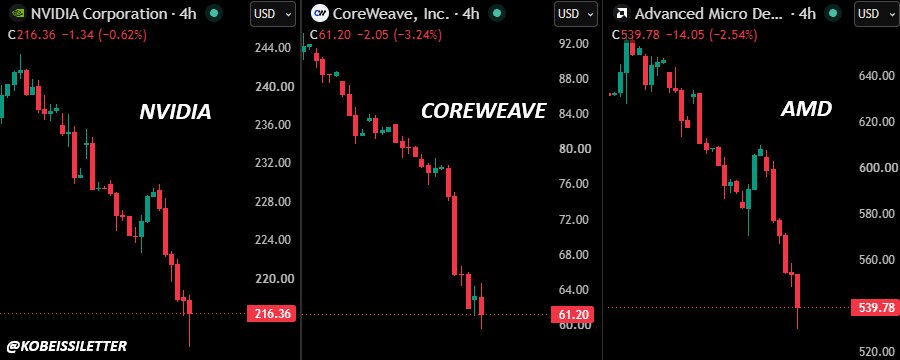
Tech's P/E is the cheapest since 2022 @dualityresearch
Now well below the March 2026 and April 2025 lows...
