

membrane biophysics lab, interested in the role that phase-mediated heterogeneity plays in signaling processes @ the plasma membrane.
University of Michigan
Joined January 2020
- Tweets85
- Following105
- Followers682
- Likes115





Steal away. It brings me much joy and I always have pretty pictures to talk about whenever I have visitors in my office.
The wall celebrating veatchlab alums is up just in time for the start of the academic year at @UMBiophys including a few new ones representing @ss_shelbs , @suminkim28, and Thomas Shaw. Your impact looms large.

Apply to be my colleague in biophysics at Michigan! We are a vibrant small program in a large and resource-rich university. We are looking for applications at the assistant prof and newly minted associate prof levels. Reach out with ?s if interested.

Colleagues note: Michigan Biophysics through the LSA Collegiate Fellows Program aims to recruit and hire exceptional tenure-track assistant and new tenured associate professors to promote an inclusive scholarly environment. Deadlines and requirements. myumi.ch/JYppY.

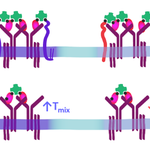
Introducing Dr. Thomas Shaw! Congrats to Thomas for a great talk and thesis -- and check out that cake made by veatchlab members and alums including @ss_shelbs @AdamDecker98 @JenChemFlan inspired by a figure made by @biophysnerd!

What he said! This piece does a particularly good job summarizing @ss_shelbs observations of tunable domain contrast at BCR clusters.

Neat, quick summary of beautiful recent paper by @VeatchLab and @ss_shelbs. Will only take you 2min to read... but be warned, you'll then want to read the whole paper.
@suminkim28 has put together several imaging approaches in this impressive story. Check it out! .

Actually, now that I click I of course know this paper. So awesome and love that all of these approaches are converging.
This one has been in the works for a long time!
Thanks to the many people that made it possible: Of course our co-authors Kathleen Wisser, @Ivanubis84, and @leventallab.
Also thanks to @uiztok, @AgEggeling, and @Sciezgin for the News & Views shoutout! nature.com/articles/s41589-0…
For some more perspective, we recently published a short review summarizing how we are thinking about phases, rafts, and the incredible things that membranes can do.
sciencedirect.com/science/ar…
Takeaway: we think that these domains at BCR clusters have tunable contrast because they integrate both the stimulus (related to proteins brought to the domain through protein interactions) and the membrane thermodynamics (how close the membrane is to its phase transition).

Not only did this manipulate how anchors sort w/r/t BCR clusters, it also tuned the magnitude of BCR Tyr phosphorylation! This nicely corroborates existing work implicating lipid rafts in BCR activation, now w/ a direct connection to the underlying membrane phase transition.

We tuned contrast two ways: first by co-clustering BCR with minimal “co-receptors” to alter the stimulus, and second by adding hydrophobic small molecules to manipulate membrane thermodynamics by shifting the phase transition temperature.

Now for that twist: we noticed that these domains at BCR clusters sort anchors less strongly than phases in vesicles. In other words, domains in cells have lower “contrast” than ordered domains in phase separated vesicles. Maybe contrast can be tuned?

Seeing these relationships was made possible by quantitative methods described in the paper and in an upcoming methods chapter (more deets soon!). Code and sample scripts posted here: github.com/VeatchLab/smlm-an…
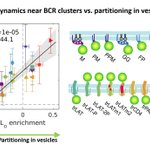
We can also look at anchor dynamics, and anchor confinement near BCR clusters is also strongly correlated with partitioning in vesicles. Conclusion: the membrane phase transition drives both the concentration and retention of membrane components within domains.

They agree very well! Anchor partitioning between vesicle phases quantitatively predicts anchor concentration near BCR clusters. Conclusion: membrane phase separation is a physical driver of domain formation around clustered BCRs.

At the same time, our awesome collaborators in @leventallab measured partitioning of the same anchors in phase-separated giant plasma membrane vesicles (GPMVs). Both measurements basically quantify local concentration of anchors, so we can compare them directly. When we do…

