

locked in on AI agents & LLMs, building quant systems onchain.
on chain
Joined February 2026
- Tweets2.9K
- Following465
- Followers4.8K
- Likes17.3K


Pinned Tweet
Most quant systems find the signal. The best ones build the infrastructure that manages it.
Here is the complete build.
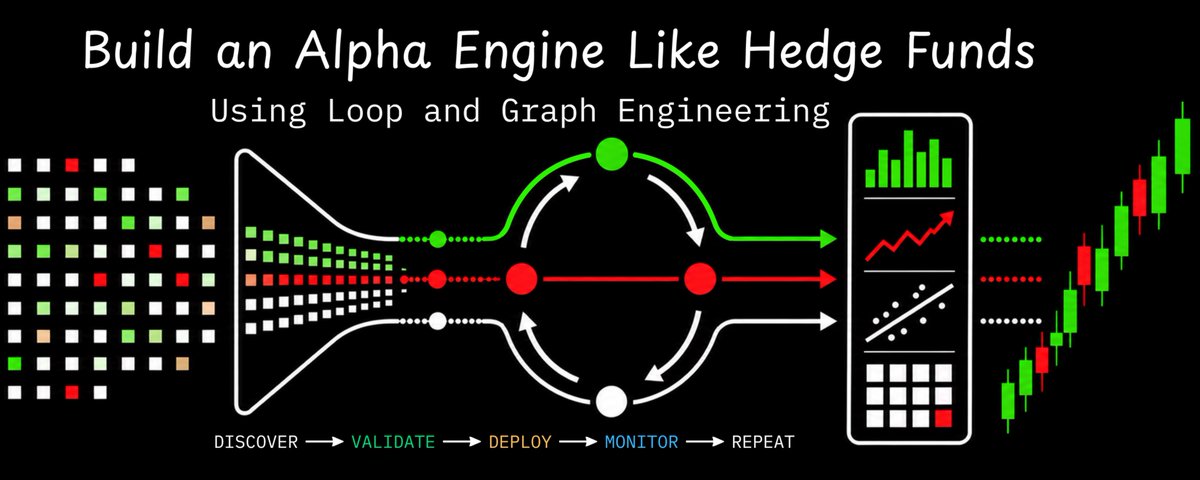
someone just mapped out a full multi-agent trading system spec and made it public.
every agent has one job. every output is typed and structured. every failure is traceable to a specific layer.
this is what institutional AI trading infrastructure looks like in the article below


HEDGE FUNDS BUILD THIS INTERNALLY AND CHARGE MILLIONS TO ACCESS IT
someone built a full ML trading curriculum and put it on GitHub for free
27 chapters that takes you from raw market data all the way to a running strategy
deep learning, causal ML, RL, autonomous agents, all with real working code
21k+ people already have it bookmarked

machine-learning-for-trading
github.com/stefan-jansen/mac…

a single system prompt that turns Claude into a quantitative research engineer
it writes the thesis, drafts the rules, stress-tests them with the tools you connect, and logs every experiment in a versioned record
this is what a disciplined algo research workflow looks like now


a quant researcher can now build a complete strategy playbook using Claude Opus 5.5.
the AI writes the rules, tests on real data, stress tests every parameter and labels every result. DATA VALIDATED. TRADE-OFF. NO EDGE.
every number comes from a tested data layer. this is how serious systematic research actually works.


I’ve seen people spend months trying to understand how quants think.
It comes down to one thing.
They write a rule, test it on real data, and let the numbers decide.
probably that’s the whole edge.


This is the most underrated way to learn how quants think.
They don't guess. They write a simple rule, test it on real market data, and let the numbers decide.
Now you can do the same, step by step, even as a complete beginner.


honestly one of the most quietly powerful repos in all of crypto.
CCXT has been powering crypto trading systems for years. one library, 100+ exchanges, every major language supported.
the unglamorous backbone of the whole algo trading world.

The complete playbook for running a quant desk in 2026: tools, stack and the structure that keep you alive.



Something that deserves more attention in AI research and trading workflows:
what the agent actually reads.
Everyone talks about the model: quality, context windows, inference speed, agent frameworks. All of it matters.
But consider the moment an agent gets a 300-page annual report.
Reading it accurately, quickly, and keeping every number connected to its source is where things can quietly go wrong.
That is a document intelligence problem as much as a model problem, and this is the gap Nace Document Intelligence is built to address.
It parses, classifies, extracts, splits, and keeps each value linked to its original page.
Nace reads and structures the files → Drex as the decision layer → Opus 5.5 handles deeper reasoning where needed
Reasoning is only as good as the input it starts from.
🤝 Paid partnership


Introducing NDI 1.0 - a small model for document processing.
#1 on Parse Index Normalized (across 6 public benchmarks)
GPT-6 Astra performance at 1/10th the cost
📈 Trained on 15M+ financial files for industry-grade accuracy.
Get started with $25 in free credits:
nace.ai/ndi
Reply "NDI" for a single file setup for Claude Code, Codex, PI, Opencode, Hermes, Prime Agent, and more. Start parsing and classifying documents.
